

Difficult feedback: word-for-word scripts
Word-for-word scripts for five difficult feedback conversations, and what to say when the reaction comes.
The short version
- Build difficult feedback from one specific behaviour, its measurable impact and one change you can check. Then hand them the floor with a question.
- Spend 15 minutes on a prep sheet before you go in.
- When they get defensive, cry or get angry, keep to the frame and repeat the example word for word. Pause only when shouting or shutdown stops the message getting through.
- Send a three-sentence recap within 24 hours, and book check-ins at one week and one month, so the feedback changes something.
- Describe the behaviour, never the character. A fact you can both check takes the heat out. A verdict puts it in.
Contents
- What makes feedback difficult?
- How do you prepare for a difficult feedback conversation in 15 minutes?
- What exactly do you say?
- How do you handle defensive, tearful or angry reactions?
- How do you give difficult feedback remotely or in writing?
- How do you follow up after difficult feedback?
- How should you respond when you receive difficult feedback?
- Which playbook libraries cover difficult feedback?
Give difficult feedback in one planned conversation. Say what they did, what it cost and what needs to change, then keep to it when the reaction comes. Below are word-for-word scripts for five common situations, and what to say when you meet defensiveness, tears or anger.
What makes feedback difficult?
Difficult feedback is the kind you expect the other person to resist. An underperforming member of your team. A defensive peer. A senior stakeholder who won't like what you have to say. Routine feedback ("tighten the PR description") fits in a corridor. Difficult feedback lands on someone's standing, and that is what makes them defend themselves.
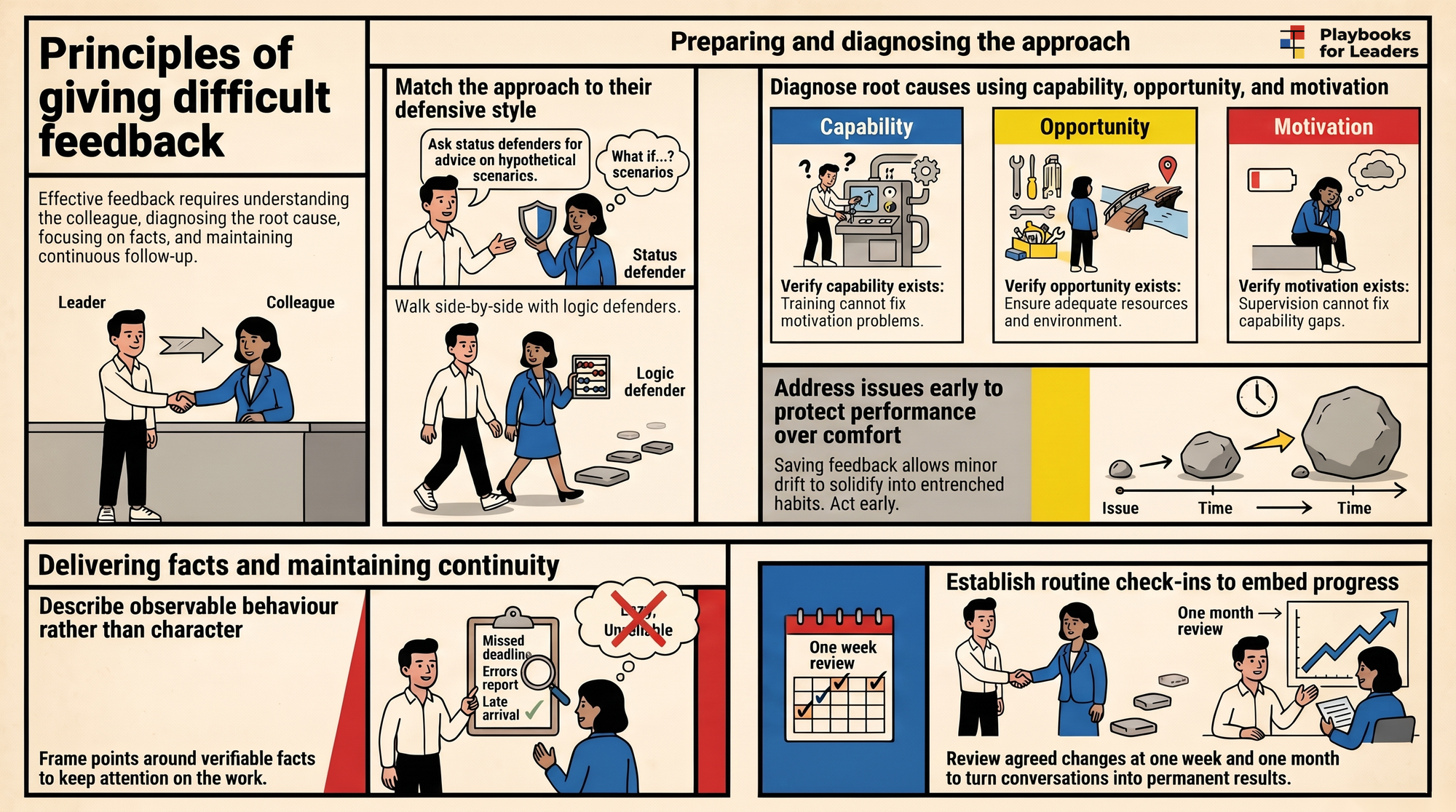
The Difficult feedback Playbook starts from the same place. It asks you to read, before you open your mouth, whether this person will defend their status or their reasoning, because the two need different first moves.
The test for whether you need a plan: if the reaction could derail the message, the relationship or the person's next two weeks, book a conversation. Don't do it in passing. It works best alongside the feedback loops you should already have running.
How do you prepare for a difficult feedback conversation in 15 minutes?
Preparation is the difference between a conversation and a fight. Write four things down before you walk in.
The 15-minute prep sheet
- Minutes 0 to 4: the observation. One recent fact you can both check. "The API spec slipped twice last sprint", not "your work is slipping".
- Minutes 4 to 8: the impact on you, the team or the deadline, in one sentence.
- Minutes 8 to 11: the ask, as a change you can check by Friday.
- Minutes 11 to 15: the sentence you won't say. It's usually some version of "this is how I handled it at your stage". Cut it, because it turns feedback into a contest about status.
If this is bigger than one conversation, the Playbook's Plan takes you through three tools, in order, for the weeks after.
Pick the room and the first sentence
Book a room, not a chat at their desk, and give it 30 minutes. Your first sentence sets the frame: "I want to talk about the spec slips, because I think we can fix them this week."
What exactly do you say?
Here are word-for-word scripts for five common scenarios. The shape stays the same in all five: say what they did, say what it cost, then ask for their read before you agree what changes. Only the opening line differs. Use them as drafts.
Scenario 1: the quality has slipped
"Your last two specs needed more rework than usual. The payment-flow spec came back with 14 comments, where three used to be normal. What's changed on your end?"
Scenario 2: deadlines keep slipping
"The onboarding migration has moved twice, and both times we heard on the due date, not before. That leaves the teams downstream no room to re-plan. I need a date you're confident in, and a heads-up the moment it's at risk."
Scenario 3: behaviour in meetings
"In yesterday's architecture review, you interrupted Priya twice mid-sentence. Nobody offered a counterpoint after that. I want the challenge, delivered so people can answer it."
Scenario 4: attitude or morale
"You've been quieter in stand-ups for three weeks, and your last two status reports said 'on track' when neither project was. I'm not here to discipline you. I want to know what's going on."
Scenario 5: feedback to a peer or someone more senior
With a peer or a stakeholder, ask permission and be specific: "Can I give you some direct feedback on the vendor review? When you changed the criteria mid-meeting, the team lost two weeks re-scoping. Next time, flag the change before we commit." Say it out loud, one to one, and keep a short note of what you agreed. Save written records for a pattern you may later need to show HR.
One rule makes these scripts survive contact with a real person: describe the behaviour, never the character. "The spec needed 14 rounds of comments" is a fact you can both check. "Your work is getting sloppy" is a verdict they can only defend themselves against, and once they're defending, the work drops out of the conversation. Every script above does the same three things in order: one instance, one cost, one question that hands them the floor. Keep that shape and you can find the words for anything this week. When the work itself is in dispute, the Kano Model keeps the feedback on the work and off the person, which is often the only feedback the person can hear.
How do you handle defensive, tearful or angry reactions?
Your job is to keep to the frame, say what you see and decide whether to carry on or pause. Here's the script for each.
Defensive: 'That's not fair'
Don't argue about fairness. Say: "I can see this lands hard, and I'm not asking you to agree right now. Look at the example with me." Then repeat the example word for word, with the date. Defensiveness usually collapses when the facts don't move.
If they come back with "you do it too", answer: "Possibly. Let's book time to talk about my part. Right now we're on yours."
If you can see the defence coming before you start, the Playbook has two first moves. Someone defending their status will hear the message better as a request for advice about a colleague who sounds remarkably like them. Edgar Schein's work on humble inquiry is behind that one. Someone defending their reasoning will argue every point across a desk, so have the conversation side by side, on a walk.
Tearful: they shut down
Stop the content and stay in the room. Say: "Take a minute. This isn't a gotcha, and I'm not going anywhere." Hand over some water, stay quiet and let the pause run longer than feels comfortable. When they're ready, ask: "What's your read on what I said?" If they can't go on, close with a follow-up in the diary and one concrete next step, so the issue doesn't drift. The Performance Management tool shows how to make that follow-up visible to you both.
Angry: they push back hard
Let the first burst pass without interrupting. If they get louder, call it once: "I want to hear this, but not like this. Let's pick it up in an hour." A pause protects the message. Carry on only when the anger is verbal and they're still talking about the point.
How do you give difficult feedback remotely or in writing?
Video beats writing for anything that matters. They can hear your tone and ask questions, and you can see whether the message landed. On a remote call, keep your camera on, share nothing on screen and send nothing beforehand except a calendar invite that doesn't say "quick chat". Open with the script you'd use in person, then stop talking and let the silence run.
Write it only when you need a record, when the person takes things in better as text, or when you're documenting a pattern for HR. Even then, write it, then read it aloud to yourself. If it sounds cold, rewrite it.
How do you follow up after difficult feedback?
The conversation changes nothing on its own. Within 24 hours, send a written recap: what you saw, what you agreed and the change you expect, with a date on it. Three sentences, no adjectives. A week later you'll both remember the meeting differently, and the recap settles it.
Then book two check-ins. The first at one week, short: is the change happening, and is anything in the way? The second at one month, against evidence you can both see, not a feeling.
Close it either way. If the behaviour has changed, say so plainly and stop managing it. If it hasn't, say that at the second check-in and move to a documented next step. The COM-B Model helps you work out why: whether the person can't do it, has no chance to, or doesn't want to.
The commonest failure is feedback given once and never mentioned again. Your team learns that nothing said in that room mattered.
How should you respond when you receive difficult feedback?
When you receive feedback, come away with one thing you can use.
Whatever the first line stirs up in you, say nothing for the first exchange. Then ask for specifics: "Can you give me a recent example?" or "What would 'better' have looked like on that project?" Pin vague feedback to a situation and you can act on it. When the feedback is unfair or wrong, separate the claim from the signal. Say: "I see that differently, and here's what happened on my side." Feedback often arrives badly delivered with something true inside it. Keep the true part. Then thank them, take one concrete item, and go back a week later with what you changed.
Which playbook libraries cover difficult feedback?
Judge any library on three things: scripts, handling the reaction and follow-up.
| Source | Scripts | Reaction handling | Follow-up |
|---|---|---|---|
| Playbooks for Leaders | Yes, five scenarios in this article | Yes, here and in the Playbook's two Plays | Yes, a three-tool Plan in the Playbook |
| Harvard Business Review | Partial, article-length | Partial | Partial |
| Strategyzer | No, strategy-focused | No | No |
| MasterClass | No, video-first | Partial | Partial |
HBR and MasterClass cover the subject broadly, but rarely give you the exact sentences for a hostile meeting or a slipping project. Strategyzer's library is built for business models, not conversations. There's a longer comparison on Playbooks for Leaders and HBR.
The scripts here build on the Difficult feedback Playbook, a video of about fifteen minutes with its Plays, Plan and Precedents. Watch the Playbook for the read and the moves, and come back here for the words.
FAQ
Should I give difficult feedback in a one-to-one or book a separate meeting?
Book a separate meeting if the reaction could derail the message or the relationship. A routine one-to-one agenda will crowd it out, or make it feel like an ambush. Book 30 minutes in a room.
What if the person denies the behaviour happened?
Go back to the specific fact you can both check, and don't argue about character or intent. "The payment-flow spec came back with 14 comments on Tuesday" is something you can both look up. Repeat the example word for word, with the date, and don't move off it.
How do I give difficult feedback to someone more senior than me?
Ask permission and be specific. Ask whether you can give direct feedback, then describe one instance and what it cost, such as criteria changing mid-meeting and costing the team two weeks. Say it out loud, one to one, never in a group, and keep a short note of what you agreed.
How soon after an incident should I give difficult feedback?
Soon enough that the example is recent and checkable, but not while either of you is still heated. You need time for the 15-minute prep sheet. A day's delay protects the message without letting it go stale.
What's the difference between difficult feedback and a performance conversation or PIP?
Difficult feedback is one planned conversation: one behaviour, what it cost, one change you can check, then the check-ins. A performance conversation, or a performance improvement plan (PIP), is a formal, documented process with HR involved. It usually starts when repeated feedback hasn't changed the behaviour.
Sources on difficult feedback
- Humble Inquiry by Edgar Schein and Peter Schein. It's our source for asking someone defending their status for advice about a colleague who sounds like them. If you want the book itself, buy it from Bookshop.org or Amazon.
- The Happiness Hypothesis by Jonathan Haidt. It's our source for the rider and the elephant, the model behind the walk with someone defending their reasoning. If you want the book itself, buy it from Bookshop.org or Amazon.
Some book links on this page are affiliate links. If you buy through one, we earn a small commission.