

Core delegation skills: fix the result, leave the method
Choose the task and the person, fix the result in the brief and leave the method to them, then check in on a date you both agreed.
The short version
- Hand over the work that comes round often and does little harm if it goes wrong. Keep the rare calls that do a lot of harm.
- Give the task to someone it will stretch, and have the team ready to help.
- In the brief, fix the result and the limits. Leave the method to them.
- Say out loud which decisions are theirs and which are yours.
- Agree a check-in date before the brief ends, and step back in only on one of three signals.
Contents
- What are the core delegation skills?
- How do you choose what to hand over?
- How do you choose who gets the task?
- What goes in a delegation brief?
- How do you say who decides what?
- How do you follow up without taking the work back?
- What if the project is already slipping?
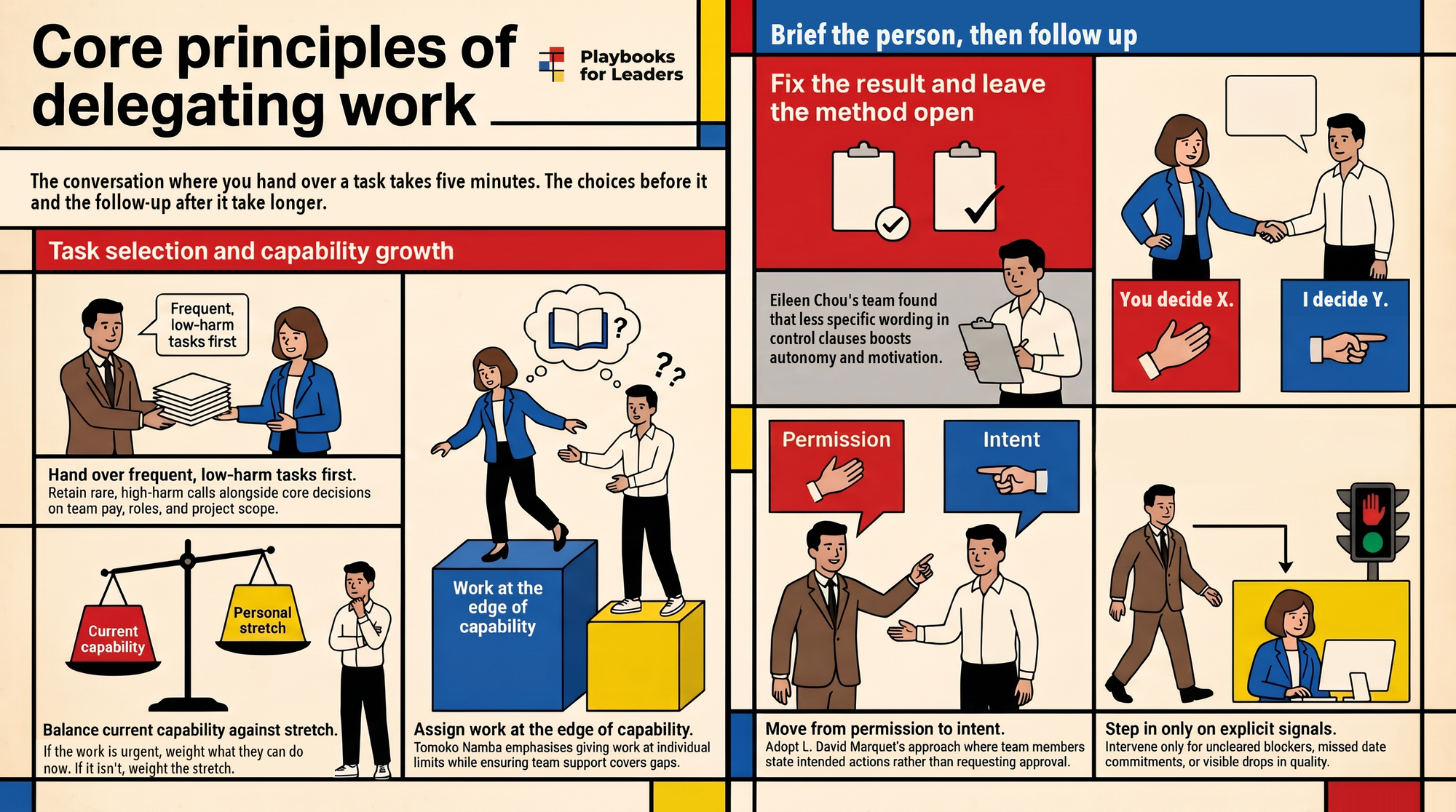
The conversation where you hand over a task takes five minutes. The choices before it and the follow-up after it take longer. This post goes through them in order. If you're deciding how much of a single decision to hand over, the Delegation frameworks tool sets out the levels, from telling someone what to do to handing over the whole decision.
What are the core delegation skills?
There are four, and you use them in this order:
- Choose the task.
- Choose the person.
- Brief them.
- Follow up without taking the work back.
How do you choose what to hand over?
Score each task on your list from 1 to 5, twice. The first score is the harm a competent person's mistake would do. The second is how often the task comes round. Hand over the frequent, low-harm work first. Chances are that's where your hours go, and a mistake in it costs little. Keep the rare, high-harm calls, or hand them over with a close review.
Two things stay with you whatever they score: decisions about people's jobs and pay, and the final call on scope. Hand those over and you've given away your own job.
How do you choose who gets the task?
Check whether they can do it now and whether they have the hours this month. Then ask whether it would stretch them towards their next role. If the work is urgent, weight what they can do now. If it isn't, weight the stretch.
Tomoko Namba was a McKinsey consultant before she founded DeNA, the Japanese internet company, in 1999. In her 2013 book Bukakkō Keiei, she describes how DeNA hands out work. Each person gets a job at the very edge of what they can do with everything they've got. If they can't finish it, the team piles in to help, and now and then even the team can't cover it. Namba accepts that. "We'll take that risk," she wrote, "but we won't take the risk that people don't grow." (Translated from the Japanese.)
If the person you picked says no, find out which of those failed. If nobody is ready, split the task. Hand over the parts someone can nearly do, and keep the rest.
What goes in a delegation brief?
The result, fixed, and the method, left open. In 2017 Eileen Chou, Nir Halevy, Adam Galinsky and J. Keith Murnighan published nine experiments on contracts in the Journal of Personality and Social Psychology. They found that "subtle reductions in the specificity of a contract's language can boost autonomy, which increases intrinsic motivation". People working under the less specific contracts kept at tasks longer, were more creative and cooperated more.
The paper's title calls it the Goldilocks contract. The abstract gives the limit: "These positive effects, however, only occurred when contracts provided sufficient structure." The looser wording helped in the legal clauses, which set out control, and not in the technical clauses, which coordinate the work. So keep the handover points exact: the template finance expects, the date the client sees it.
A brief has five parts. Say them in one sitting, in this order:
- The result. "I need the monthly variance pack to reconcile against finance's numbers without me in the loop."
- The limits. "Use the current tracker and the finance template."
- Who decides what. "You decide how to structure the analysis. I decide anything that changes who gets the pack."
- What done looks like. "Finance accepts it on the first submission."
- A check-in. "Let's take 20 minutes on Thursday. Bring whatever's blocked."
Then ask them to play it back, and ask what's unclear. Nurses in the United States work to the National Guidelines for Nursing Delegation, which the American Nurses Association and the National Council of State Boards of Nursing adopted in 2019. The guidelines make the brief two-way: the person taking the task "should ask any clarifying questions", and "must agree to accept the delegated activity".
How much detail goes in depends on how much the job will change under them. Lorraine Daston, a historian of science, sorts rules into thick and thin in Rules: A Short History of What We Live By. "A thick rule is upholstered with examples, caveats, observations, and exceptions" (p. 3). A thin rule, a list of steps, assumes a world where everything can be foreseen, so "they do not invite the exercise of discretion" (p. 3). If the job will change, give one worked example and the exceptions you expect. Keep the checklist for the parts that never vary.
How do you say who decides what?
Out loud, in one sentence: "You decide X. I decide Y." If you leave it out, the person guesses, and you'll find out which way they guessed at the first check-in.
L. David Marquet took command of the United States Navy submarine Santa Fe in 1999 and stopped telling his officers what to do. They told him what they were about to do instead. "I don't run around telling people to submerge the ship," he said on The Leadership List, a podcast from American Forces Network Radio, which published the interview in 2020. "The officer comes to me and says, 'I intend to submerge the ship.'" Each statement had three parts: what the officer intended to do, why it was technically correct and why they wanted to do it.
Marquet is plain about the limits. Telling people they're empowered without saying which decisions are theirs, he said, "doesn't work."
You can borrow his sentence. Ask the person to bring decisions to you as "I intend to …, because …". Then all you do is agree or ask a question, and the decision stays theirs.
How do you follow up without taking the work back?
Agree the check-in in the brief, so it's part of the job from the start. Put the first one at the first point of risk, not the first milestone: if the supplier's answer is due on Tuesday, meet on Thursday. Start closer than feels comfortable, and widen the gap after two check-ins with nothing to fix. If you already hold one-to-one meetings, the check-in can go on their agenda.
The nursing guidelines end their checks with supervision: the nurse follows up when the task is done, checks the result and "should be ready and available to intervene as necessary". Step back in only on one of these three signals:
- a blocker the person can't clear
- a slip that hits a date you've committed to
- a drop in quality you can see
Open with a question: "What's in your way, and what do you need from me?" If none of the three signals appears, stay out, even when you'd have done it differently.
Handing work over costs you some output while they learn. Marquet put it plainly: "I'm gonna give up a little bit of production, I'm gonna be building leaders and decision-makers."
What if the project is already slipping?
You use the same four skills, faster. Keep only what nobody else can do this week, and hand over the rest at once. Give each task to whoever has done it before, because there's no time for a learning curve. Namba's stretch can wait for the next project.
The brief gets shorter: "The milestone has moved to the 14th. You own the integration work. Send me a one-page status on Friday, and I'll take the stakeholder meeting." Check in daily for fifteen minutes, at the same time, until the date is safe. Then widen the gap again.
When delegating is part of a bigger situation
If what you find fits one of these situations, the Playbook for it starts there.
| What you find | Playbook |
|---|---|
| The project is slipping and you can't see where | Project slipping |
| You're behind and have to decide what to drop | Behind, what to drop |
| You need a decision today and the team can't agree | Decision today |
| The team is burned out and you still have to ship | Burned-out team |
| A new starter joined on Monday and you haven't onboarded them | New starter |
FAQ
What are the five rights of delegation?
They're the checks a nurse in the United States runs before handing a task to someone else. The National Council of State Boards of Nursing first set them out in 1995 and 1996:
- the right task
- the right circumstance
- the right person
- the right directions and communication
- the right supervision and evaluation
The fourth goes further than this post. Under it, the person taking the task makes no decisions or changes without asking the nurse first. That suits a clinical task, where the method is part of the result.
Should you delegate work nobody asked for?
Yes, if it scores as frequent and low-harm. Nobody asks to chase a supplier's weekly status. Brief it properly and say what it will teach them, so they don't read it as work you didn't want.
What do you do when someone keeps handing decisions back?
Treat it as a gap in the brief. Say again who decides what. The next time a decision comes back, ask "What's your recommendation?" and wait for the answer.
Sources on delegating
- Turn the Ship Around! by L. David Marquet. It's his own account of the Santa Fe, where his officers said "I intend to" instead of asking permission. If you want the book itself, buy it from Bookshop.org or Amazon.
- Rules: A Short History of What We Live By by Lorraine Daston. It's our source for thick and thin rules, and for when a brief needs examples more than steps. If you want the book itself, buy it from Bookshop.org or Amazon.
Some book links on this page are affiliate links. If you buy through one, we earn a small commission.