

One-to-one meetings: a shared agenda and a worked example
A shared one-to-one agenda you can copy, an example of 30 minutes run with it and the signs your one-to-ones are working.
The short version
- Meet each person every week for 30 minutes. Cancel for a holiday or a real emergency, never because you're busy.
- Keep one shared agenda document. Their items go first.
- Ask for status in writing before the meeting, so the half hour goes on what a status update can't show.
- Before you hang up, write down who does what by when.
- If their half of the agenda stays empty two weeks running, ask them why.
Contents
- What is a one-to-one meeting for?
- How often should one-to-ones happen, and how long should they be?
- What goes on a one-to-one agenda?
- What does a one-to-one look like in practice?
- What should you keep out of a one-to-one?
- How do you run one-to-ones with a remote team?
- How do you know your one-to-ones are working?
- When should you stop holding them?
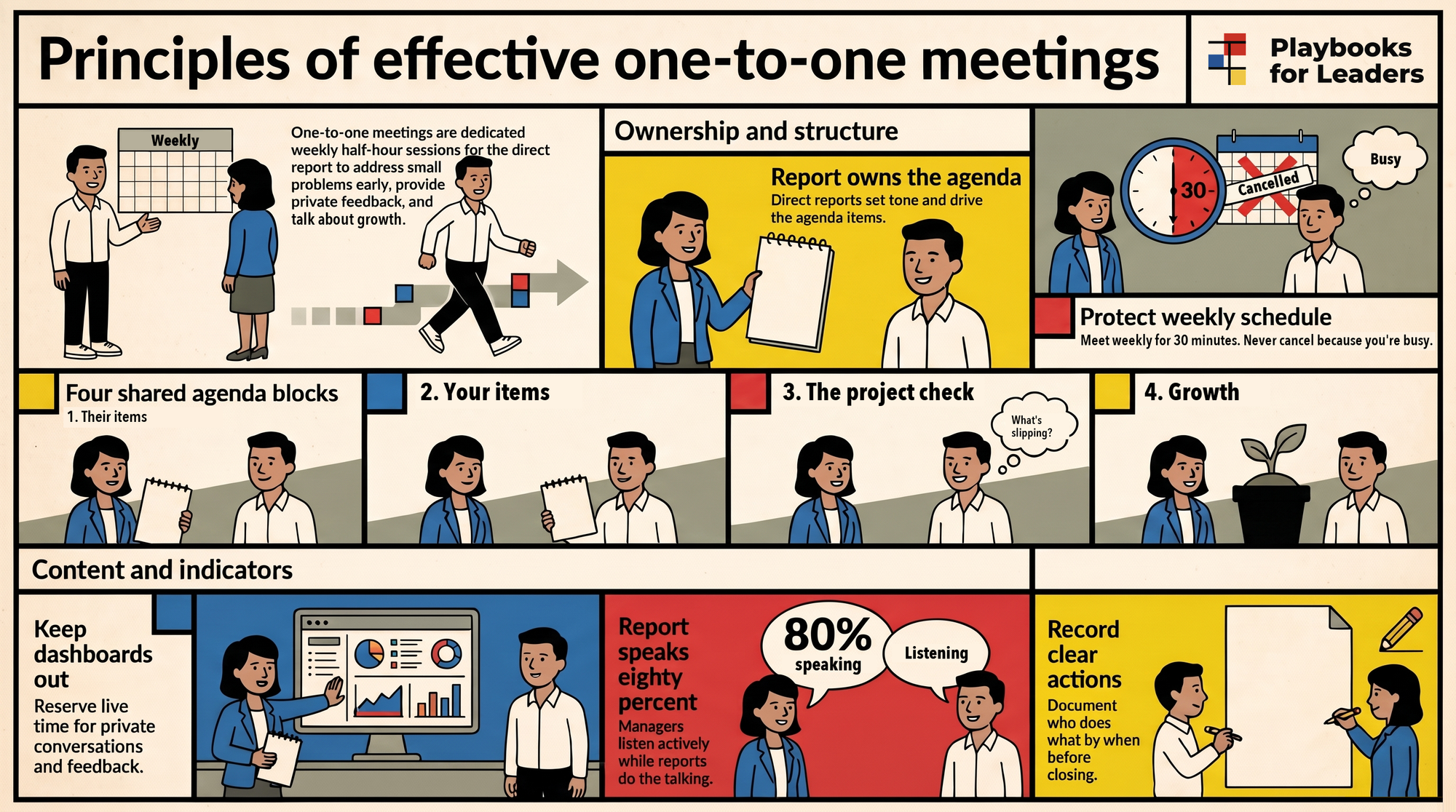
A one-to-one is the half hour each week when someone who works for you can tell you what they haven't told anyone else. That might be the project that's slipping, the colleague they've stopped talking to or the job they'd like next. You hear it only if they own the agenda and you do most of the listening. Below is an agenda you can copy, an example of 30 minutes run with it and the signs that it's working.
What is a one-to-one meeting for?
It's their meeting. Andy Grove, who ran Intel, argued in High Output Management that the one-to-one belongs to the person who reports to you, and that they set its agenda and its tone. GitLab's handbook quotes him and adds a test: if the manager puts more than half the items on the agenda, "this is an indication that something is wrong" (GitLab, 1-1).
You get two things from it. You hear about a problem while it's still small, from the person closest to it. You also learn which decisions they can make without you, which tells you what to hand over.
Gallup estimates that managers account for at least 70% of the variance in employee engagement scores across business units (Gallup). You see each of your people alone in one meeting a week, and it's the one-to-one.
How often should one-to-ones happen, and how long should they be?
Weekly, for 30 minutes. GitLab's handbook advises holding them "at least once a week" and calls cancelling one "a last resort". Cancel one and your report may read it as a statement of where they rank. A small problem can grow in a quiet week.
When to change the default
- A new starter: twice a week for the first month. The New starter Playbook covers the first week.
- A team you've inherited: weekly, but 45 minutes for the first six weeks, because you're learning what you can't yet see. The Inherited team Playbook covers what to do with what you hear.
- A project in trouble: two 15-minute check-ins a week instead of one long one. The Project slipping Playbook covers a team that hides the slip.
- Senior people: Grove's answer was that frequency follows task-relevant maturity, meaning how much experience the person has with the work in hand. Someone senior in a job they know well can move to fortnightly with a written update in the week between. GitLab's floor is two live one-to-ones a month.
What goes on a one-to-one agenda?
Keep one shared document, private to the two of you. GitLab says to keep it private "because performance feedback should be as private as possible". Either of you adds an item as soon as it comes up, so nothing waits for the meeting.
Copy these four blocks into the document, in this order:
- Their items. Whatever they brought, in their order. "What's on your list this week?"
- Your items. Feedback, decisions you need from them and news they should hear from you first.
- The project check. One question: "What's slipping, and what do you need from me?"
- Growth. One thread on skills, visibility or the job they want next. "What would you like to be doing in a year, and what would help you get there?"
They own blocks 1 and 4 and you own block 2. You share block 3: they flag the slip and you commit the help. End every meeting with a line in the document saying who does what by when, and open the next one by checking it.
Keep it to a page. If it grows past that, the overflow belongs in a written update.
If their half is empty, ask. GitLab's handbook keeps a list of questions for that case. Two of them are "What can I (your manager) improve on?" and "What are potential troubles you see for the team".
What does a one-to-one look like in practice?
Here's an invented 30 minutes with that agenda. The person you're meeting runs a migration project that's slipping, and their team's morale has dropped.
Minutes 0–5: their items
Ask what's on their list. They raise the migration. Don't go to your notes yet. If you spend their five minutes on status, they stop bringing anything real.
Minutes 5–20: the project
This is the long block. You'll want to solve it: "Cut scope and ship the login piece." Ask what changed since the plan was written instead.
They tell you the vendor's system accepts far fewer requests than its documents said. The team has spent two weeks quietly trying workarounds, without telling anyone, because the deadline was already public. Now you have three problems: a technical one, a morale one and a communication one.
The technical problem is theirs. The communication problem is yours, because you explain the miss upward. Agree that split out loud. The Explain the miss Playbook covers that conversation.
Minutes 20–30: decisions and the close
Write the decisions in the document while you're both still there: "Vendor limit written up by Thursday. I brief the steering group on Friday. We revisit scope next week."
Then one question about the person: "How are you doing, honestly, after the last two weeks?" Ask it last. GitLab's handbook notes that "people will often reveal their important information at the end of a conversation".
What should you keep out of a one-to-one?
Anything a document can carry. Your half hour should hold what only a private conversation can.
| Topic | Where it goes |
|---|---|
| Project status and dates | A written update before the meeting |
| Scope, dependencies and resourcing | The team meeting |
| A decision that needs several people | The team meeting, or a document they all review |
| Feedback they'll find hard, falling morale, how the team gets on | The one-to-one |
If a dashboard could answer it, it doesn't belong in the room.
Give feedback when it happens, good or bad, and don't save it for the one-to-one. Keep the one-to-one for feedback someone will take hard or is hearing for the second time. For the words, the difficult feedback scripts in the Journal cover five versions of the conversation. If you've been putting it off, start with the Difficult feedback Playbook.
How do you run one-to-ones with a remote team?
Keep the same weekly half hour and protect it harder. In an office, you can make up a skipped meeting in the corridor. Remotely, there's no corridor.
Ask for three lines in the shared document the day before: progress, blockers and one thing they need from you. GitLab suggests filling the agenda "at least 24 hours in advance". A quieter person gets their items on the page before the loud ones start talking.
On video, a quiet person looks like a bad connection. Watch for short answers, cameras that stay off and meetings that keep moving. Ask one specific question each week. For example: "What part of the plan do you no longer believe in?"
If your team is hybrid, give everyone the same document and the same slot, wherever they sit. The person in the office shouldn't get a corridor version while the remote person gets the scheduled one.
How do you know your one-to-ones are working?
Four signs:
- They tell you about a problem before you hear it anywhere else.
- They bring items you didn't plant.
- Actions close. If the same item sits on three agendas in a row, nothing is happening.
- You can say what each person's priority and biggest blocker are without opening the document.
Check your talking, too. GitLab's handbook says the manager "should strive to do 20% of the talking while the direct report does 80%".
Read back your last four agendas. If two of the four signs are missing, the meeting has turned into a status update. Tell your report what you've noticed and ask what they need the next one to be for.
When should you stop holding them?
Sometimes the one-to-ones stop surfacing anything, because people are too cautious to tell their boss the truth. In the Falling morale Playbook, one of the two Plays is to stop the one-to-ones for a month. Pair people off and ask them to meet each other weekly instead. People tell their peers what they won't tell you, and it reaches you another way.
FAQ
Who should own the one-to-one agenda?
The person who reports to you. They fill their block first and the growth block too, and you add yours in advance. If you're writing more than half the items, the meeting has become yours.
What do you do when someone has nothing to talk about?
If it happens once, move to your items. If it happens twice, say so: "Your section's been blank for two weeks. What's going on?" Chances are that someone who has gone quiet has something they've decided isn't worth raising, and your job is to make it safe to raise.
Is it all right to cancel a one-to-one when you're busy?
No. If time is tight, cut it to 15 minutes and keep the slot.
What's the difference between a one-to-one and a skip-level meeting?
A one-to-one is with someone who reports to you. A skip-level is with someone who reports to one of your managers, without that manager in the room. You use it to hear how the organisation runs below you, never to check up on the manager in between.
What should you write down after a one-to-one?
Who does what by when, for every decision, written in the shared document during the meeting.
Sources on one-to-ones
- High Output Management by Andy Grove. It's our source for where the one-to-one came from, and for how often to meet each person. If you want the book itself, buy it from Bookshop.org or Amazon.
- Radical Candor by Kim Scott. It's our source for telling someone in a one-to-one that their work has to change. If you want the book itself, buy it from Bookshop.org or Amazon.
Some book links on this page are affiliate links. If you buy through one, we earn a small commission.