
Delegation Frameworks
“Structured approaches for transferring responsibility and authority appropriately.”
You're in every decision. Your calendar is wall-to-wall. The team waits for you to weigh in before moving. You tell yourself it's faster this way.
Delegation frameworks are structured models — like Delegation Poker, which defines levels from "tell" through to full delegation — for transferring responsibility and authority at the right level. You match the degree of autonomy to the person's capability, set clear expectations, and establish checkpoints.
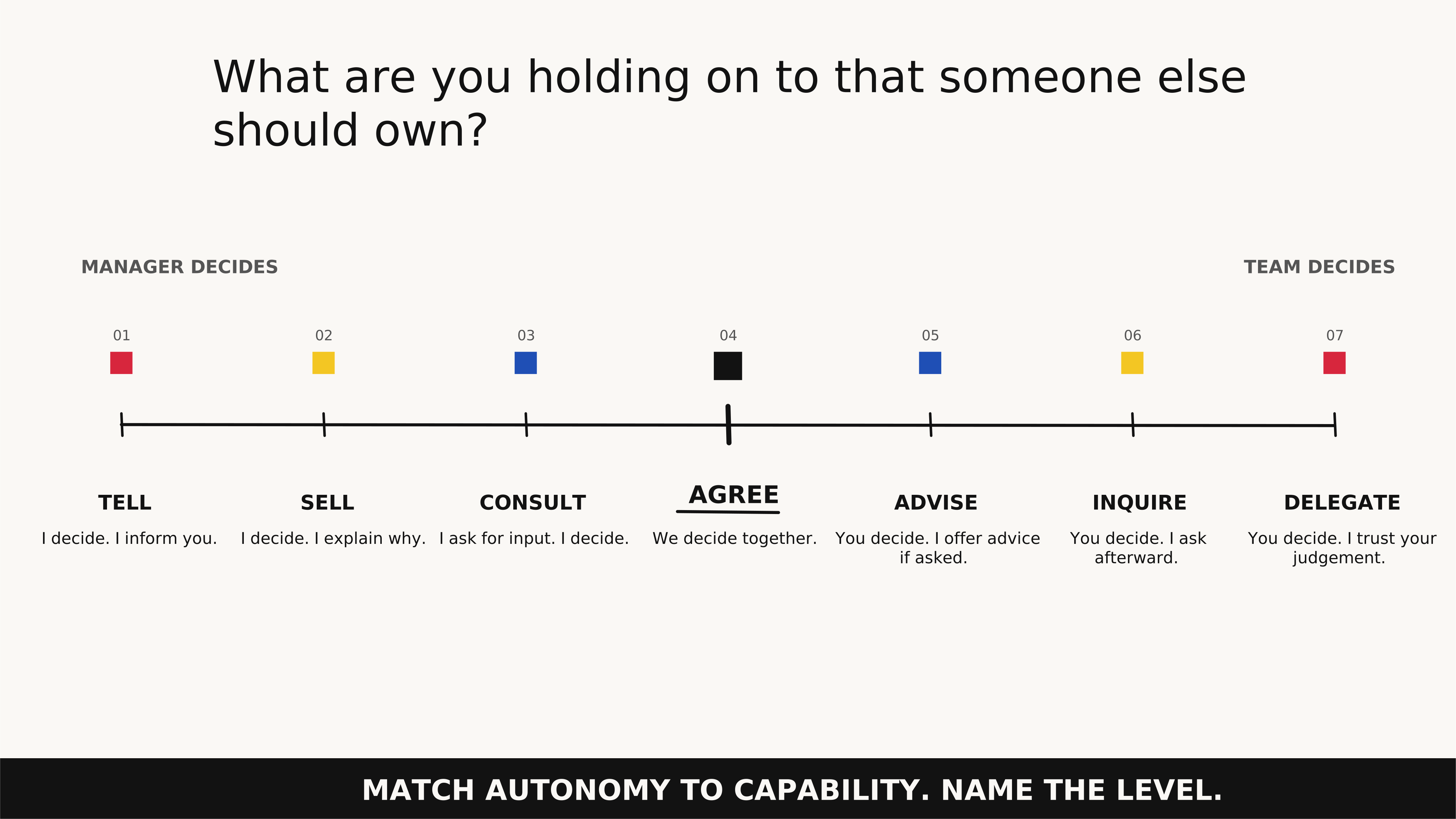
The unique strength is replacing the binary "do it yourself / hand it off entirely" with a spectrum. Most delegation fails not because people can't do the work but because they're given tasks without sufficient context or authority — set up to fail from the start. Reach for it when you're the bottleneck, when a capable team member is underused, or when you notice yourself re-doing delegated work.
It's essential for scaling leadership and developing people. It fails when there's no genuine trust in the team's capability — delegation without trust is just abdication with extra steps. And it's overhead for one-off tasks where a quick "can you handle this" suffices.
Your next move: Which decision are you about to make yourself in the next meeting that someone on your team is perfectly capable of making — and what are you actually protecting by holding on to it?
What it looked like for them
James Burke, Johnson & Johnson, 1982. When cyanide-laced Tylenol killed seven people in Chicago, Burke faced a delegation question before he faced a product question. The board hadn't met. The legal team wanted to scope the problem to Chicago.
The financial analysts wanted a local, not national, recall. Every layer of the organisation was producing advice designed to slow the decision down. Burke chose not to delegate. He recalled every bottle of Tylenol in the country, unilaterally, within hours.
The framework he applied was simple: when the cost of a wrong decision is recoverable and the cost of a slow decision isn't, the decision belongs to whoever can act fastest. Burke could act fastest. He did. The recall cost a hundred million dollars.
The brand recovered within a year. Delegation frameworks don't just tell you when to push authority down. They tell you when to take it back — and the Tylenol recall is the canonical case for knowing the difference.
“I'm taking over a team that's just had a bad manager.”