
Pre-mortem Analysis
“Gary Klein's technique, in which teams imagine a project has failed spectacularly, then work backwards to identify what went wrong.”
What is a pre-mortem?
Pre-mortem analysis is Gary Klein's technique for surfacing hidden risks. You ask the team to imagine the project has failed spectacularly, then work backwards to identify what went wrong. The hypothetical framing makes it acceptable to voice doubts. Explaining why something failed feels different from criticising someone's plan.
The plan looks solid. Everyone's nodding. But three people in the room have doubts they're not voicing.
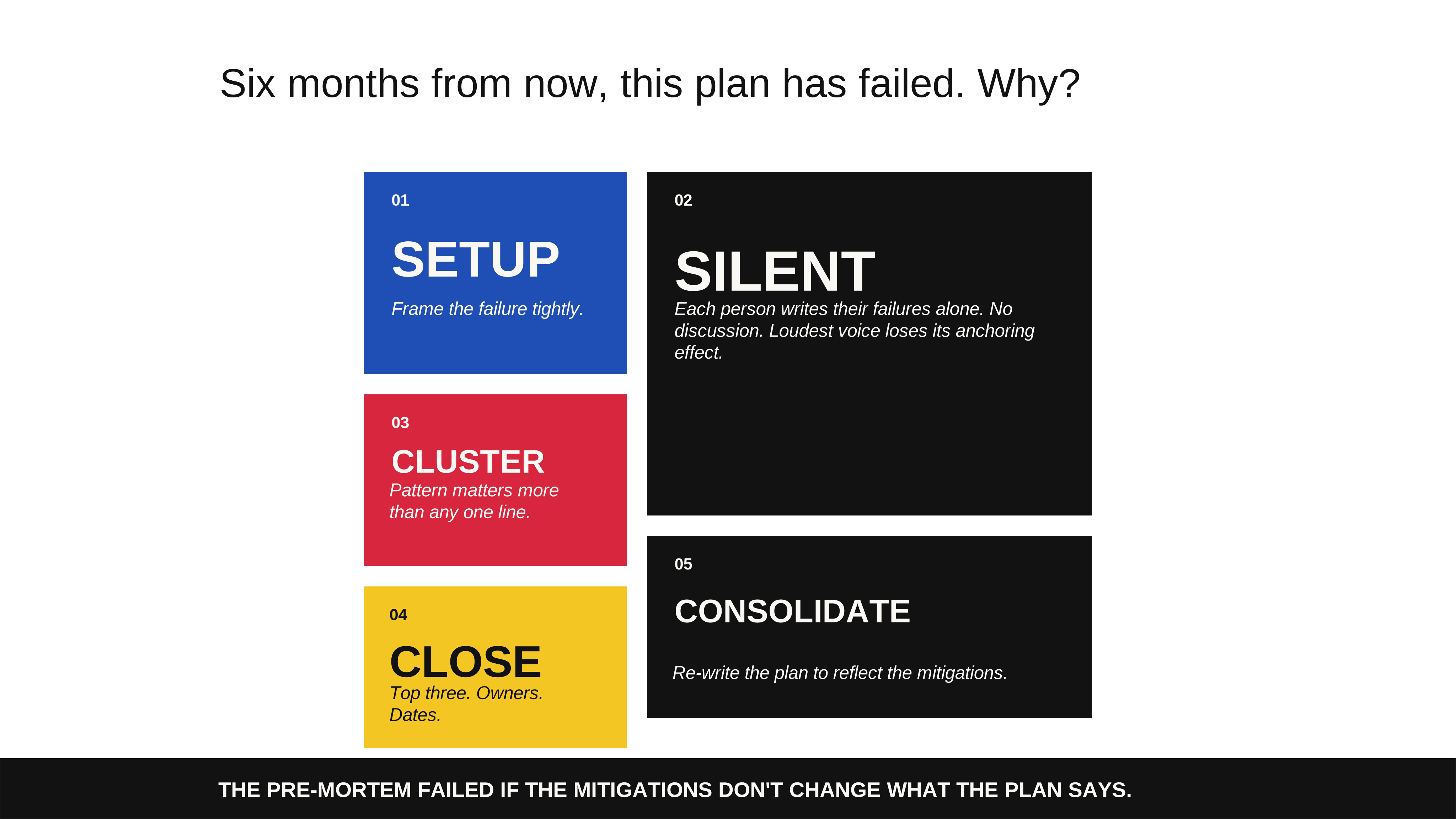
When should you run a pre-mortem?
Pre-mortems overcome optimism bias by making failure psychologically accessible. Reach for one at project launch or major milestones, before commitment creates investment in the plan. The exercise surfaces concerns that traditional planning overlooks: team dynamics, stakeholder politics, uncomfortable truths that nobody would raise unprompted.
A pre-mortem requires psychological safety; even hypothetical criticism needs a safe context. It fails after decisions are irreversible, when the exercise becomes theatre, or when the facilitator can't protect candour from retaliation.
Your next move: Imagine standing at the post-mortem six months from now explaining why this failed: what's the one sentence you already know you'd have to say?
What it looked like for them
Knight Capital Group, August 2012. Knight Capital handled roughly ten per cent of all US equity trading. On 1 August 2012, a deployment pushed new code to their trading servers, but one of eight servers still had old "Power Peg" test code active.
When the new code triggered a flag the old code shared, that server began executing trades without recognising they'd been filled. In forty-five minutes, Knight executed over four million trades against 212 customer orders.
The loss was roughly four hundred and forty million dollars. The company was acquired within four months. The SEC investigation found the failure was structural: no kill switch, no automated check that all servers were running the same code, no process to verify decommissioned software had actually been removed.
Every one of those gaps is the kind of thing a pre-mortem catches: a structured session asking "what could go wrong" before the deployment, not after. The failure wasn't unpredictable. It was unpredicted.
Which Playbooks use a pre-mortem?
You use a pre-mortem in the Plan of one Playbook:
What works well with a pre-mortem?
Pair a pre-mortem with Assumption Mapping and Scenario Planning.
When shouldn't you use a pre-mortem?
If your team doesn't feel safe enough to criticise a plan, even a hypothetical one, don't run a pre-mortem. Once nobody can reverse the decision, it's too late for one.
How long does a pre-mortem take?
About 30 minutes. You come away seeing the problem more clearly.
Where it comes from: Gary Klein, "Performing a Project Premortem", Harvard Business Review, 2007
Learn more: Gary Klein: Pre-mortem
“The room has gone quiet and I don't know what to ask next.”