

How to tell an employee they are not performing well: say it plainly, then ask
Say what you saw and what you make of it, then ask how they saw it at the time. Keep a calm face and a written record.
The short version
- Answer "how am I doing?" with the gap, the first time they ask.
- Write two sentences before you go in: what you saw, and what you make of it.
- Say both sentences, then ask how they saw it at the time, and listen to the whole answer.
- Keep a calm, warm face, and don't wrap the verdict in praise you don't believe.
- Keep a written record of the conversation.
Contents
- Why does putting it off make it worse?
- What do you say first?
- How plain do you need to be?
- Does your face matter as much as your words?
- What if they take it badly?
- What happens after the conversation?
You know their work has slipped. The conversation itself is short: two sentences from you and one question. The hard part is starting it. This post goes through what to say, in what order, and what to do afterwards. If the slip has already become a pattern, our post on managing an underperforming employee starts with finding the cause.
Why does putting it off make it worse?
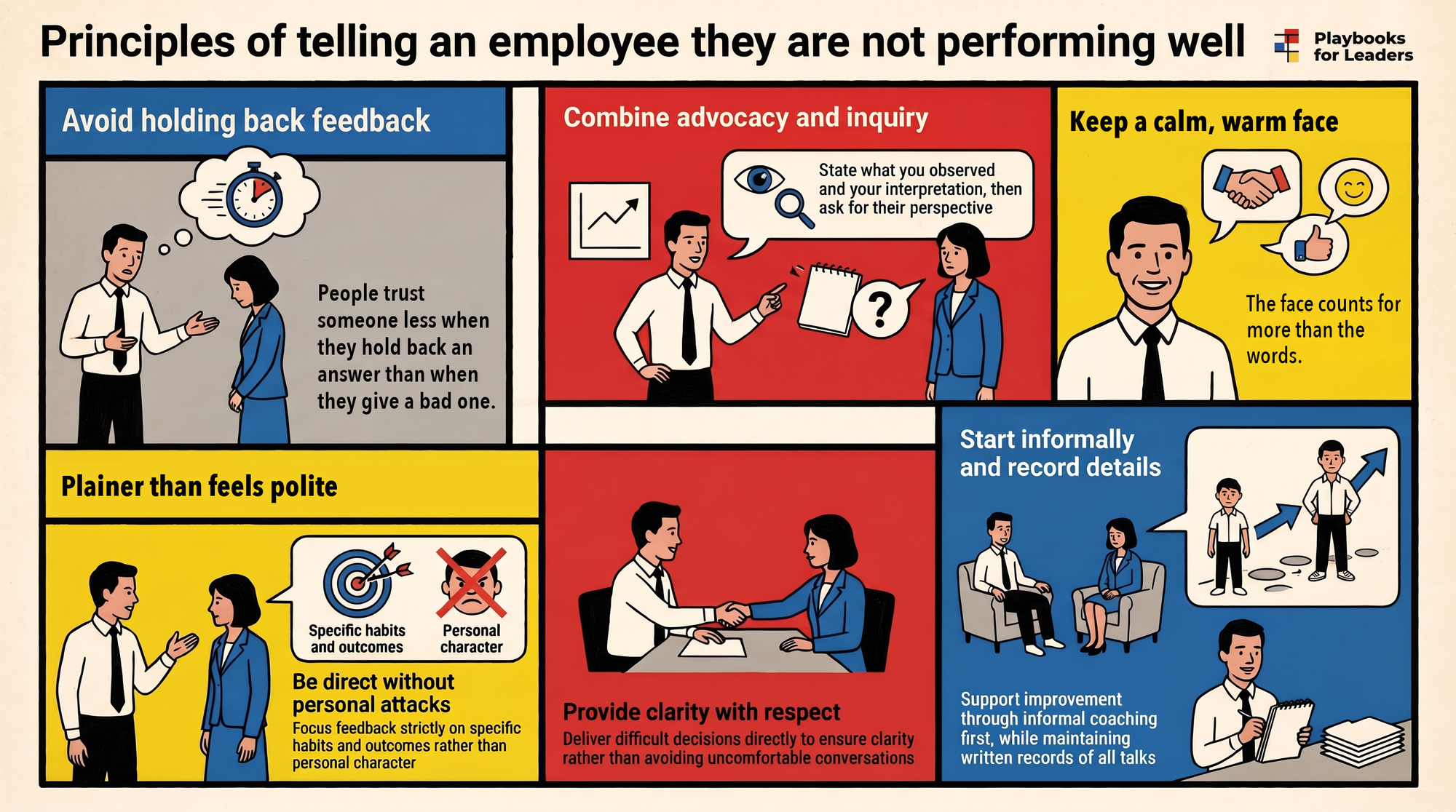
People trust someone less when they hold back an answer than when they give a bad one. Leslie John, Kate Barasz and Michael Norton of Harvard Business School ran seven experiments on this, published in the Proceedings of the National Academy of Sciences in 2016. In one, people chose between two job candidates: one who admitted poor grades and one who wouldn't say. They guessed the one who wouldn't say had the better grades, and 89% of them still hired the one who answered. The authors' summary: "In short, failing to disclose can leave a bad impression."
The same paper found that most people don't see the cost coming. In another experiment, 70.5% of the employees taking part chose to hold the information back.
The experiments are about people hiding facts about themselves. Applying them to a manager who dodges a question about someone else's work is our step, not the paper's. But the shape is the same: if they ask "how am I doing?" and you steer round it, they notice, and they trust the next answer less.
What do you say first?
Two sentences, then a question. Jenny Rudolph and three colleagues at a medical simulation centre in Cambridge, Massachusetts, set out the method in 2006, for doctors debriefing other doctors after a simulated emergency. They call the two halves advocacy and inquiry: "An advocacy is an assertion, observation, or statement, whereas an inquiry is a question."
Their own example comes from the operating theatre. The instructor says what they noticed: that the trainee stepped away from the patient to find a bag mask while the vital signs fell. Then what they make of it: that there were other ways to get oxygen into the patient. Then the question: "how were you seeing the situation at that time?"
At work, it runs the same way:
- Before you go in, write one sentence on what you saw, with the date and the result, and one on what you make of it.
- Say both sentences, plainly, near the start.
- Ask how they saw it at the time, and listen to the whole answer.
- Agree the change against what the answer showed.
Kerry Patterson and four co-authors make the same point in Crucial Accountability. When someone has let you down, start "by simply describing the gap between what was expected and what was observed", and end with a question. Then you're "listening to diagnose the underlying cause".
The question isn't a softener. Rudolph's team found that even mistakes are usually "intentionally rational": the action made sense given how the person saw the situation. The answer tells you what to fix.
The paper warns against the opposite move, the leading question that hints at the verdict without saying it. The authors borrow Chris Argyris's name for it, "easing in", and found it can leave the person confused about the question or suspicious about your motives.
How plain do you need to be?
Plainer than feels polite, if the soft version hasn't landed. Kim Scott tells this story in Radical Candor. Shortly after she joined Google in 2004, she gave a presentation to the chief executive and the founders. Afterwards her boss, Sheryl Sandberg, praised it, then mentioned that she'd said "um" a lot. Sandberg offered a speech coach that Google would pay for. Scott brushed it off.
Sandberg tried again, and this time she was blunt: "You are one of the smartest people I know, but saying 'um' so much makes you sound stupid." Scott worked with the coach, and dropped the habit.
Sandberg said it twice. The first time, Scott could choose not to hear it. The second time, Sandberg named the cost and repeated the offer of help in the same breath. Both versions are Scott's: we found no account of the conversation from Sandberg herself.
Does your face matter as much as your words?
Yes, and possibly more. Michael Newcombe and Neal Ashkanasy, at the University of Queensland, showed 537 people videos of actors playing leaders giving appraisal feedback, published in The Leadership Quarterly in 2002. The words were positive or negative, and the face either matched them or didn't. Leaders with a positive face were rated higher whatever the words said. Praise given with a negative face scored lowest of all.
Their conclusion: "it is not enough just to use positive language in delivering performance appraisal feedback." Rudolph's team found the same from the other side: a critic's real view "leaks" through facial expression and tone, even when the words are careful.
So say the hard sentence with a calm, warm face, and don't dress it in praise you don't mean. The face counts for more than the words.
What if they take it badly?
Stand by what you said, and keep the relationship. Rahul Dravid was India's head coach. He told Wriddhiman Saha, the reserve wicketkeeper, that the team wanted to bring on a younger keeper. Saha was left out of the Test squad for the home series against Sri Lanka. On 19 February 2022 he told reporters: "Even coach Rahul Dravid suggested that I think about taking retirement."
Dravid answered the next day, at the end of a T20 series against the West Indies. He said he wasn't hurt, and that Saha "deserved honesty and clarity". He'd told him first on purpose. "I didn't want him to hear about it from the media." And he said he'd keep having those talks: "You can have difficult conversations with the players, but that doesn't mean you brush it under the carpet and don't have the conversations."
Saha heard the news as advice to retire. Dravid's news was about Saha's place behind Rishabh Pant, not a fall in his form, so the story shows how to deliver a verdict, not how to reach one.
What happens after the conversation?
Write it down. Acas, the UK's workplace advice service, says "It's important for employers to keep a record of any conversations they have with employees about performance."
Acas also sets the order: help the person improve before any formal procedure. If the problem is their ability rather than their behaviour, Acas suggests support such as coaching or training. If the informal steps don't work, a performance improvement plan comes next. Acas says it should set out:
- specific objectives
- a reasonable timeline to meet them
- any further support or training they need
Acas adds that the employer should talk the plan through with the person and share a written record of it. Our post on difficult feedback has word-for-word scripts for the follow-up conversations.
When the gap is part of a bigger situation
If what you find fits one of these situations, the Playbook for it starts there.
| What you find | Playbook |
|---|---|
| You've been putting off the conversation for weeks | Difficult feedback |
| One person's work is holding up everyone else's | One blocker |
| You've taken over the team and found the gap on arrival | After a bad manager |
| They're new, and nobody told them what good looks like | New starter |
FAQ
Should you tell them in a one-to-one?
Book a separate meeting if the reaction could take over the one-to-one. Our post on one-to-one meetings covers what belongs on that agenda.
Do you need to start a performance improvement plan?
Not at first. Acas puts informal steps first, and a plan only "If informal steps do not work".
What if they ask "how am I doing?" before you're ready?
Answer it. If you need the numbers to hand, say so, and give a date in the next day or two. Don't say everything's fine.
Sources on telling someone they are not performing
- Radical Candor by Kim Scott. It's our source for Sheryl Sandberg's feedback to Scott at Google. If you want the book itself, buy it from Bookshop.org or Amazon.
- Crucial Accountability by Kerry Patterson, Joseph Grenny, David Maxfield, Ron McMillan and Al Switzler. It's our source for describing the gap and ending with a question, on pages 81 and 100. If you want the book itself, buy it from Bookshop.org or Amazon.
Some book links on this page are affiliate links. If you buy through one, we earn a small commission.