

How to have one-to-one meetings that move things: start with the hard part
Your one-to-ones happen every week and nothing changes. How to get the hard part on the table early, from their side and from yours.
The short version
- Ask for their whole list before you pick anything from it, and take their items first.
- If you have something hard to say, tell them at the start, and make it the first item in your half.
- Let them do most of the talking, and say what they did, not what you think it means.
- If someone has stopped disagreeing with you, say so and ask why.
- Ask them what isn't working in your one-to-ones, and change something they can see.
Contents
- Why do one-to-ones stop moving anything?
- How do you get the real item on the table early?
- How do you raise a hard point in a one-to-one?
- What do you do when someone has stopped disagreeing with you?
- How do you find out what isn't working in your one-to-ones?
- What if the same problem comes back every week?
- What do you cut when the half hour is short?
You hold the one-to-ones every week, the agenda fills up and nothing changes afterwards. Our guide to one-to-one meetings covers the agenda and how often to meet. This post is about the half hour itself, once the meetings have stopped working. Most of it comes down to when the hard part comes up.
Why do one-to-ones stop moving anything?
Chances are that the hard part comes up last. GitLab says so in its handbook on one-to-ones: "People will often reveal their important information at the end of a conversation." At minute 28 there's no time to do anything with it except add it to next week's list, where it can arrive at minute 28 again.
Steven Rogelberg is an organisational psychologist at the University of North Carolina at Charlotte. In Harvard Business Review in 2022 he reported three years of research on one-to-ones, including this: "Of 250 direct reports I surveyed recently, nearly half rated their 1:1 experiences as suboptimal." His example is Bill, a manager made up from several he worked with and studied. Bill built his one-to-ones round his own priorities, so his team's concerns usually ended up at the end of the meeting, and often weren't dealt with at all when time ran out.
Doctors see the same thing. White, Levinson and Roter recorded 88 patients' visits to 20 primary care doctors in Oregon, for a study published in the Journal of General Internal Medicine in 1994. In 21% of the visits the patient raised a new problem in the closing moments, one that hadn't come up before. A surgery isn't a one-to-one, and reading one across to the other is our step.
Another sign that the one-to-ones have stalled is the same conversation about the same problem, two weeks running. To check yours, read back your last four agendas against the four signs in our guide.
How do you get the real item on the table early?
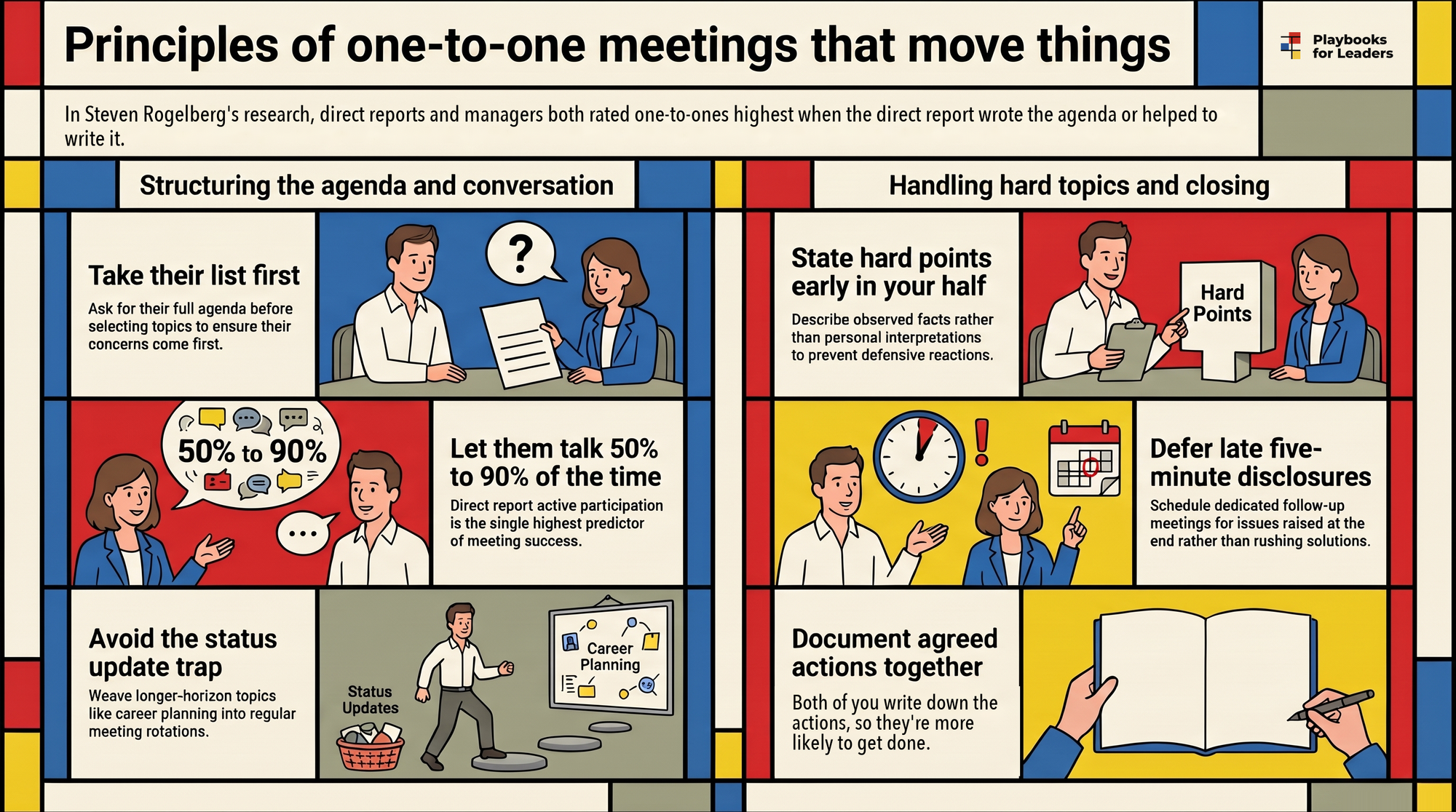
Ask for their whole list before you pick anything from it. "What's on your list this week?" Then "What else?", until they say there's nothing else. Then agree which item goes first.
Rogelberg calls the simplest version the listing approach. You and they each write a list of topics before the meeting, and in the meeting you work through theirs first and yours after. In his research, both direct reports and managers rated one-to-ones highest when the direct report wrote the agenda or helped to write it.
In 1999 Marvel, Epstein, Flowers and Beckman reported in JAMA on 264 consultations with 29 family doctors in the United States and Canada. The doctors redirected the patient's opening statement of concerns after 23.1 seconds on average. Patients who were allowed to finish took only 6 seconds longer on average. Concerns that came up late were more common when the doctor hadn't asked for the patient's concerns: 34.9% against 14.9%. Again, the step from a consulting room to your one-to-one is ours. Six seconds is a small price for the whole list.
Then let them talk. In Rogelberg's research, the biggest predictor of a one-to-one's success is how much of it the direct report spends talking. He puts the ideal at "anywhere from 50% to 90%".
When an item on their list is an update on something slipping, ask about the work, not the person. In the Project slipping Playbook we ask the team "where's the bottleneck", not "what's gone wrong". The first question invites a diagnosis and the second a defence.
How do you raise a hard point in a one-to-one?
Early. Their items still go first, so tell them at the start that you have something to raise, and make it the first item in your half. Rogelberg also tells managers to say at the outset that the agenda can change if something critical comes up. If you save your point for the last two minutes, they leave with it and have no time to answer.
Before the meeting, write down one thing you saw and one question. Say what happened, not what you think it means. "The last two sprint demos slipped a day" is what happened. "You're not prioritising this" is your reading of it, and it gets you a defence instead of an explanation. Then ask what you're missing.
If you need the words for a harder version of the conversation, the difficult feedback scripts in the Journal cover five of them.
What do you do when someone has stopped disagreeing with you?
Say what you've noticed: "You've disagreed with me less over the last month. What's going on?"
Then look at the items you add. GitLab writes in its handbook that people who report to a manager "tend to assume that they must do everything added by the manager". Its managers are to make clear that people can push back on an item: it isn't a good idea, or it isn't worth the time, or someone else should handle it. When you add an item, tell them they can push back on it.
Look too at what happens to their ideas. Rogelberg's rule is that if their solution to a problem works, you go with it, even when you think yours is a bit better. He makes an exception when yours is much better and a wrong answer would cost a lot. Going with theirs, he writes, "creates more commitment to the team member's proposed path forward."
If their half of the agenda is empty too, our guide to one-to-one meetings covers what to ask.
How do you find out what isn't working in your one-to-ones?
Ask the people you meet. Rogelberg writes that managers rate their own skill at one-to-ones higher than their direct reports rate it. "They think they are better at them than what their directs say."
He suggests asking each person for ideas to make the one-to-ones better, or running an anonymous survey of the team with his three questions:
- "What's going well with the 1:1s?"
- "What's not going well?"
- "Do you have ideas for improving them?"
Inside the meeting, you can ask two of his sample questions about yourself: "What feedback from me could be helpful?" and "Would you like more or less coaching or direction from me?"
Then change something they can see. In Bill's first survey, his team questioned whether he cared about their performance or their growth. They pointed to the meetings he cancelled, and said they often couldn't get a word in. Once he met them regularly, on topics that mattered to them, Rogelberg writes that they seemed more committed to their work, and better at it.
If you're on the other side of the table, our post on one-to-ones with your boss covers how to give your boss feedback.
What if the same problem comes back every week?
Then the item isn't producing a decision. Write the contradiction under it in one sentence, in the shared document. In the Same meeting again Playbook we call this naming the paradox: "How can we cut costs and keep the team intact?"
Once it's written down, the two of you are choosing between two goods instead of looking for the right answer. In the Playbook we put it this way: "Naming the trade-off is what lets the trade-off be made."
What do you cut when the half hour is short?
Cut in this order:
- Status. Ask for it in writing before the meeting. Rogelberg warns against one-to-ones that fall into "a status update trap".
- A topic that needs an hour. Book the hour instead of letting it fill this half hour.
- Your own items, if they run over. In the listing approach yours come after theirs, as time allows.
Never cut their items two weeks running. Cut them once and it's a bad week. Cut them twice and you've told them their items can wait.
Don't cancel the meeting to save the time. If you have to cancel, Rogelberg's advice is to move it, to the same week if you can. Or shorten it: "Some time together is better than none at all."
When one-to-ones are part of a bigger situation
If what you find fits one of these situations, the Playbook for it starts there.
| What you find | Playbook |
|---|---|
| The whole team has gone quiet, not one person | Falling morale |
| A project is slipping and nobody says where | Project slipping |
| You've been putting off feedback someone needs to hear | Difficult feedback |
| The same argument comes back every week | Same meeting again |
FAQ
What if they raise something big in the last five minutes?
Don't start solving it in the time left. Say back what you heard, and agree when you'll talk about it, within days rather than at next week's one-to-one. Then put it first on the agenda for that conversation.
How do you know a one-to-one has moved something?
Something you agreed is done before the next one, and they bring you a decision to look at instead of an update. Rogelberg's advice is to end each one-to-one with the actions for both of you, written down by both of you. Then, he writes, "chances are better that the actions will be carried out." Our guide to one-to-one meetings lists four signs.
How often should one-to-ones be, and how long?
Weekly, for 30 minutes, is the default in our guide to one-to-one meetings, which also covers when to change it. In Rogelberg's surveys, employees rated weekly half-hour one-to-ones the most desirable.
Sources on one-to-ones
- Glad We Met: The Art and Science of 1:1 Meetings by Steven G. Rogelberg. It's his own account of the research we quote from his Harvard Business Review article. If you want the book itself, buy it from Bookshop.org or Amazon.
Some book links on this page are affiliate links. If you buy through one, we earn a small commission.