

Executive presence in writing: the new rules
If your team works apart, people judge your presence by what you write. A decision record you can copy, four written habits and what to send when a project slips.
The short version
- If your team works apart, people judge you on what you write.
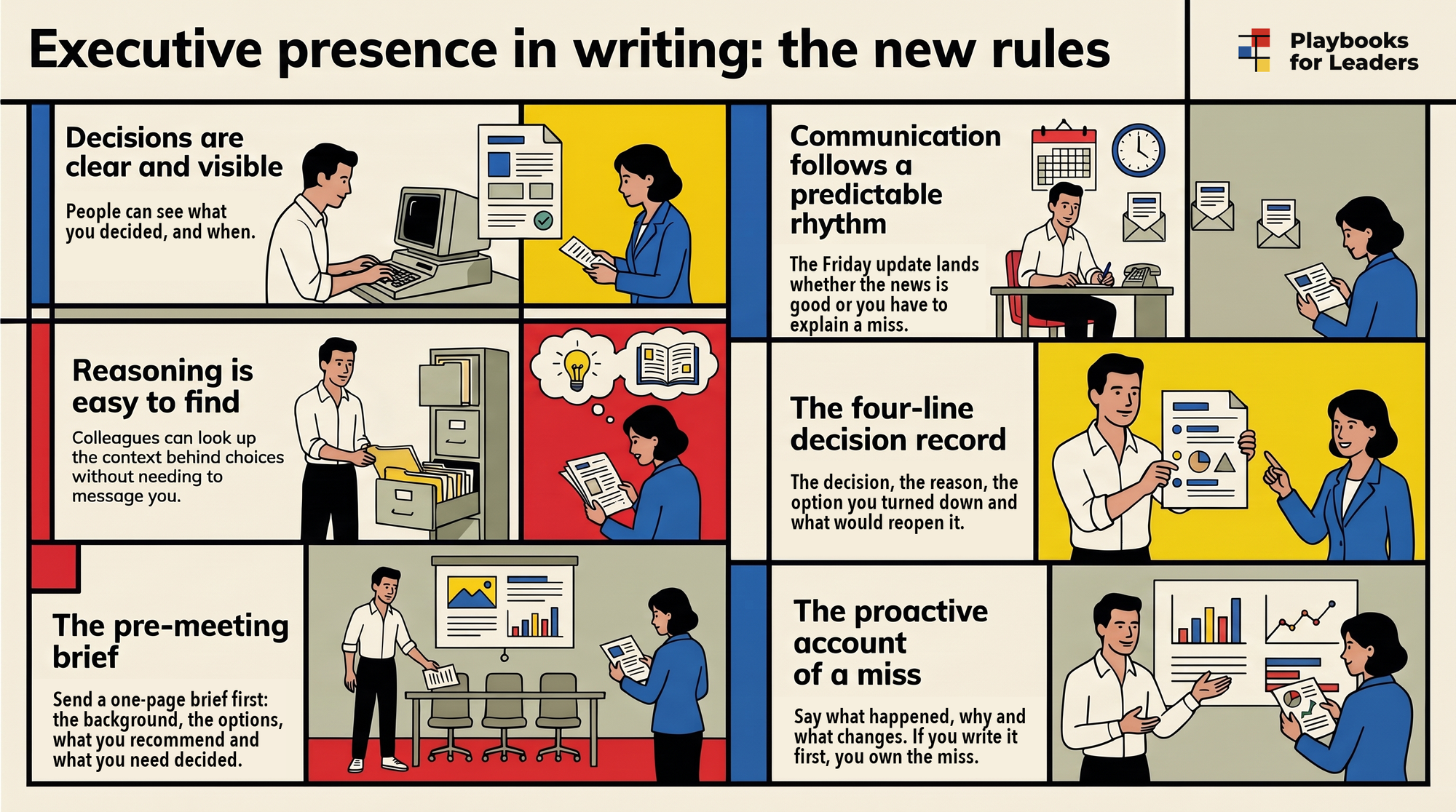
- Record each decision in four lines: the decision, the reason, the option you turned down and what would reopen it.
- Four written habits do the work a commanding voice used to do: a weekly update, a brief before the meeting, a decision log and a written account of a miss.
- If a project slips, write the update before anyone asks for it.
- In a new role, publish a one-page brief in your first week.
Contents
- Why did the old rules of executive presence stop working?
- What are the new rules?
- How does a written decision build presence?
- Which written habits mark out a senior leader?
- How do you build presence with a team you inherit remotely?
- How do you keep presence when the project slips?
- What should you do this week?
Executive presence used to mean how you held a room. If your team works across buildings and time zones, the people deciding whether to trust you may never have been in a room with you. They read your decisions, your updates and your account of what went wrong. So presence now lives on the page, and you can build it the same way you'd build any other habit.
Why did the old rules of executive presence stop working?
The old rules judged what people could see: how you held a room, your eye contact, your voice, how fast you answered under pressure. If you inherited a team or had to explain a miss, you did it in person, and people read your manner as well as your words.
Then the room went. If your team is spread across offices and kitchens, they make up their minds about you from documents and calls. Your decisions leave a written trail that anyone can read without you there. And people judge you on whether they can find your reasoning, not on how well you perform a summary of it.
What are the new rules?
Presence is now the confidence people have in your decisions when you're not there. Three rules build it.
- People can see what you decided, and when.
- People can find why. Someone stuck at eleven at night can look up why you chose this route without messaging you.
- Your updates arrive when people expect them. The Friday update lands whether the news is good or you have to explain a miss.
That rhythm is what I mean by presence. Charisma doesn't come into it. Our standard for it is the one on every Playbook: prepared, not performing. The reasoning is on the page before the meeting, so the meeting reviews it.
How does a written decision build presence?
Nobody sees you think. They see what you leave behind. A decision record says what you decided, why, what you turned down and what would change your mind. It does the job the performance in the meeting used to do.
Amazon makes this a rule. Jeff Bezos wrote to Amazon's shareholders in April 2018 that the company didn't use slide presentations. "We write narratively structured six-page memos," he wrote, and each meeting began with everyone reading one in silence (Amazon, 2017 letter to shareowners). Nobody at the table can perform their way past a page of reasoning that doesn't hold.
A decision record you can copy
Four lines, and anyone can search for it later.
- Decision: what we're doing.
- Why: the constraint or the goal behind it.
- Turned down: the main alternative, and why it lost.
- Reopen if: the condition that would bring the decision back.
The same decision, written two ways
Here's the vague version: "We're pausing the migration to focus on stability." It reads like a verdict handed down.
Here's the record: "We're pausing the migration, because two serious incidents this month came from half-finished cutovers. We turned down finishing on schedule, because that risks a third. We'll restart when we see fewer than one error a week."
Both announce the same call. The second shows your reasoning stands up to questions. Someone who disagrees can argue with the reasoning instead of with you. And the people who report to you can explain the decision to their own teams without you in the room.
When the decision is unpopular
Write it anyway, and describe the option you turned down fairly. If you make the losing side look foolish, the record reads as spin. "We turned down X because we put Y first, and here's what that costs" invites disagreement without costing you authority.
Which written habits mark out a senior leader?
Four habits do the work a commanding voice used to do. People judge each one on whether they can find it and use it without you.
The weekly update
Three to five lines: what moved, what's stuck and what you decided. Send it every week, whatever the news. If those updates have been honest, people give you more room when a project goes wrong.
The brief before the meeting
If the meeting is going to be a fight, send a one-page brief first: the background, the options, what you recommend and what you need decided. People arrive having read it, and you've set out the question before anyone else speaks. The Hostile meeting Playbook adds a step to take before you write it: work out, with the SCARF Model, whose status, certainty or autonomy feels threatened.
The decision log
One line for each decision: what, why, who you asked and the date. The log makes your judgement visible across time zones, and after you've moved on. The person who inherits your area reads it first.
The written account of a miss
Say what happened, why and what changes. People trust a leader's account of a miss more than a defence of it.
Start with the weekly update. Add the decision log when decisions start getting lost.
How do you build presence with a team you inherit remotely?
If you inherit a team you can't sit with, people meet your writing before they meet you. So write first.
Your first week
On your second day, write a one-page brief. Say what you understand the team is there to do, what you don't yet understand and the three situations you expect to face first. Publish it where the team works. It gives people something concrete to correct, and their corrections tell you what you got wrong.
Sheryl Sandberg did the same in person. She joined Facebook as chief operating officer on 24 March 2008 and spent her first weeks walking up to desks and asking questions. Either way, the new leader asks before deciding. Writing lets you ask people you can't walk up to. Her story is in the New starter Playbook.
Your first decisions
For each early decision, write down the options you weighed, the call you made and why. Post it before the next meeting, so the meeting argues about the reasoning instead of discovering it. The Inherited team Playbook covers the rest of the first month.
How do you keep presence when the project slips?
The longer you stay quiet, the more other people tell the story for you. If you write it first, in your own words, you own the miss.
Buffer makes an app that schedules posts to social media. On Saturday 26 October 2013 attackers broke into it and sent spam from 30,000 customers' Facebook accounts. About two hours later Joel Gascoigne, Buffer's founder and chief executive, posted on the company blog that Buffer had been hacked and what users should do. Over the next nine days he added ten updates to the post. Downgrades from the paid plan rose that week, then fell back to normal.
What the update says
Post it where the people waiting for the work already look, not in a meeting you chair. Keep it to one page, in this order:
- The miss, with nothing softened: what you promised, what slipped and by how much.
- The cause, in one sentence, without blaming a person.
- The plan: what changes, and who owns each change.
- The date you'll report again, and what you'll measure by then.
Without the fourth item, the update reads as an apology. With it, the update reads as a decision. The Explain the miss Playbook helps you decide first whether the team missed the target or the target missed the world, because the two need different updates. The Status Reporting tool sets out the variance, the facts and the dates.
If you can't yet see where the project is slipping, start with the Project slipping Playbook.
What should you do this week?
- Pick one situation that keeps coming back: the slipping project, the inherited team or the feedback conversation you keep rehearsing.
- Write one decision record for it, on one page.
- Send one written update that people can find without you: what changed, what you decided and what you need from whom, by when.
Do the same next week on the same situation.
Where a Playbook library falls short
We write the Playbooks for situations, not for your organisation, so a Playbook won't know your board or your politics. It won't replace feedback from people who know your team. And no library covers every case. If yours isn't one of the 40, you'll have to write that part yourself.
FAQ
Can you have executive presence if you rarely speak in meetings?
Yes. If your team works apart, the people judging you may never see you on a call. They judge whether they can find your reasoning. A leader whose written reasoning stands up to questions has more presence than a fluent speaker whose decisions leave no trace.
How long does it take to build presence in a new remote role?
It starts in your first week, with a one-page brief and a written record of your first decisions.
Is executive presence different for introverts?
If you think before you speak, the new rules suit you. The old ones rewarded command of a room and quick answers, a performance under pressure. Writing rewards preparation: reasoning that stands up, updates that land every Friday and a brief that arrives before the meeting.
Does executive presence matter if you don't manage anyone?
Yes. If other people rely on your judgement, say on a system you own or a migration you decide, you build presence the same way. Write down what you decided, why and what you turned down.
Sources on writing for leaders
- Writing for Busy Readers by Todd Rogers and Jessica Lasky-Fink. It's our source for writing to busy readers. The authors set out six principles, and the first is "less is more": use fewer words, include fewer ideas and make fewer requests. If you want the book itself, buy it from Bookshop.org or Amazon.
- Working Backwards by Colin Bryar and Bill Carr. It's our source for how Amazon writes a decision down before it builds anything. The press release that opens its PR/FAQ document runs to less than a page. If you want the book itself, buy it from Bookshop.org or Amazon.
Some book links on this page are affiliate links. If you buy through one, we earn a small commission.