

How to have a difficult conversation with an employee: prepare it, and repair it if it goes wrong
Write the conversation down in four lines, say the hard part so it doesn't land as an accusation, and repair it if it goes wrong.
The short version
- Write the conversation down first, in four lines.
- Cut any line that judges the person instead of describing what they did.
- Say what you're not suggesting about them before you give the hard fact.
- Put the fact in a form that comes from outside you both, such as the agreed standard or the figures.
- If the conversation went badly, have a second one: apologise, and tell them honestly why you handled it the way you did.
Contents
- Why does a difficult conversation with an employee go wrong?
- How do you prepare the conversation?
- How do you stop the facts sounding like an accusation?
- What do you do while they're answering?
- How do you repair a conversation that went badly?
- What do you agree before you finish?
You've put this conversation off, and you'll have it this week. Here's how to prepare it in four lines, how to say the hard part without it landing as an accusation, and what to do if it goes wrong anyway.
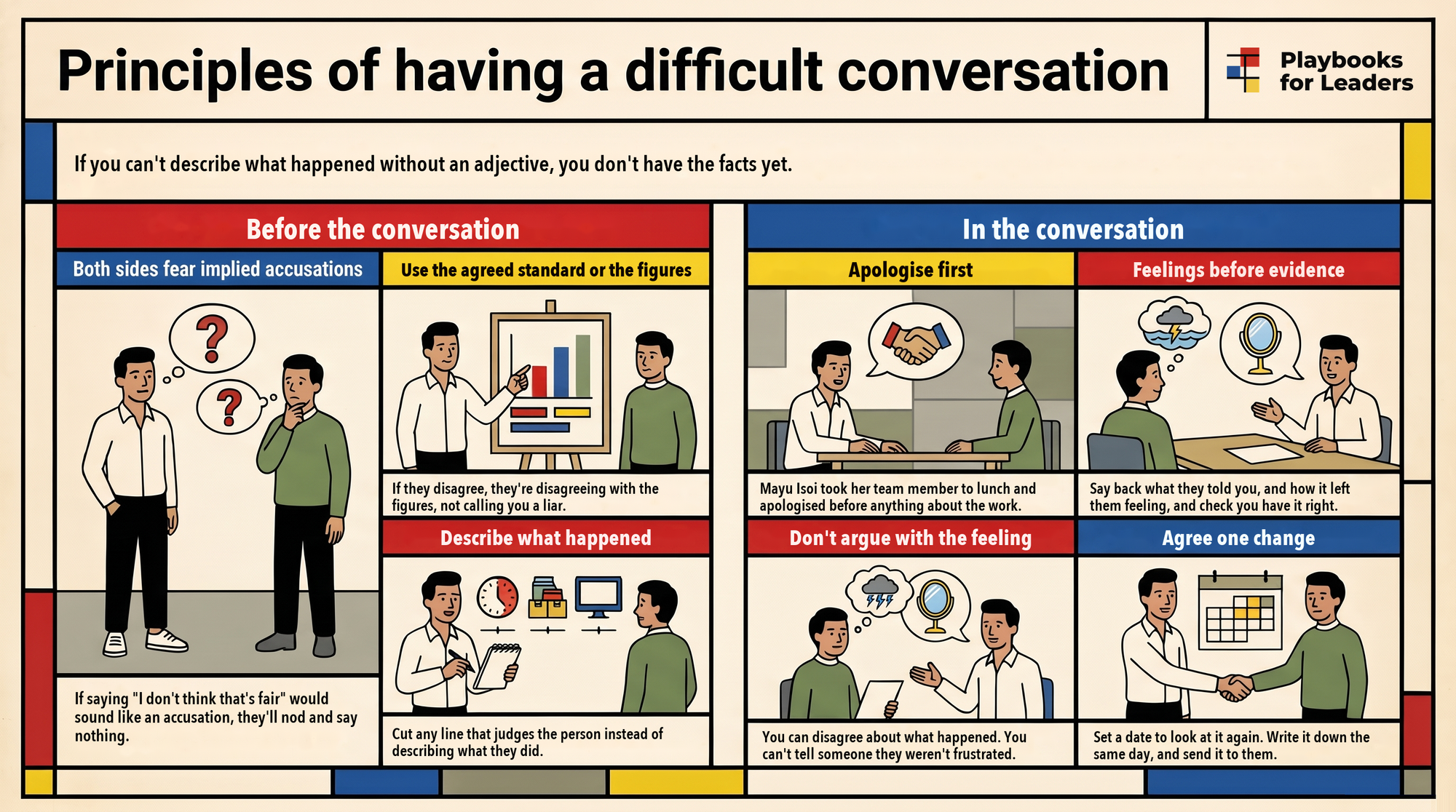
Why does a difficult conversation with an employee go wrong?
Chances are you both walk in afraid of the same thing: that what you say will sound like an accusation. You worry that the facts will sound like an attack on them. They worry that disagreeing with you will sound like calling you unfair or wrong.
Sunita Sah, George Loewenstein and Daylian Cain have a name for the second fear. In 2019, in Personality and Social Psychology Bulletin, they called it insinuation anxiety: the "concern that rejection of advice may be interpreted by an advisor as an indication of distrust" (p. 1099). Their four experiments were about advice from someone with a conflict of interest, such as a doctor who gains if the patient takes the advice. Once the adviser disclosed the conflict, people trusted the advice less and still felt more pressure to take it, because turning it down would suggest they thought the adviser biased. The pressure fell when someone else made the disclosure instead of the adviser.
Your employee isn't taking advice from a doctor, and applying the finding to them is our step. But the fear is the same one. If saying "I don't think that's fair" would sound like an accusation, they'll nod and say nothing, and you'll leave thinking the conversation went well.
How do you prepare the conversation?
Write it down in four lines. TeamSTEPPS, a teamwork programme for hospital staff in the United States, teaches a script for this called DESC. In its pocket guide, TeamSTEPPS calls DESC "A constructive approach for managing and resolving conflict" (p. 27). Each letter is one line:
- Describe what happened, with specific examples.
- Express how it affects you, and what worries you.
- Suggest what you'd like instead, and ask whether they agree.
- State the consequences for the team or the work.
Write one line for each, then read every line and cut anything that judges the person instead of describing what they did. "You don't care about deadlines" goes. "The client report was due on Friday and went out on Tuesday" stays.
If you can't write the first line without an adjective, you don't have the facts yet. Find them before you book the meeting.
How do you stop the facts sounding like an accusation?
Say what you're not suggesting before you say anything else: "I'm not saying you aren't trying. I want to look at the last three reports with you." Then give the fact in a form that comes from outside you both: the standard you agreed when they took the work on, or the figures. That way, if they disagree, they're disagreeing with the figures, not calling you a liar.
Both moves are ours, taken from Sah's finding that the pressure fell when someone other than the adviser made the disclosure. The experiments didn't test them with managers.
Then stop, and ask how they see it: "What am I missing?"
What do you do while they're answering?
Say back what they told you, and how it left them feeling, and check you have it right: "So the brief changed twice, and you felt you were being blamed for the second change. Is that right?" Only once they've said yes do you look at the evidence together.
Don't argue with the feeling. You can disagree about what happened. You can't tell someone they weren't frustrated.
If they go quiet, wait. If they get upset, offer to stop and pick it up tomorrow, and say when.
How do you repair a conversation that went badly?
Have a second conversation, and start it with an apology.
Mayu Isoi got this wrong in her first year as a manager at Robert Walters Japan, a recruitment firm, and told the writer Yukiko Utashiro about it for PRESIDENT WOMAN Online in July 2019. A man on her team was much older than her, came from an English-speaking country and had years in the industry. At their one-to-one every week she pressed him hard on his figures: this is down by so many per cent, so what's the cause? One week he answered "I don't know", with tears in his eyes, and his voice broke.
Isoi told Utashiro that only then did she see what she'd been doing. She hadn't wanted him to look down on her. Her English wasn't native, so she had kept to numbers and logic, with no feeling in it, and he had felt blamed. She took him to lunch away from the office, apologised and told him honestly how she'd been dealing with him. He opened up, and she learnt that he lacked confidence too. She worked out what his strengths were and started going to clients with him.
Her repair had three parts, and you can use all three:
- Somewhere neutral, away from where the first conversation happened.
- An apology first, before anything about the work.
- The truth about why you handled it the way you did, even if the reason is your own nerves.
Then get back to the work, together.
What do you agree before you finish?
One change, and a date to look at it again. Say it back to each other before you leave the room: "So you'll send me the draft on Wednesday, and we'll look at it together on Thursday."
Write it down the same day, and send it to them. If the conversation was about conduct, or the law is involved, go to HR before you promise anything.
Then teach the four lines to your team, so anyone can use them with you.
When the conversation is part of a bigger situation
If what you find fits one of these situations, the Playbook for it starts there.
| What you find | Playbook |
|---|---|
| You've been asked to give someone difficult feedback and you've been putting it off | Difficult feedback |
| One person on your team is blocking everyone else | One blocker |
| Two of your people are in open conflict and you've been pulled in | Open team conflict |
| Morale has dropped and you can't tell why | Falling morale |
| You're taking over a team that's just had a bad manager | After a bad manager |
FAQ
How do you start a difficult conversation with an employee?
Say what you're not suggesting, then give the first line of your four, the one that describes what happened. Our post on difficult conversations at work has opening lines for six common ones.
Should a difficult conversation happen in a one-to-one?
Only if it's short. If the reaction could take over the meeting, book a separate one, so the rest of your one-to-one doesn't get lost.
What if the employee gets upset?
Stop, and offer to pick it up the next day at a time you name. Don't take back what you said to end the upset. Isoi apologised for how she'd handled it, not for the figures.
What if the same problem keeps coming back?
Then it's no longer one conversation. In our post on the difficult employee we set out what to do when it's a pattern.