

How to deal with a difficult employee: start with a quiet word
Get the facts, raise it in private and act within the week, before the rest of the team catches the mood.
The short version
- Get the facts before you act, including how the person sees it.
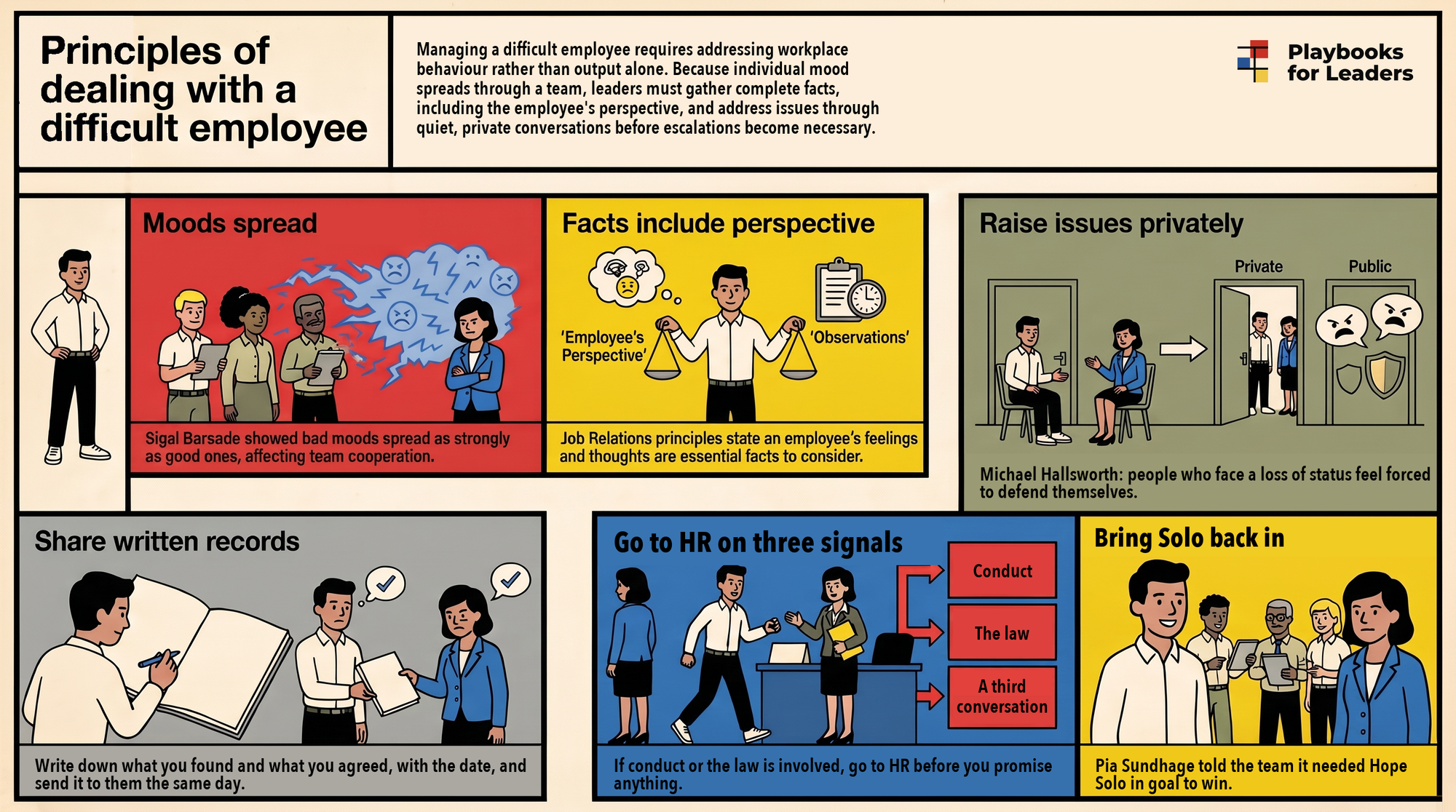
- Raise it in private. In front of the team, they'll defend themselves instead of listening.
- Ask what they expect of a good colleague, then where they fell short of it last week.
- Act within the week, because the rest of the team catches their mood.
- If conduct or the law is involved, go to HR before you promise anything.
Contents
- Why can't you wait for a difficult employee to settle down?
- How do you get the facts?
- How do you raise it without a fight?
- What do you do after the conversation?
- What if the team has turned against them?
- What if they give you an ultimatum?
- When should you take a difficult employee to HR?
A difficult employee, in this post, means a problem of behaviour: the person whose work may be fine but who makes the people around them worse. If the problem is the work itself, start with How to manage an underperforming employee.
Why can't you wait for a difficult employee to settle down?
Because the rest of the team catches their mood. In 2002 Sigal Barsade, then at Yale, planted a trained actor in groups of business students working through a management exercise. The actor showed a pleasant mood or an unpleasant one, and the rest of each group caught it. Outside observers saw it on video, and the students reported it themselves.
Barsade called people "walking mood inductors". Each person keeps changing the moods of the people around them, and then their judgements and what they do. In her study, groups that caught a good mood cooperated more and argued less.
So a difficult employee's mood isn't their own business. Act on it within the week.
How do you get the facts?
In 1944 the United States War Manpower Commission wrote a course for first-line supervisors in war factories, called Job Relations. Its case is a supervisor who disciplined a worker called Joe for missing work, without asking why. Joe's father had been hurt.
The course's first step is to get the facts:
- Review the record, including what you know about the person that isn't on paper.
- Find out which rules and customs apply.
- Talk with each person involved.
- Get their opinions and feelings.
The manual's reason for the last one, on page 39: "what a person feels or thinks, right or wrong, is a fact to him and must be considered as such." Be sure you have the whole story before you decide anything.
How do you raise it without a fight?
In private. Michael Hallsworth, chief behavioural scientist at the Behavioural Insights Team, says it plainly in The Hypocrisy Trap: "You don't want to expose the hypocrisy in public, since that will backfire. Instead, have a quiet word with people."
Hallsworth's reason: people who face a loss of status "feel forced to defend themselves". Pointing out a gap between what someone says and what they do works if it leaves them feeling guilt, and backfires if it leaves them feeling shame.
Hallsworth's method fits a one-to-one:
- Ask them what they expect of a good colleague.
- Ask them to recall times they didn't do what they just described.
- Give them a way to change without losing face.
What do you do after the conversation?
Job Relations has three more steps after the facts.
- Weigh and decide. Look for gaps and contradictions in what you found, and list more than one possible action. Check each one against your organisation's policies, and against its effect on the person, the team and the work. Don't jump to a conclusion.
- Take action yourself, and choose when. The manual says the timing "does influence the effectiveness of what you do". Don't pass it to someone else.
- Check results. Make your first check as soon as you can reasonably expect a result, and watch for changes in the person's work, their attitude and how they get on with the team.
Write down what you found and what you agreed, with the date. Acas, the Advisory, Conciliation and Arbitration Service, says employers should keep a record of every conversation they have with an employee about performance. Do the same for behaviour.
What if the team has turned against them?
At the 2007 World Cup, Greg Ryan, the United States women's coach, dropped his goalkeeper Hope Solo for the semi-final against Brazil. The United States lost 4-0, and Solo said in public, "It was the wrong decision". Her teammates shut her out of the third-place match, the medal ceremony, team meals and the flight home.
Pia Sundhage took over as coach that November. "I could just ignore it and say I wasn't part of it," she told Sports Illustrated in 2008. "But I wanted to respect all the feelings that were flying around." Julie Foudy, a former captain, wrote that Sundhage asked the team to move on and told them it needed Solo in goal to win. Solo was in goal when the United States won Olympic gold in Beijing in 2008.
What if they give you an ultimatum?
In 1961, two years after Kazuo Inamori founded Kyoto Ceramic, now Kyocera, eleven employees he had hired from high school the year before handed him a written demand. They wanted pay rises and bonuses guaranteed for years ahead, and said they would all quit if he refused.
Inamori wouldn't promise what he couldn't keep, and he didn't let them go either. He took them home to his council flat. Over three days and three nights, in his words, he "tried to persuade them to continue." He told them, "Because we are a new company, I cannot say anything definite about our future, but rest assured that I will work harder and more desperately than anybody else to protect the company." Every one of them stayed.
When should you take a difficult employee to HR?
Go to HR on any of these three signals.
- Conduct: harassment, discrimination, threats or anything a reasonable person would call a safety issue.
- The law: pay claims, family leave, disability adjustments and whistleblowing all carry statutory duties, so talk to HR before you promise anything.
- Repetition: a third conversation about the same behaviour, after your check showed no change.
In the UK, workers have a statutory right to be accompanied at a disciplinary meeting that could lead to formal action (Acas Code of Practice, paragraph 13). Hand HR your dated notes as you wrote them.
When the difficulty is part of a bigger situation
If what you find fits one of these situations, the Playbook for it starts there.
| What you find | Playbook |
|---|---|
| Two of your people are in open conflict and you've been pulled in | Open team conflict |
| The meeting you're about to run is going to be a fight | Hostile meeting |
| Morale has dropped and you can't tell why | Falling morale |
| You've taken over a team that just had a bad manager | After a bad manager |
| You've put off telling them their behaviour has to change | Difficult feedback |
FAQ
What's the difference between a difficult employee and an underperforming one?
The underperformer's work has dropped. The difficult employee's behaviour makes other people's work harder, and their own work may be fine. A person can be both. Get the facts first, and you'll know which conversation to have.
Should you tell the person what you've written down?
Yes. Write what you found and what you agreed, and send it to them the same day. If they can see every note you keep, the record is a plan you share.
What if they've been there longer than you?
Get the facts the same way, and ask for their read before you give yours. Hallsworth's point about status matters more here, so keep the conversation private.
Sources on dealing with a difficult employee
- The Hypocrisy Trap by Michael Hallsworth. It's our source for how to point out the gap between what someone says and what they do. If you want the book itself, buy it from Bookshop.org or Amazon.
- Difficult Conversations by Douglas Stone, Bruce Patton and Sheila Heen, from the Harvard Negotiation Project. It's our source for how to prepare for a conversation you expect to go badly. If you want the book itself, buy it from Bookshop.org or Amazon.
Some book links on this page are affiliate links. If you buy through one, we earn a small commission.