
INVEST Model
“Bill Wake's mnemonic for well-formed user stories: Independent, Negotiable, Valuable, Estimable, Small, and Testable.”
What is the INVEST model?
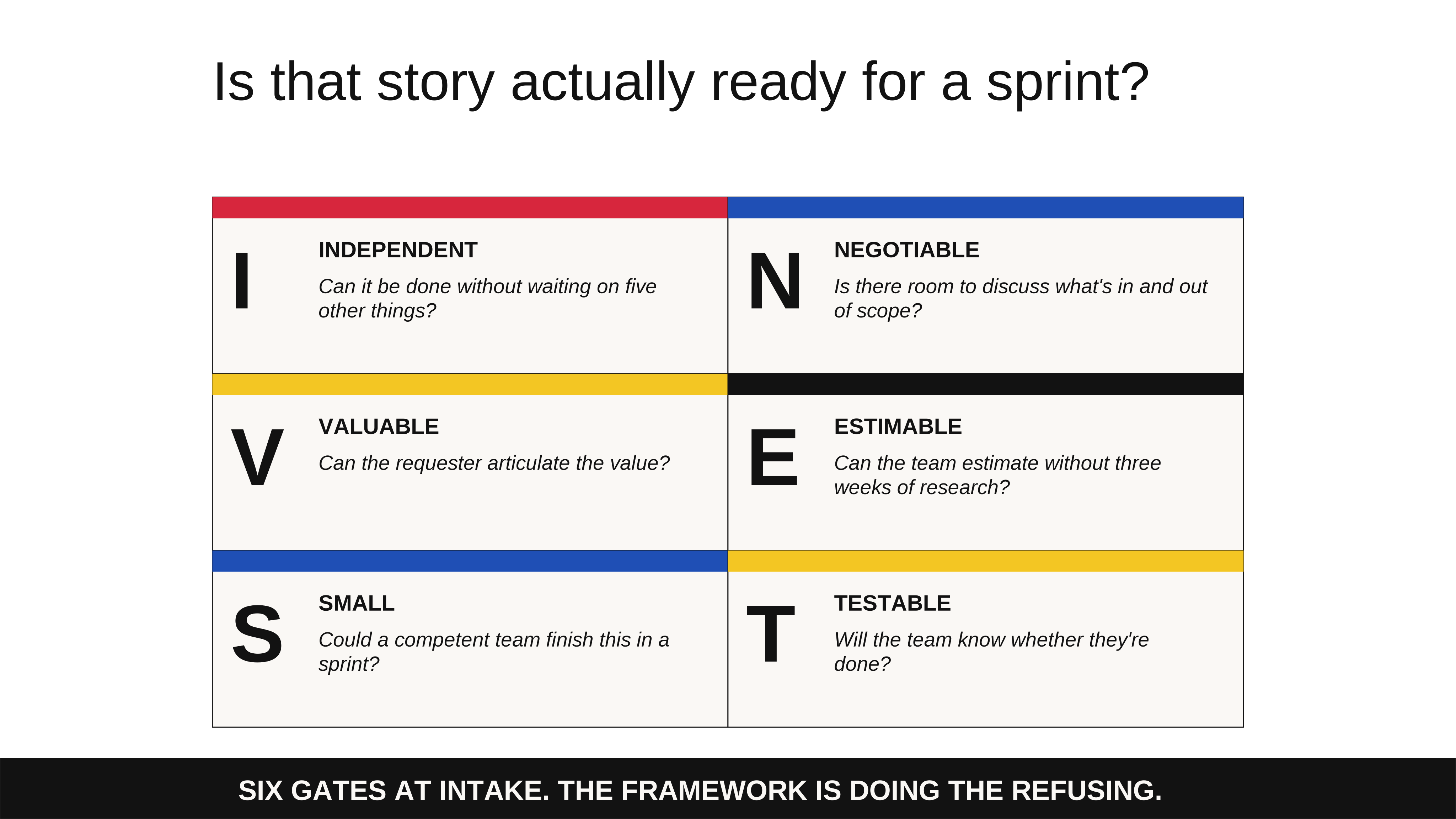
INVEST is Bill Wake's mnemonic for well-formed user stories: Independent, Negotiable, Valuable, Estimable, Small, and Testable. You run each story through the six criteria during backlog refinement, catching problems before they enter a sprint.
There's an item at the top of the backlog that everyone's been avoiding. It's too big, too vague, and nobody can estimate it. It's about to land in the next sprint anyway.
When should you use the INVEST model?
The unique strength is giving teams a shared quality gate that's fast to apply and hard to argue with. Stories that fail INVEST cause predictable damage: dependencies create blocking, vague requirements prevent estimation, and oversized items blow up sprint commitments.
The 'Small' criterion trips most teams up; they habitually write epics and label them stories. It falls apart when over-applied as a rigid checklist to every item, including spikes and technical work that don't fit the user-story shape.
Your next move: Which 'story' at the top of your backlog is actually an epic that nobody has bothered to break down, and how predictable will the next sprint be when it lands intact?
Which Playbooks use the INVEST model?
You use the INVEST model in the Plan of one Playbook:
What works well with the INVEST model?
Pair the INVEST model with User Story Mapping and Planning Poker.
When shouldn't you use the INVEST model?
Don't apply INVEST to a technical spike, which doesn't fit the user-story shape. And don't run it as a rigid checklist on every item.
How long does the INVEST model take?
About 30 minutes. You come away with a decision.
Where it comes from: Agile Alliance, INVEST
Learn more: Bill Wake: INVEST in Good Stories
“We've been told to do more with less and I have to decide what stops.”