
User Story Mapping
“Jeff Patton's visual technique represents user journeys with a horizontal backbone of activities and vertical depth of functionality beneath each.”
The backlog's two hundred items long. Nobody can tell which release delivers a complete experience. Features keep shipping that work in isolation but make no sense together.
User Story Mapping is Jeff Patton's visual technique for laying out a product backlog as a user journey. You arrange activities along a horizontal backbone, then stack the detail beneath each one — higher means more important — so the team sees how pieces relate to real experience rather than sitting in a flat list.
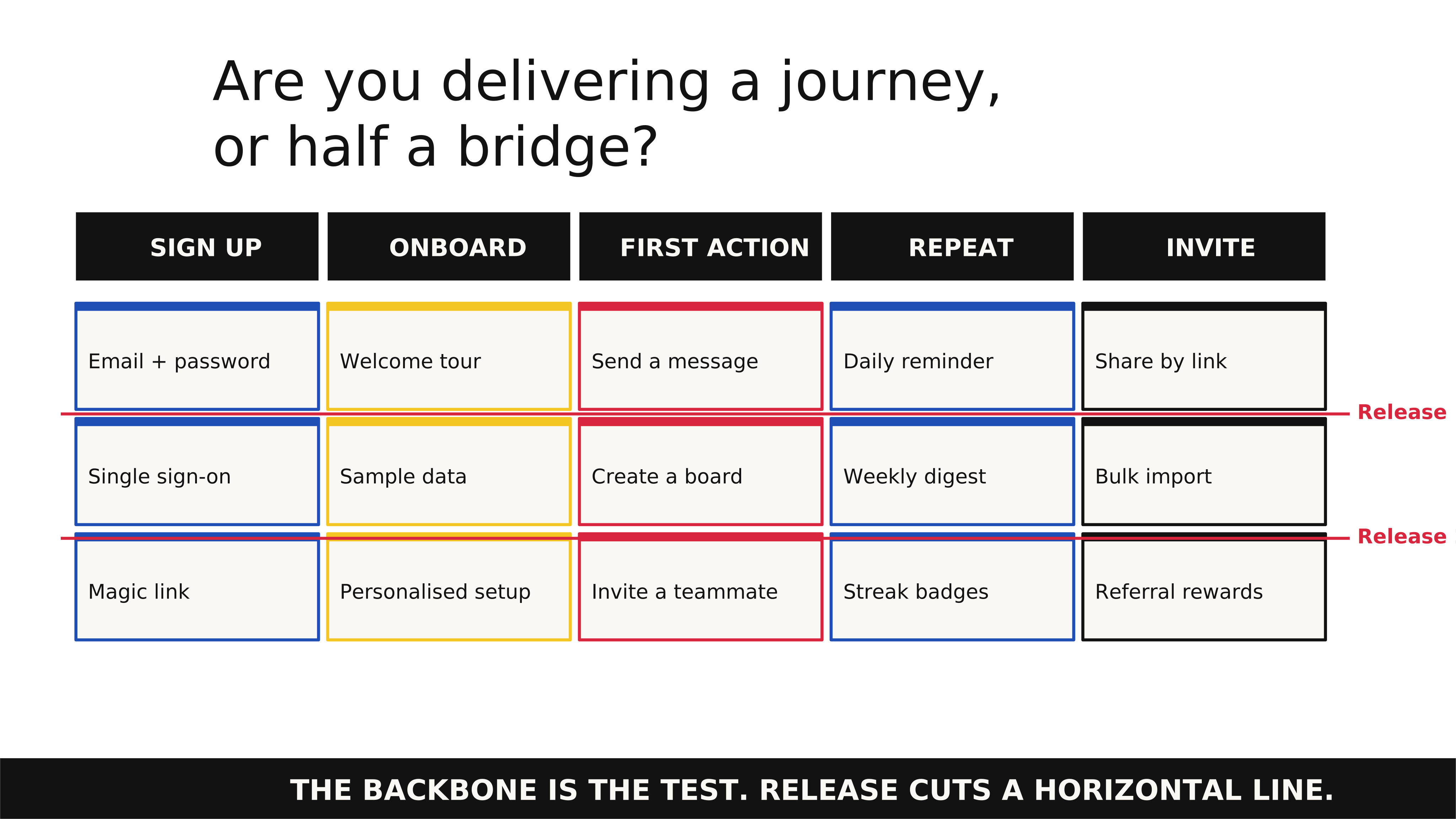
The format makes release slicing honest. Draw a horizontal line through the map and you can see instantly whether that cut delivers a coherent journey or a collection of disconnected fragments.
Use it when the backlog has ballooned past comprehension, or when you're about to define an MVP. It falls apart without underlying user research — the map is only as good as the journey it's built on — and it's wrong for pure infrastructure work that has no user-facing thread.
Your next move: Does the next release you're shipping actually let a user complete a whole journey — or are you proudly delivering half a bridge?
What it looked like for them
Mark Barwald, mass-customised jeans, early 2010s. Barwald's startup offered roughly twelve million jean configurations — leg shape, inseam, waist, wash, pocket style, every combination technically possible. The supply chain was built to fulfil them all.
When orders arrived, ninety per cent were the same handful of configurations: standard fits for tall women in dark washes. The customers didn't want infinite choice. They wanted one underserved option that existing retailers didn't stock.
The operational overhead of twelve million configurations was already baked in and couldn't be unwound. A user story map — laying out what real users actually want to do, in what order, and at what frequency — would have shown the concentration before a single pair shipped. The team had mapped what was possible to build. They hadn't mapped what anyone would actually order. The gap between those two maps was the entire cost of the business.
“The deadline moved and nobody told my team.”