
Vision Calibrating
“The practice of grounding ambitious vision in environmental reality through frameworks such as PESTLE.”
The strategy was written eighteen months ago. The world has moved. The team keeps executing against a vision whose foundations have quietly shifted — but nobody has gone back to test them.
Vision Calibrating is the practice of grounding ambitious vision in environmental reality. You use frameworks such as PESTLE (Political, Economic, Social, Technological, Legal, Environmental) to identify which elements of context are stable and which are fluid, then adjust strategy to account for real constraints rather than inherited assumptions.
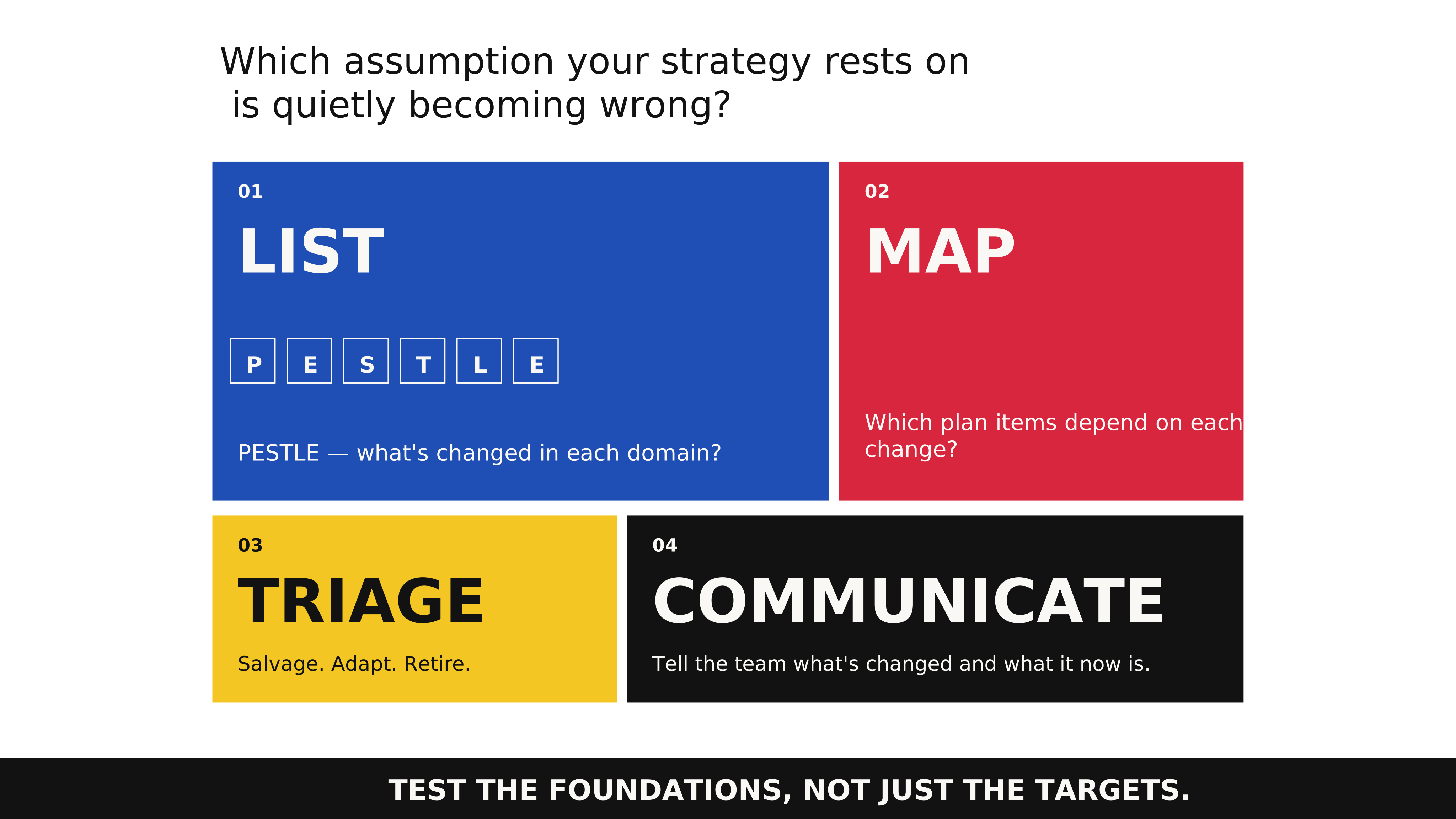
Its strength is the reality check that strategy documents don't perform on themselves. Ambitious visions that ignore constraints don't survive contact with reality; calibration keeps aspiration achievable without killing ambition.
Reach for it when delivery reality has diverged from strategy documents, when environmental shifts have made founding assumptions look fragile, or at regular intervals as part of strategic hygiene. It fails when the vision is already well grounded and the exercise becomes procedural, and it's the wrong tool for short-term tactical planning where environmental scanning adds overhead without insight.
Your next move: Which assumption your strategy rests on was true two years ago and is quietly becoming wrong — and when did you last check it, rather than reread the strategy doc?
What it looked like for them
Nirvanix, September 2013. Nirvanix had a compelling vision: enterprise-grade cloud storage at petabyte scale. The technology worked. The clients were real — large corporations storing serious data. Over seventy million dollars in funding said the market believed in it.
The vision was never calibrated to the financial reality underneath. The gap between what it cost to serve petabyte clients and what those clients would pay was wider than the funding could bridge, and nobody forced the calibration until the money ran out.
On 16 September 2013, Nirvanix announced it was shutting down and gave customers two weeks to migrate their data. Two weeks for petabyte workloads. The vision had been ambitious, credible, and wrong about the unit economics. Vision calibrating doesn't mean shrinking the ambition.
It means testing whether the economics beneath the ambition can support the weight. Nirvanix's vision was structurally sound. The foundation it was standing on wasn't. The calibration that would have caught this needed to happen before the funding ran out, not after.
“I'm behind and I have to decide what to drop.”