
Open Innovation
“Henry Chesbrough's paradigm recognises that useful knowledge is widely distributed.”
The R&D team is stuck on a problem they've been circling for months. Meanwhile, someone outside the organisation — a startup, a university lab, a former competitor — solved it last year. But nobody thought to look.
Open Innovation is Henry Chesbrough's framework for leveraging knowledge flows across organisational boundaries. You intentionally use inflows and outflows of ideas — through licensing, joint ventures, hackathons, innovation challenges, or corporate venture capital — to accelerate innovation beyond what internal R&D alone can produce.
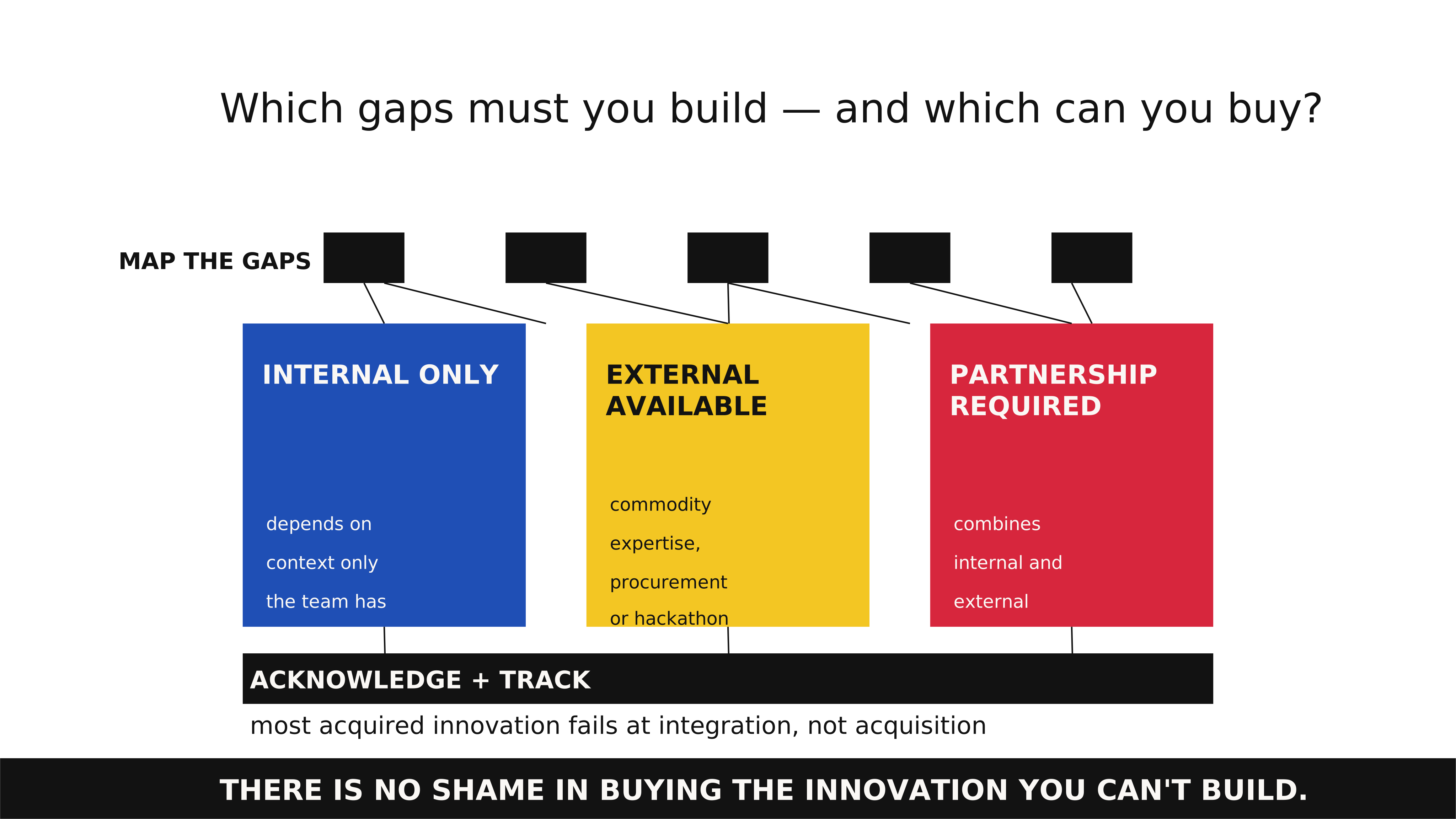
Its strength is defeating "Not Invented Here" syndrome with a structured alternative. The smartest people in your field almost certainly don't work for you; open innovation is how you work with them anyway. Reach for it when internal R&D has plateaued, when speed matters more than sole ownership, or when the organisation needs access to capabilities it can't build fast enough.
It requires absorptive capacity — the ability to recognise and apply external knowledge, not just acquire it. It fails without intellectual property protection, and it risks core competency if boundaries aren't managed. Organisations that can't integrate what they find externally just collect partnerships.
Your next move: Which expert outside your organisation would have solved your hardest current problem in a week — and what's stopping you from picking up the phone?
What it looked like for them
John Davis and Scott Pegau, InnoCentive / Oil Spill Recovery Institute, 2007. After the 1989 Exxon Valdez spill, oil mixed with seawater and froze into a viscous mass in recovery barges along the Alaskan coast. The Oil Spill Recovery Institute spent years trying to solve the separation problem internally.
Nothing worked. They posted the challenge on InnoCentive, an open innovation platform. John Davis — a chemist from the central United States with no oil industry experience — recognised the problem within hours. Frozen oil-water slurry behaves like uncured cement.
He proposed using modified pneumatic concrete vibrators, standard equipment in the construction industry, to keep the mixture fluid enough to pump. He won the twenty-thousand-dollar prize. Scott Pegau, OSRI's Research Programme Manager, was direct about the lesson: "We would never have found this through our regular RFP process."
The solution came from a domain — concrete construction — that no one inside the oil industry would have thought to consult. Open innovation works because the solver doesn't know what's supposed to be impossible.
“I'm behind and I have to decide what to drop.”