
Product Vision Board
“A single-page template constraining product vision to five elements.”
The team talks about "the vision" as if everyone agrees. But when you ask two people to describe it separately, the answers don't match. The misalignment has been there for months — nobody wanted to surface it.
The Product Vision Board is Roman Pichler's single-page template constraining product vision to five elements. You fill in Vision, Target Group, Needs, Product, and Business Goals — and the constraint is the mechanism. If the vision can't fit on one page, it isn't clear enough yet.
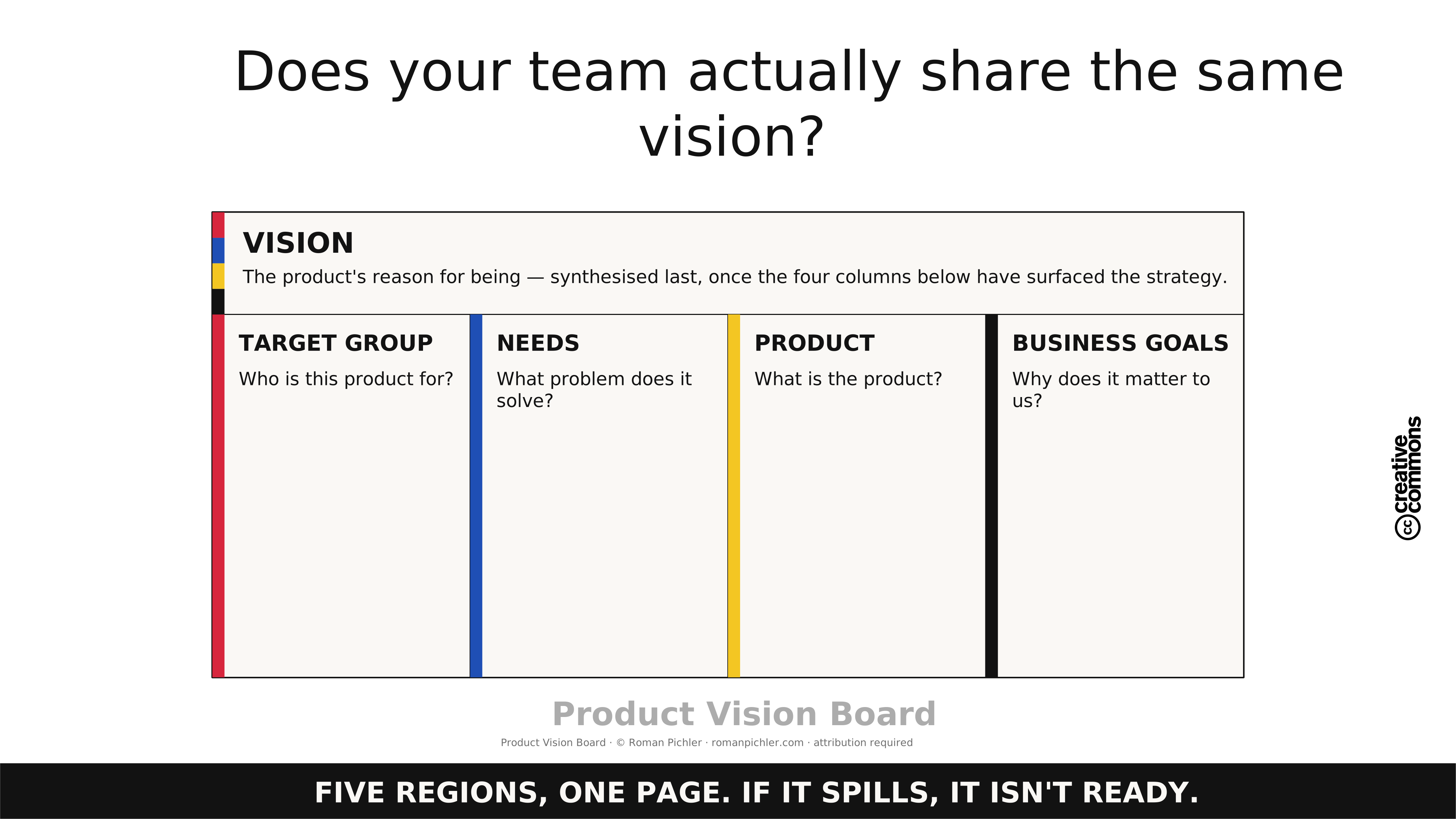
Its strength is the disagreements it surfaces. When a team fills in the board and discovers they don't share a vision, that's the finding — not the failure. Reach for it at product inception, when onboarding new team members who need the direction quickly, or when stakeholder alignment has drifted.
It fails when the problem space itself is still unclear — a crisp vision of the wrong problem is worse than no vision at all. And if the team fills it in without generating any disagreement, they've probably found comfort rather than clarity.
Your next move: If three people on your team filled in the vision board separately right now, how different would the five answers be — and which differences would you rather not discover?
What it looked like for them
Steve Jobs, Apple, 1997. The two-by-two grid Jobs drew on a whiteboard compressed everything Apple was supposed to be into four squares. Consumer desktop. Consumer portable. Professional desktop. Professional portable. That was the entire vision. A company with hundreds of products, thousands of employees, and an identity crisis that had been running for a decade — reduced to four words repeated twice. The compression was the work.
Every product vision board is an exercise in deciding what fits on a single page and what gets left off. Jobs didn't need the grid to tell him which products to build.
He needed it to make the vision simple enough that everyone in the room could hold it in their heads simultaneously, repeat it to their teams, and use it to make their own decisions without checking back. A vision that doesn't fit on one page isn't a vision yet. Jobs proved the point by fitting it on four squares.
“I'm behind and I have to decide what to drop.”