
Product Strategy Canvas
“Roman Pichler's template for connecting product vision to execution.”
Someone asks what the product strategy is. Three people give three different answers. The strategy document exists, but it's long enough that nobody has read it since it was written.
The Product Strategy Canvas is Roman Pichler's single-page template for connecting vision to execution. You fill in six sections — Vision, Target Group, Needs, Product, Business Goals, Standout Features — forcing the strategy into a format concise enough to challenge and clear enough to align around.
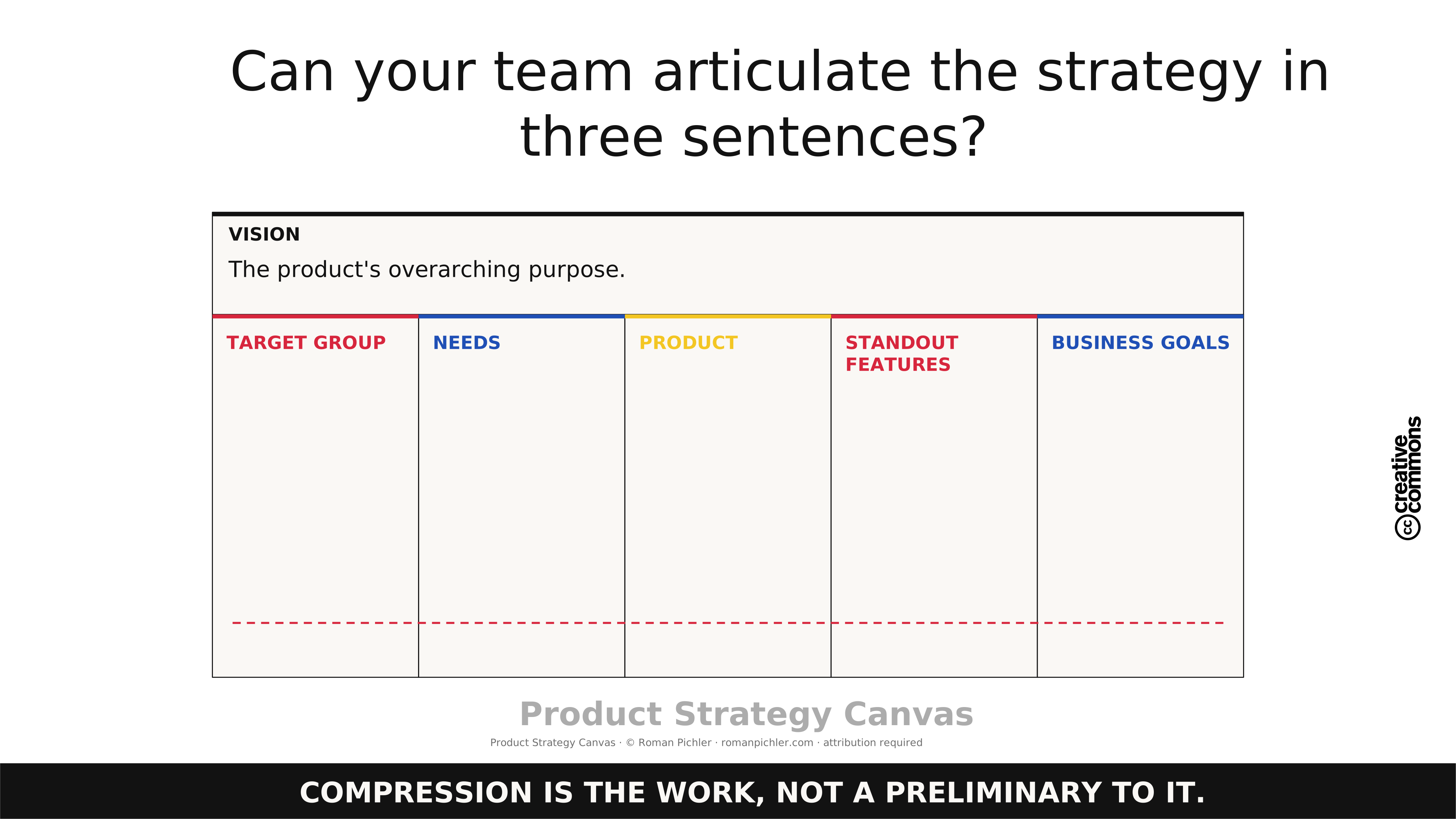
Its strength is compression. If strategy can't be articulated on one page, it probably isn't clear — the canvas makes woolly thinking structurally impossible to hide. Reach for it when the team needs alignment on strategic intent, when onboarding new people who need the big picture quickly, or when a strategy review has stalled in document-editing loops.
It fails without underlying market research to fill the boxes honestly, and it's the wrong tool for feature-level decisions where the strategic frame isn't in question. A canvas filled in by one person without challenge is a wish list, not a strategy.
Your next move: Could you describe your product strategy in three sentences to someone in the lift — and would they be able to repeat it back, or just nod politely?
What it looked like for them
Steve Jobs, Apple, 1997. When Jobs returned to a company weeks from insolvency, the product line had ballooned to hundreds of items — printers, PDAs, servers, monitors, half a dozen laptop variants nobody could tell apart. His two-by-two grid (consumer/pro, desktop/portable) didn't just cut products. It connected each surviving product to a specific user and a specific need in a single visual.
The grid was a product strategy canvas: it made visible which user segments Apple would serve, what it would build for each, and — critically — the empty space where it would not compete. The Macintosh Performa, the Newton, the QuickTake camera — all cancelled not because they were bad products, but because they couldn't find a square on the canvas.
The strategy's power wasn't in what it said yes to. It was in the clarity with which it said no, and in making that no visible enough that no one in the organisation could pretend it hadn't been said.
“I'm behind and I have to decide what to drop.”