
Lean Canvas
“Ash Maurya's adaptation of Business Model Canvas is optimised for startups and new ventures.”
You're planning a new product or venture. The business plan is growing but the confidence isn't. The team keeps adding detail to avoid confronting what they don't actually know.
Lean Canvas is Ash Maurya's adaptation of the Business Model Canvas, tuned for startups and new ventures. You fill a single page covering Problem, Solution, Key Metrics, Unfair Advantage, and five other blocks — documenting the riskiest assumptions rather than building a polished plan.
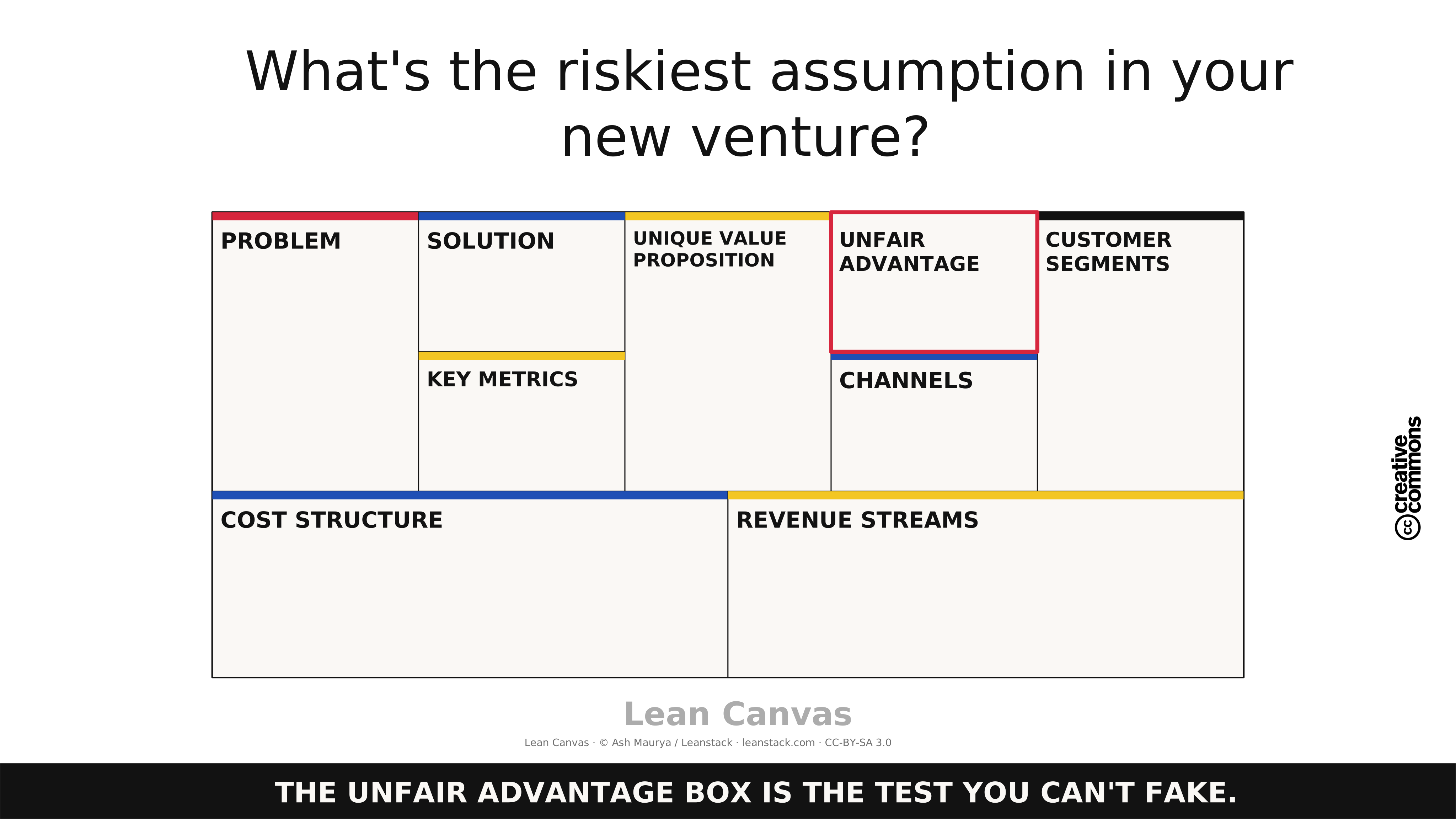
Its strength is honesty by design. The Unfair Advantage box stays stubbornly empty for most teams, which is itself the finding — genuine competitive advantages are rare, and the canvas won't let you pretend otherwise. Reach for it early, when a venture needs its assumptions surfaced, tested, and iterated rather than buried in a fifty-page document nobody revisits.
It works as a living artefact, updated as hypotheses are validated or killed. It fails for mature, established products where the assumptions have already been resolved, and it flatlines if the team fills it in once and files it away. A canvas that doesn't change isn't being used.
Your next move: What would you actually write in the Unfair Advantage box if you weren't allowed to leave it blank — and would anyone outside the room agree?
What it looked like for them
Steve Huffman and Alexis Ohanian, Reddit, 2005. Huffman and Ohanian walked into a meeting with Paul Graham at Y Combinator without a plan. Their original pitch — a mobile food-ordering app — had been rejected the day before.
Over the course of a single conversation, they invented Reddit: a front page of the internet where users submitted and voted on links. The plan didn't exist before the meeting started. The entire proposition was assembled live, under pressure, from the constraint of needing something simple enough to build in three weeks.
That constraint was the canvas. Every assumption had to be testable fast: would people submit links? Would they vote? Would enough of them return tomorrow?
The riskiest assumption — that anyone would post at all — was tested by Huffman and Ohanian themselves, creating fake accounts and seeding the site with content until real users arrived. The company that resulted is now worth billions. The lean canvas it was built on was a whiteboard in a single conversation.
“I'm behind and I have to decide what to drop.”