
Impact Mapping
“Gojko Adzic's technique connects deliverables to business goals through a four-level hierarchy: Why (goal), Who (actors), How (impacts on actor behaviour), and What (deliverables).”
The roadmap is full. Nobody can explain why half the items are there. When someone asks "but what's this for?", the answer involves hand-waving about a goal from two quarters ago.
Impact Mapping is Gojko Adzic's technique for connecting deliverables to business goals. You build a four-level hierarchy — Why (goal), Who (actors), How (impacts on behaviour), What (deliverables) — creating an explicit, testable chain from every piece of work back to the outcome it's supposed to produce.
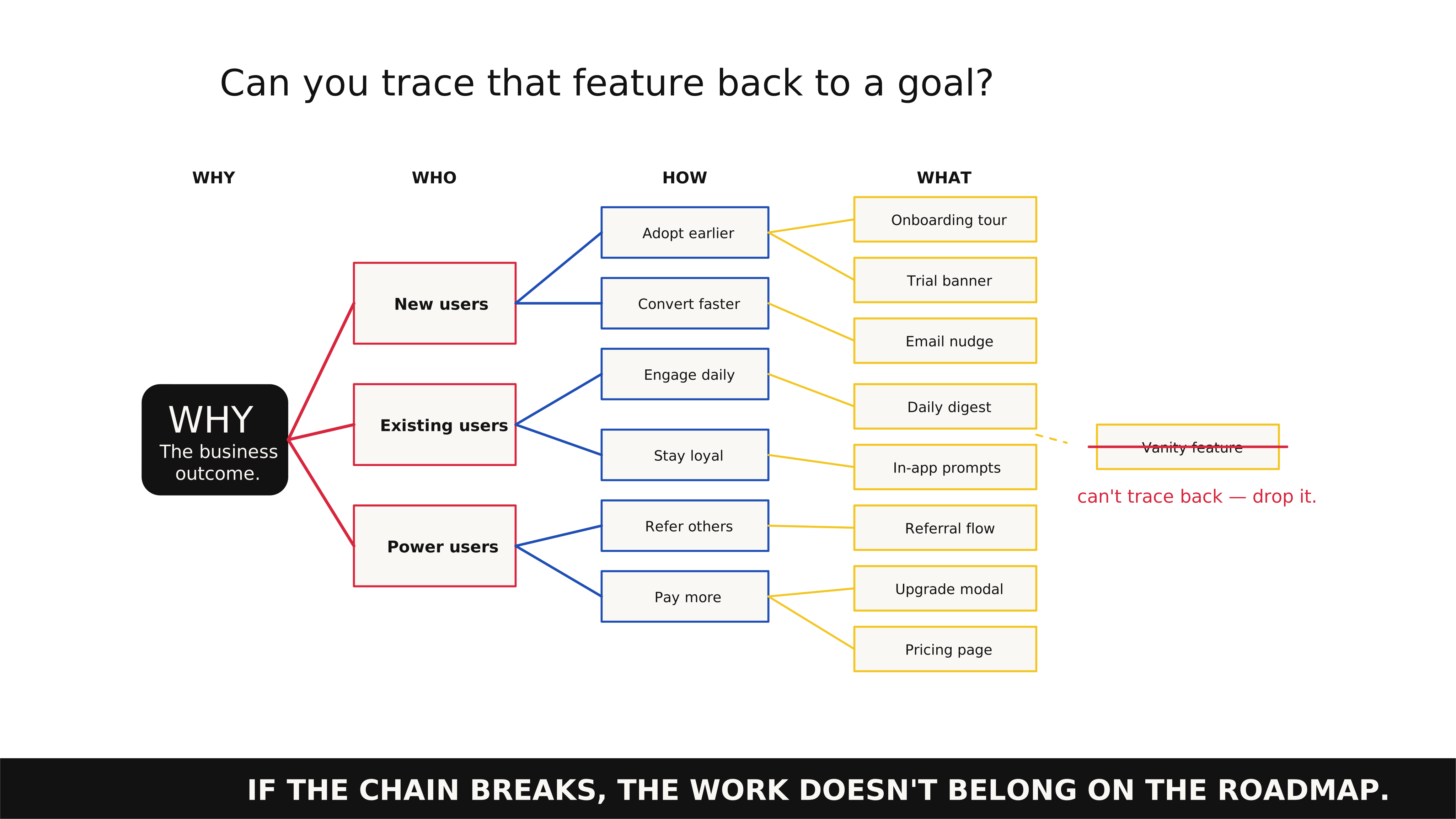
Its strength is making invisible assumption chains visible. When a deliverable can't be traced back through a behaviour change to a goal, you've found scope that exists through habit rather than intent. Reach for it when scope has crept unchallenged, when teams are busy but can't articulate what their work is supposed to change, or when a new goal needs a clear path to execution.
It fails without clear business goals to anchor the map — if the "Why" is vague, the hierarchy below it is fiction. And maps left unrevised become decoration; they need updating as assumptions are validated or disproved.
Your next move: Trace the deliverable on top of your roadmap back to the actor whose behaviour it's supposed to change — and if you can't, why is it on the roadmap?
What it looked like for them
Steve Jobs, Apple, 1997. Apple had hundreds of products, confused positioning, and was weeks from insolvency. Jobs returned, walked to a whiteboard, and drew a two-by-two grid: consumer versus professional on one axis, desktop versus portable on the other.
Four squares. Everything that didn't fit was cancelled — seventy per cent of the product line, gone. The grid wasn't a product strategy. It was an impact map: each square represented a specific user, a specific need, and a specific business goal.
Features that couldn't trace a line from what they delivered to one of those four intersections were cut, regardless of how far along they were. Engineers who'd spent years on the cancelled products were reassigned or let go. Apple returned to profit within a year. The map held for a decade. The impact wasn't in the products that survived. It was in the clarity the grid gave to the question: what are we trying to change for whom?
“I'm behind and I have to decide what to drop.”