
Blue Ocean Strategy
“W. Chan Kim and Renée Mauborgne's framework for creating uncontested market space rather than competing in crowded 'red oceans'.”
You've benchmarked every rival. You've squeezed every margin. The team keeps fighting for share in a market where the rules reward everyone equally badly.
Blue Ocean Strategy is W. Chan Kim and Renee Mauborgne's framework for creating uncontested market space. You map competitive factors on a Strategy Canvas, then use the Four Actions Framework — eliminate, reduce, raise, create — to reconstruct buyer value in a way that sidesteps the existing contest entirely.
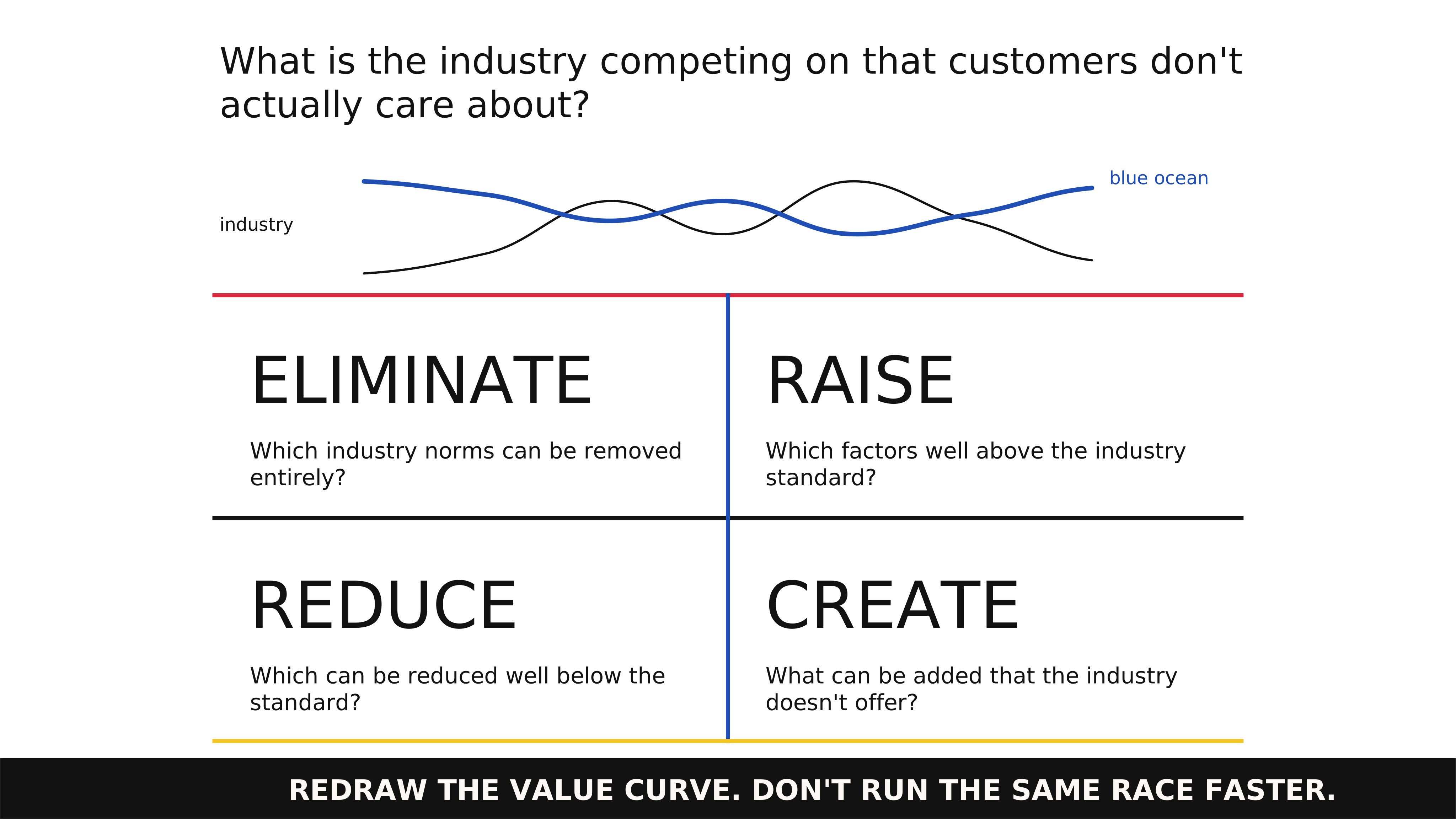
Its unique strength is forcing the question competitors won't ask: which factors the industry competes on that customers don't actually care about. Reach for it when incremental improvement has stalled and the only remaining move is to redefine the playing field — new value curves, not better ones.
It fails when the team treats it as a brainstorming exercise rather than a disciplined analytical process, or when there's no strategic mandate to act on what the canvas reveals. A strong existing market position makes the effort unnecessary; a weak mandate makes it theatrical.
Your next move: Which competitor are you about to spend the next meeting trying to beat — and what would it take to stop playing their game entirely?
What it looked like for them
Jensen Huang, NVIDIA, 2012 onwards. In the early 2010s, NVIDIA was a graphics chip company fighting AMD on performance benchmarks, driver quality, and price — the same axes every competitor had been fighting on for a decade.
Every option looked like a more expensive version of the same contest. Huang's move was to stop competing. He redirected engineering resources toward GPU-accelerated computing for artificial intelligence, a market that barely existed.
The bet looked eccentric: AI researchers were a tiny customer base, the revenue was negligible, and Wall Street wanted gaming chips. Huang held the line.
By 2023, NVIDIA's data-centre revenue had overtaken gaming, the company's market capitalisation had passed a trillion dollars, and the competitors who'd stayed in the graphics race were fighting over a market that no longer defined NVIDIA's trajectory. The blue ocean wasn't found by analysing the existing map. It was found by noticing a market nobody else thought was a market yet.
“I'm behind and I have to decide what to drop.”