
Cost of Delay
“A framework quantifying the economic impact of time on feature value, developed by Donald Reinertsen and popularised by Joshua Arnold.”
You're arguing about which feature goes next. Everyone has an opinion. Nobody has a number.
Cost of Delay is Donald Reinertsen's technique for quantifying the economic impact of time on feature value. You ask one question — what does it cost us each week we don't have this? — and let the answer sequence your backlog.
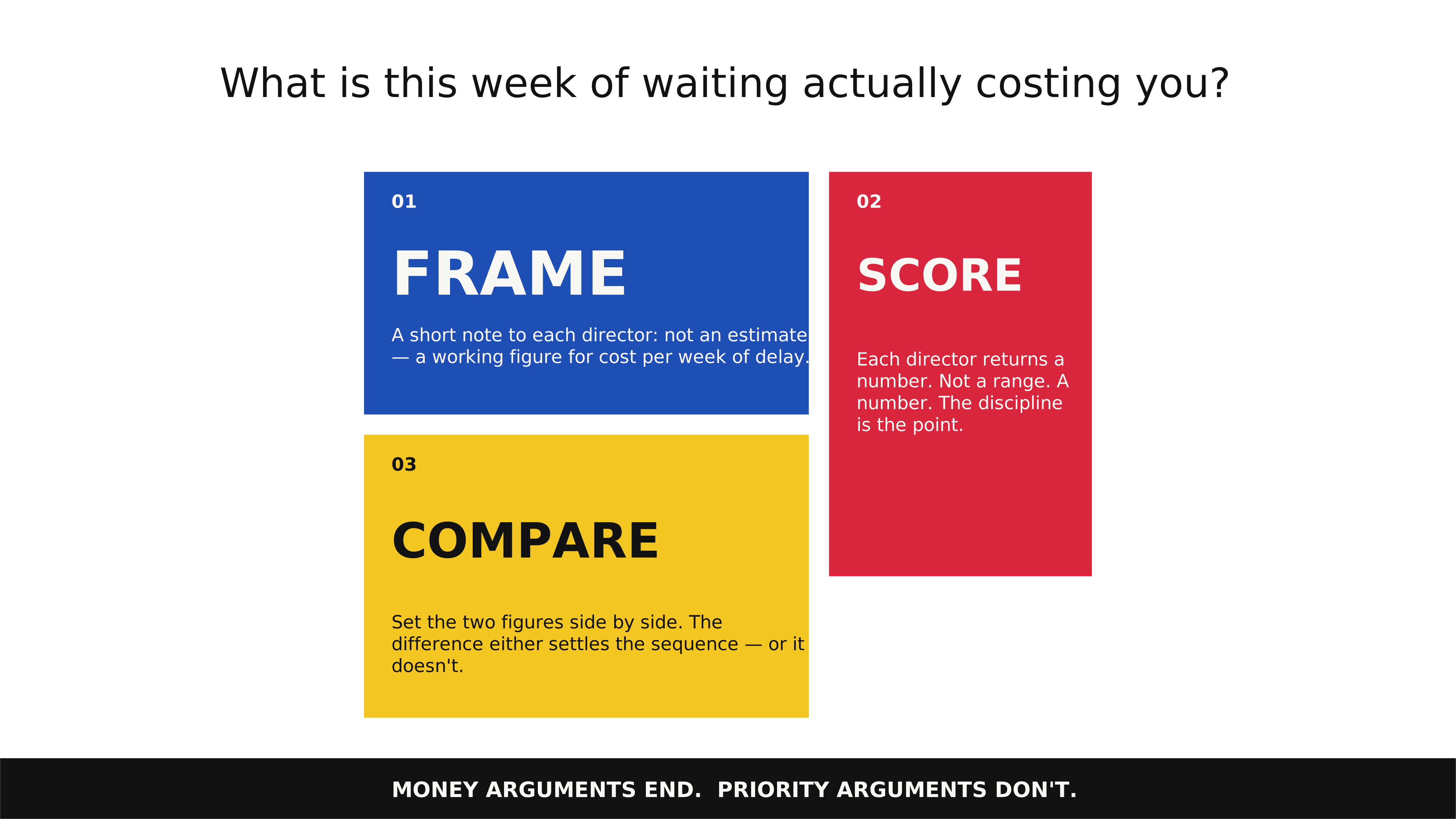
It kills subjective priority debates. Different features have different delay profiles: some decay steadily, others hit a cliff at a deadline, and some lose all value overnight. Once you've mapped those profiles, sequencing becomes arithmetic rather than politics — particularly when combined with Weighted Shortest Job First (WSJF).
The technique demands real financial data, which is both its power and its constraint. Without credible numbers, the exercise produces false precision that's worse than gut feel. It also flattens out when every item has similar time sensitivity — if nothing's urgent, the model has nothing to differentiate.
Your next move: What's the weekly cost of the decision your team has been quietly deferring for a month — and would anyone in the meeting be willing to say it out loud?
What it looked like for them
Monitor110, 2005–2008. Monitor110 had two competing visions from day one. The technology team wanted to build a real-time natural language processing engine for the entire public web. The business team wanted a curated intelligence product — a Bloomberg terminal for web content.
Because the company had raised money easily, nobody was forced to choose. Both visions ran in parallel for three years, each consuming cash, neither delivering a product the market could evaluate.
The post-mortem names the refusal to decide as the single cause of death. Every week the choice was deferred, the cost compounded — engineers building for two roadmaps instead of one, salespeople pitching a product that didn't quite exist, customers waiting for something coherent that never arrived. The founders could have calculated the cost of running both visions simultaneously. They chose not to. The company died of the delay they wouldn't price.
“The dashboard says we're fine but I don't believe it.”