

How to run a team meeting that decides something: everyone writes first
Ask everyone to write their answer before anyone speaks. Then start with the questions the team rates highest, and write the decision down.
The short version
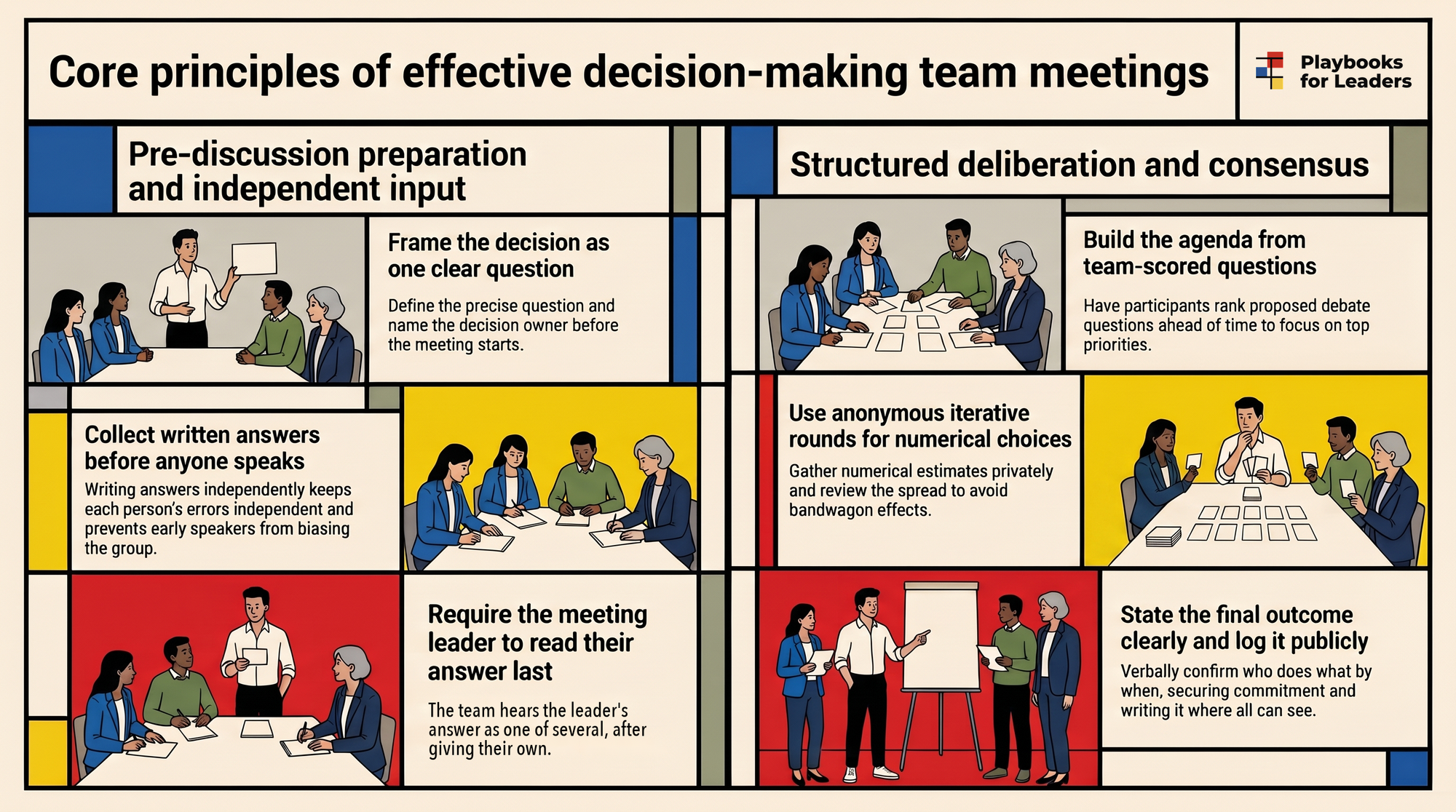
- Before the meeting, write the decision as one question, and say who makes the call.
- Ask everyone to write their answer before anyone speaks, and read yours out last.
- Let the team score the questions beforehand, and start with the ones it rates highest.
- If the decision is a number, show the team the spread, hear from the people at each end, then ask again.
- Before anyone leaves, say the decision out loud, then write it where the team works.
Contents
- Why does a team agree with the first person to speak?
- What went wrong in the Columbia mission meeting?
- What do you settle before the meeting starts?
- How do you hear every answer before the discussion starts?
- How do you choose what the team talks about first?
- How does a team settle a number?
- How do you close a meeting so people keep to the decision?
You call the team together to decide something. An hour later you leave with no decision, or with everyone agreeing with whoever spoke first. This post is about that hour: how to hear each person's own answer before the team settles on one, and how to leave with the decision written down. If the same argument comes back every week, start with the Same meeting again Playbook instead.
Why does a team agree with the first person to speak?
Daniel Kahneman, the psychologist who won the Nobel prize in economics in 2002, gave the reason in Thinking, Fast and Slow: "The standard practice of open discussion gives too much weight to the opinions of those who speak early and assertively, causing others to line up behind them."
Solomon Asch, a psychologist at Swarthmore College, measured it. In his experiments, published in 1956, college students said out loud which of three lines matched a fourth, after a planted majority had all given the same wrong answer. In one version, 14 students wrote their answers down while the majority still spoke. They made about a third as many errors as the 123 students who answered aloud, and none of them followed the majority when its answer was furthest from the truth.
Asch warned that 14 students were too few to prove the difference. His students were strangers judging lines, not a team with its boss in the room, and reading his result across to your meeting is our step.
What went wrong in the Columbia mission meeting?
On 24 January 2003, eight days into the space shuttle Columbia's last flight, Linda Ham chaired NASA's Mission Management Team. Don McCormack, the Mission Evaluation Room manager, summarised the engineers' analysis of the foam that had hit the left wing at launch. The Columbia Accident Investigation Board found that nobody asked for the analysis behind his summary, and nobody asked a technical question.
Ham restated his answer for the room: no safety-of-flight issue, only repairs to make before the next flight. People on the teleconference said they couldn't hear the tile expert, so she told them what he'd said, then closed the item: "That's it? Alright, any questions on that?" She signed minutes that didn't mention the foam strike.
Two days earlier, Rodney Rocha, NASA's chief engineer for the shuttle's thermal protection system, wrote an email calling the decision not to ask for pictures of the wing "the wrong (and bordering on irresponsible) answer". He printed it, showed it to a colleague and never sent it. Asked later why he hadn't sent it, he said he didn't want to jump the chain of command. Columbia broke up on re-entry on 1 February 2003, and all seven crew died.
Nearly six months after the accident, Ham told reporters that she learned only afterwards that some of the engineers who wanted the pictures had sat in her meetings and never spoken up. "We were all trying to do the right thing," she said. In her meeting the chair gave the answer first and asked for questions after it.
What do you settle before the meeting starts?
The question, and who answers it. Write the decision as one question the team can answer in a sentence, such as which supplier to use.
Then say who makes the call. In the Decision today Playbook our next move is to name who owns the decision before the meeting starts, not after. In the Playbook we suggest RAPID, which names who recommends, who gives input, who agrees, who carries the decision out and who decides.
How do you hear every answer before the discussion starts?
Ask for each answer in writing, before anyone talks. Kahneman's rule, in the same passage: "before an issue is discussed, all members of the committee should be asked to write a very brief summary of their position."
In the meeting:
- Put the question up and give everyone two minutes, in silence, to write their answer and one reason.
- Go round the table and have each person read theirs out. Read yours last.
- Open the discussion where the answers differ.
With fourteen people in the room, in the 14-person meeting Playbook we use 1-2-4-All for the same job: everyone thinks alone, then in pairs, then in fours, then the room shares.
Taiwan's civic hackers ran a version of this for a whole country. In 2015 they built vTaiwan, a platform for discussing proposed laws. When Uber's arrival set taxi drivers against the company, vTaiwan put the question on a tool called Pol.is, where people posted statements and voted on each other's but couldn't reply to them. Audrey Tang, then Taiwan's digital minister, told MIT Technology Review in 2018: "If people can propose their ideas and comments but they cannot reply to each other, then it drastically reduces the motivation for trolls to troll."
The voters first split into a pro-Uber group and an anti-Uber group about twice its size. Then both groups backed statements on rider safety and insurance, until seven statements had almost everyone's support. Tang took those seven into face-to-face talks with Uber, the taxi drivers and experts, and the government adopted rules along the lines vTaiwan had produced.
How do you choose what the team talks about first?
Let the team score the questions before it meets. Brad Jacobs, the founder of XPO and now chairman and chief executive of QXO, described his monthly operating reviews to David Senra on Senra's podcast in October 2025. Everyone reads the papers beforehand, then sends in their main takeaways and the questions they think the whole group should spend its time on. Everyone rates every question from 1 to 10, in an app. The questions rated 8 to 10 are the agenda.
The one he described ran for ten hours, with 25 people. The agenda the group scored, he told Senra, was "much better than I could come up with."
For an hour with your team:
- Send the paper ahead.
- Ask each person for their one question.
- Have everyone score all the questions.
- Start the meeting at the top of the list.
How does a team settle a number?
In rounds. The RAND Corporation built the Delphi method for the US Air Force, in a study that began in the early 1950s. Its first question was how many atomic bombs it would take to cut American munitions output by a set amount. Harold Linstone and Murray Turoff, who edited a book on the method in 1975, quote its aim: to reach the experts' consensus "by a series of intensive questionnaires interspersed with controlled opinion feedback." One reason they give for using it is to stop the group being dominated "by quantity or by strength of personality".
For a launch date, a budget or a headcount:
- Before the meeting, have each person send their number and one line of reasoning to someone who isn't you.
- Show the team the spread, without names, and ask the people at each end for their reasons.
- Have everyone write a number again. Take the middle of the second round, or run a third round if the numbers are still far apart.
Use Delphi for a number. For a choice between two courses of action, use the written round above.
How do you close a meeting so people keep to the decision?
Say the decision out loud before anyone leaves, with who does what by when. Then ask the person who argued hardest against it whether they can live with it. In the Decision today Playbook we use Consensus Building to bring the objectors to "I can live with this", not to "I agree".
Then write the decision down where the team works, the same day. Anyone who relied on the Columbia minutes never read about the foam strike. In our post on handling conflict at work we put it this way: nobody can keep to a decision they can't find again.
When a team meeting is part of a bigger situation
If what you find fits one of these situations, the Playbook for it starts there.
| What you find | Playbook |
|---|---|
| You need a decision today and the team can't agree | Decision today |
| Fourteen people are coming and there's no clear outcome | 14-person meeting |
| The room has gone quiet and you don't know what to ask next | Room's gone quiet |
| The team keeps having the same meeting and never decides | Same meeting again |
| Someone senior is going to try to take over the meeting | Hijacked meeting |
| The meeting is going to be a fight | Hostile meeting |
FAQ
What if the team still can't agree?
Set a default. In the Decision today Playbook, Play A is to tell the team you'll go ahead with one option at five o'clock unless they come back before then with an alternative they all agree on. If the indecision is really a way of handing the call back to you, Play B is to say you'll bring in an outside consultant to make it.
Does the boss have to stay quiet?
No. Write your answer down with everyone else and read it out last. That way the team hears your answer as one of several, after they've given their own.
How do you know the meeting decided something?
Someone who wasn't there can read what was decided, who does what and by when. If they can't, the team talked about the decision and didn't make it.
Sources on team meetings
- Thinking, Fast and Slow by Daniel Kahneman. It's our source for asking everyone to write down their position before a meeting discusses it. If you want the book itself, buy it from Bookshop.org or Amazon.
- How to Make a Few Billion Dollars by Brad Jacobs. It's his own account of how he runs his companies, including the meetings whose agenda the team scores. We quote his interview with David Senra, not the book. If you want the book itself, buy it from Bookshop.org or Amazon.
Some book links on this page are affiliate links. If you buy through one, we earn a small commission.