

An example of handling conflict at work: two people, one deliverable
Two people claim the same piece of work. What to say to each of them, and how to make the decision stick.
The short version
- Send the two people to settle it with each other before you step in.
- If they can't, hear each account once, alone, and carry nothing between the rooms.
- Meet them together, and say at the start that you'll make the call if they can't agree.
- Name one owner and one interface, and write the decision down the same day.
- Check in at day 7 and day 14, and change the structure if the agreement doesn't hold.
Contents
- What does a real example of handling conflict at work look like?
- How do you tell an ownership fight from a skills gap?
- What do you say to each person first?
- How do you run the joint meeting?
- How do you make the ownership decision?
- What happens in the two weeks after the decision?
- What if the first fix fails?
Here's one conflict at work, from the first sign to the fix, with the words to say at each step. If you want the general approach first, in the Open team conflict Playbook we set out two ways to end a fight between two of your people. Then come back for the script.
What does a real example of handling conflict at work look like?
Say two people on your team, Priya and Tom, both claim the same client report. Priya scoped it. Tom runs the client relationship. Both have a case. The report is due on Friday, and the client has asked who to talk to.
Nobody is shouting. Priya and Tom are each doing the same work, quietly, and copying you into emails that are a little too polite. You inherited the team four months ago, and this is the first fight that has reached your desk.
How do you tell an ownership fight from a skills gap?
A skills gap looks like one person struggling. An ownership fight looks like two capable people circling the same piece of work. The plainest sign is work done twice: Priya rewrites the plan Tom drafted, because neither is sure the other owns it. The opposite sign means the same thing: the report sits untouched in a shared folder, because each assumed the other was driving.
Listen to the tone as well as the tasks. If the two of them give shorter answers to each other at the stand-up, or one name starts dropping out of the updates, the fight has already started.
Before you act, ask three questions. Has a deadline slipped? Have they tried once to settle it between them? Can the rest of the team see it? If two answers are yes, step in this week. If none is, give them three days, then ask how it went.
What do you say to each person first?
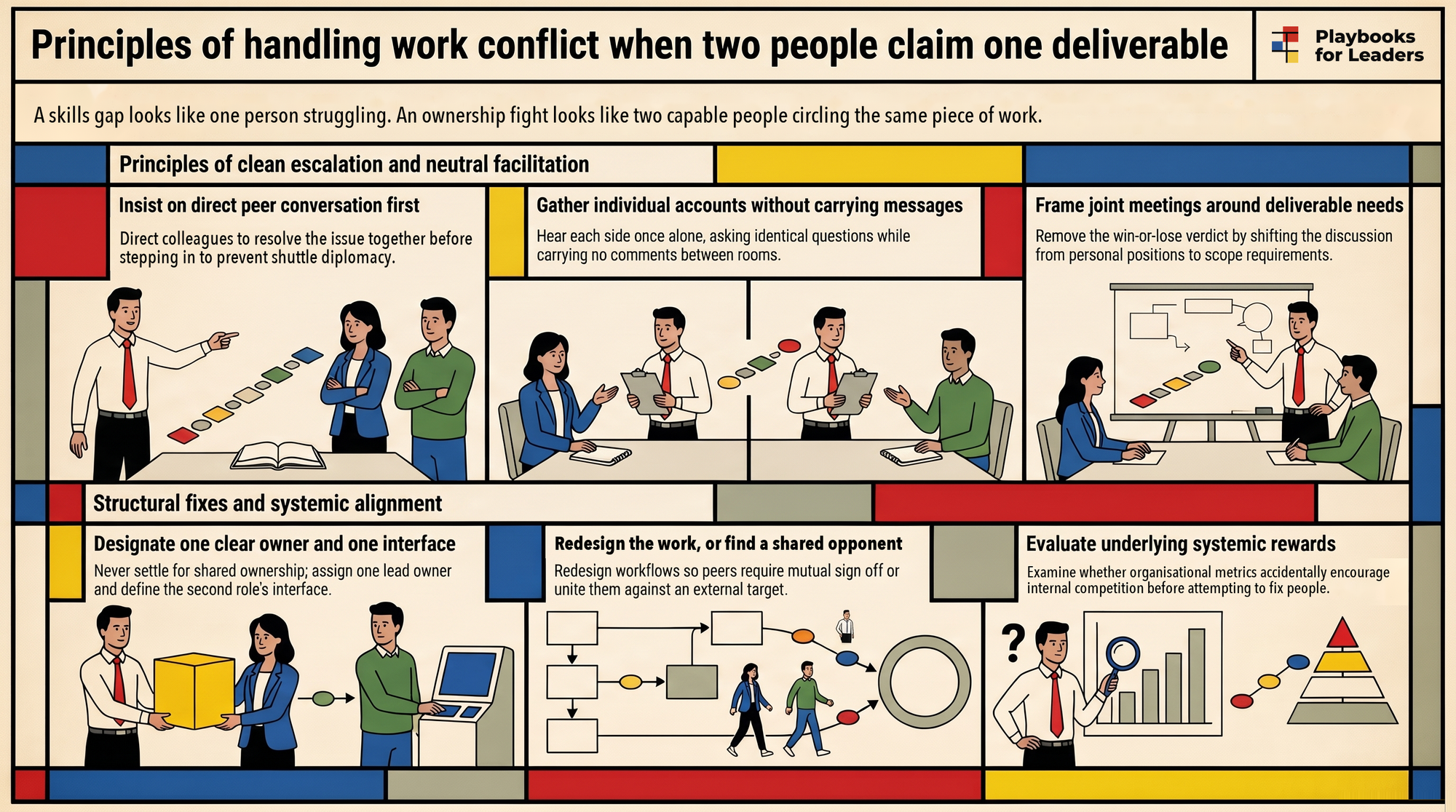
Send them to each other. Kim Scott, who later wrote Radical Candor, tried to settle a dispute between two of her reports by carrying each one's side to the other. She told First Round Review: "By trying to play shuttle diplomacy, I created exactly the kind of toxic political environment that I was trying to avoid." In hindsight, she would have insisted that the two talk to each other directly first, and stepped in herself only with both of them present.
So start with one sentence to each: "You and Tom both think you own the client report. Sort it out between you by Wednesday, and tell me what you agreed."
If Wednesday comes and they haven't agreed, hear each account once, alone, before the joint meeting. Open with the situation, not a charge: "I want to understand how you see the client report. Walk me through it from your side." Then ask both of them the same three questions:
- "When did you start treating the report as yours?"
- "What happens to the report if the other person owns it?"
- "What have you already tried, between the two of you?"
Listen hardest to the answer to the second question. It shows whether the fight is about credit or about workload, or about something older than the report.
Carry nothing from one room to the other. Don't say "I've heard both sides" until you have. Don't tell either of them to be a team player, because they'll hear it as a verdict. And don't promise to keep a secret you might have to repeat in the joint meeting.
How do you run the joint meeting?
Remove the verdict before anything else. Say: "Thanks, both. I'm not asking you to argue your case today. I'm asking you to help me work out what the client report needs. If we can't agree, I'll make the call, so neither of you has to win it here."
Say the last sentence even if it feels obvious. While both of them think the meeting decides who wins, everything they say is a closing argument.
Then turn the ownership question into a scope question. Write "What does the report need?" at the top of the whiteboard, and ask them to list the work in it: the analysis, the writing, the client calls and the sign-off. Then ask which parts need one owner and which could be shared. Chances are only one or two parts are really in dispute.
On the Conflict resolution tool page we call this separating positions from interests. A position is what someone says they want. An interest is the need behind it.
Roger Fisher and William Ury explain the difference in Getting to Yes with a story they credit to Mary Parker Follett. Two men in a library quarrelled over a window. One wanted it open and the other wanted it shut. They argued over how wide to open it, and found no width that suited both. The librarian asked each of them why. One wanted fresh air, and the other wanted to keep out the draught. She opened a window in the next room.
Priya's position is "I own the report". Her interest may be that the client gets the scope she wrote. Tom's may be that the client hears one voice. One report can meet both.
If the room goes quiet, the fight may be about credit, not the work. Say so: "I'm hearing that who gets the credit matters here as much as who does the work. Let's settle both."
If they agree a split within twenty minutes, let them propose it and confirm it yourself. If they're still trading positions, make the call.
How do you make the ownership decision?
Pick the person whose role will own the work after this project, not the one who argued harder. If both roles will keep working on it, split it: one person owns the report, and the other owns the interface into their part of the work. Don't settle for shared ownership. The fight comes back at the next deadline, because nobody knows who decides.
Tell the two of them first, together:
"Priya owns the report. Tom owns the client conversation about it. If the scope moves, Priya decides what slips, and tells Tom and me the same day."
Then tell the team within a day, and write the decision in one paragraph where the team works: the owner, the interface and the date of the decision. Nobody can keep to a decision they can't find again.
If you're tempted to put the decision off, start with the Decision today Playbook.
What happens in the two weeks after the decision?
Book 15 minutes with each of them at day 7, and 15 minutes with both at day 14. Keep both, even if things look calm.
At day 7, ask each of them the same three questions:
- "What's working about the split?"
- "Where are you still going round each other?"
- "What would you change?"
At day 14, ask the two of them one question: "What's the last thing you handed to each other, and how did it go?"
From the answers you'll know whether the fix is real. A real fix sounds like a small complaint raised without prompting, and handovers that happen without you. A performed one sounds like silence, or praise with no detail in it. If at day 14 you see only the performance, treat the first fix as failed.
What if the first fix fails?
You'll see the old pattern again. Both names appear on the same task in two status reports. The two of them stop talking and start using you as the go-between. Or one of them asks to "just own the whole thing". Any one of these means they complied with the agreement without accepting it.
Meet each of them once, briefly: "We agreed the split last Tuesday, and it isn't holding. I need to know what's in the way before Thursday." Then meet them together, and say: "The arrangement isn't working. I'm changing the structure, not reopening the agreement."
In the Open team conflict Playbook we give two structures. Which one you need depends on what's driving the fight:
- If the fight is between the two of them, a clash that has built its own momentum, make them need each other. Redesign the work so that neither can finish without the other's sign-off.
- If they're fighting because there's nothing bigger to push against, give them a shared opponent: a joint task that needs both of them to meet a client's deadline or defend the team's case to another department.
The second structure comes from the Robbers Cave study. In 1954 Muzafer Sherif and his colleagues sent two groups of 11-year-old boys camping in an Oklahoma state park. Competitive games between the groups led to open fighting. Then the staff set up urgent problems, such as a fault in the water supply, that only the two groups together could fix, and the groups made peace.
Before you change the people, check what the system rewards. On 13 November 2013 Lisa Brummel, Microsoft's head of human resources, ended stack ranking. The review system had made managers rate a fixed share of their staff as poor performers, so colleagues competed with the person at the next desk. If your targets reward Priya and Tom for the same client's work, the fight will come back whoever owns this report.
When the conflict is part of a bigger situation
If what you find fits one of these situations, the Playbook for it starts there.
| What you find | Playbook |
|---|---|
| Two of your people are in open conflict and you've been pulled in | Open team conflict |
| Two directors want different things from you, and you have to pick | Competing directors |
| The fight is really about scope that keeps moving | Scope keeps moving |
| The conflict came with a team you've just inherited | Inherited team |
| The argument has broken out in a meeting | Hostile meeting |
FAQ
What is an example of conflict resolution between two coworkers?
Two people claim the same piece of work. Their leader sends them to settle it between them first. When that fails, the leader hears each account once, then holds one joint meeting that turns the fight about ownership into a question about scope. One person owns the work, and the other owns the interface into their part of it. The leader writes the decision down, and checks in twice over the next fortnight to see whether the split holds.
Should a leader step in straight away or wait?
Ask yourself the three questions under telling an ownership fight from a skills gap. If two answers are yes, step in this week. If none is, give them three days, then ask how it went.
How do you stay neutral between two people in a dispute?
Don't carry messages between them. Hear each account once, with the same three questions, and say nothing to one about what the other said. In the joint meeting, say at the start that you'll make the call if they can't agree, so neither of them has to win the meeting.
What if one of them refuses to accept the decision?
Talk to that person alone first: "I've made the call. What would you need to make it work?" If they still refuse, treat it as a matter of conduct, not of conflict, and start with the Difficult feedback Playbook. Our post on difficult conversations at work has the opening lines.
Sources on handling conflict
- Radical Candor by Kim Scott. It's her book on honest feedback for bosses. Her account of acting as go-between for two reports, quoted above, comes from her interview with First Round Review. If you want the book itself, buy it from Bookshop.org or Amazon.
- Getting to Yes by Roger Fisher and William Ury. It's our source for the story of the librarian and the window, on page 42 of the 2011 edition. If you want the book itself, buy it from Bookshop.org or Amazon.
Some book links on this page are affiliate links. If you buy through one, we earn a small commission.