

How to improve executive presence: what people see you do
Executive presence is a few things people see you do. How to score them in your last meeting, and what to say when someone senior challenges you.
The short version
- Score your last hard meeting against six questions, within a day of it.
- Give your answer in your first sentence, then the reason and what you need.
- When someone senior challenges you, pause for one breath, then answer the strongest version of the challenge.
- When you don't know, say so, and give the date you will.
- Make small promises with dates on them, and keep them early.
Contents
- What is executive presence, in things people can see?
- How do you score your own presence?
- How do you open when you speak?
- What do you do when someone senior challenges you?
- How do you build credibility with a new team or a slipping project?
- How do you rehearse before a hard meeting?
- How do you know your presence is improving?
Executive presence sounds like something you're born with. In the room it comes down to a few things people watch you do, and you can practise each of them before your next meeting. Here they are, with a way to score yourself and the words to use when a meeting gets difficult.
What is executive presence, in things people can see?
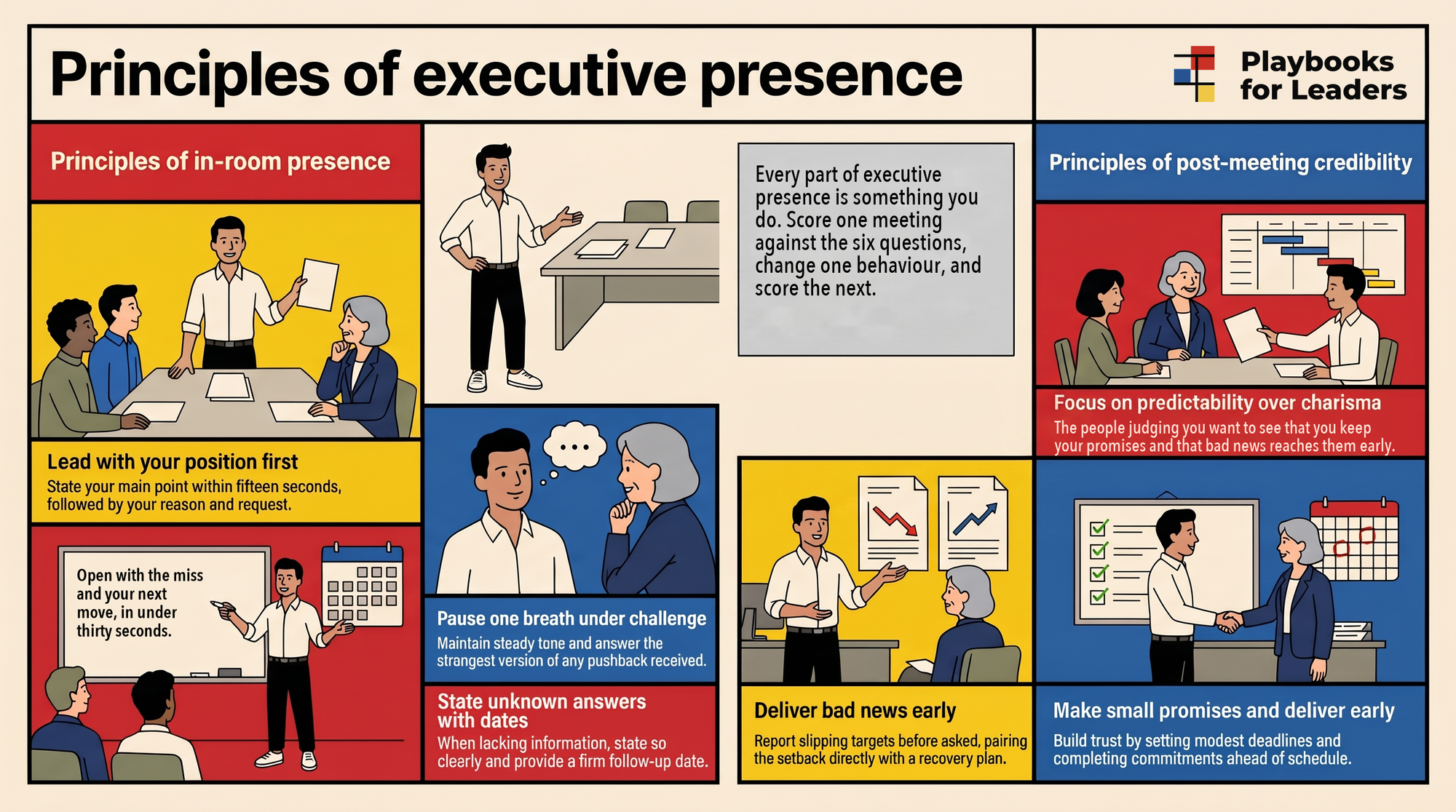
People judge it on three things, and none of them is charisma. The first is how you speak: you give your position in a sentence or two, then stop, and you answer the question you were asked, not the one you rehearsed. The second is how you take a challenge: your pace and volume stay the same, and you say what the disagreement is instead of defending yourself. The third is what happens after the meeting: people do what you said without you chasing them.
The third is the easiest to miss, because nobody sees it in the room. People see it in the week after the meeting.
How do you score your own presence?
Pick the hardest meeting on last week's calendar. Within a day of it, answer these six questions in writing:
- Did I give my position in the first two minutes, or build up to it?
- When I was challenged, did I ask a question first or start defending?
- Did I say what I was trading away, or only what I planned?
- Did I talk about this situation's specifics, or in generalities?
- When I didn't know something, did I say so and give a date to follow up?
- After I spoke, did the discussion move on to the decision, or go round again?
Score each 0, 1 or 2, and write down the moment that earned the score. A score from memory of how it felt doesn't count. If one answer scores 0, find out why before you fix anything else. On our Five whys tool page we set out how.
Then ask one colleague who was there a single question: "In that meeting, what did I do when someone pushed back?" You get an answer you can act on, and you can ask it again next month.
How do you open when you speak?
Give the answer first. The US Army has made this a rule for its writing. Its regulation on correspondence, Army Regulation 25-50, lists "putting the main point at the beginning of the correspondence (bottom line up front)" as one of two essential requirements, with the active voice as the other. The rule is for writing, and we'd use it out loud too.
Before each meeting this week, write your one-sentence answer at the top of your notes. Say it in your first fifteen seconds, then why it's right, then what you need from the room. If your answer is that you don't know yet, say that first, and say when you will.
When a project is slipping, open with the miss and your next move, in under thirty seconds: "We're two weeks late. The client changed the scope twice. The new date is the 14th, and I need your decision on the second change by Friday."
Then cut "just" and "I think" from your answers. Each one tells the room you won't defend what comes next. If you're worried about sounding blunt, keep the claim and add an invitation: "That's my recommendation. Tell me where it's weakest."
What do you do when someone senior challenges you?
Breathe once, then say what's happening: "That's a fair challenge on the timeline." Then answer the strongest version of the question, not the rudest.
Keep the pause to that one breath. In 2011 Namkje Koudenburg, Tom Postmes and Ernestine Gordijn, psychologists at the University of Groningen, showed people a six-minute video of three people in conversation. In one version the conversation stopped for four seconds. The viewers didn't notice the silence, but the ones who saw it said they felt less self-assured and more rejected than the ones who didn't. The study measured how the people watching felt. Applying it to the person answering is our own step.
Answer the argument, and let the tone go. The rest of the room is watching how you treat the person who challenged you. If the challenge is fair, say so plainly and move to the fix. If it's posturing, ask a question that narrows it: "Which risk worries you most?" The question turns the challenge into a decision the room can make.
If you don't know the answer, say "I don't know yet. I'll have it to you by Thursday." Then send it on Wednesday.
How do you build credibility with a new team or a slipping project?
By being predictable. The people judging you want to see that you keep your promises and that bad news reaches them early.
In your first week, brief the people above you on what you've confirmed and what you haven't, with a date for each open question. You lose more with a confident guess that turns out wrong than with "I don't know yet".
Then make small promises with dates on them, and keep them early. Promise a one-page summary by Thursday, and send it on Wednesday.
Elizabeth Warren used a small goal with a date on it while she was building the Consumer Financial Protection Bureau. Congress created the bureau in the Dodd-Frank Act of July 2010, to enforce the laws on credit cards, mortgages, student loans and other financial products.
Shortly after joining, she set the bureau a goal: to reach small, independent bankers from all 50 states before 21 July 2011, the day the bureau opened. By April she had spoken to bankers from every state, and the bureau tracked her progress with pushpins on a map. It was a small goal with a date anyone could check, and she met it about three months early.
When the project slips again, tell people about the miss and the new date before they ask. The person who brings the bad news gets to bring the recovery plan.
How do you rehearse before a hard meeting?
Block 15 minutes the day before. Go through the meeting in your head, from your opening sentence to your answer to the question you least want. Then say the opening out loud. If you only read it, it becomes familiar. If you say it, it's what comes out when the meeting turns hostile.
Write one page with five lines:
- The decision you want.
- The two facts that support it.
- The strongest objection.
- Your fallback.
- Your first sentence.
If it doesn't fit on one page, you don't yet know what you're asking for.
Then write down the three questions you least want to be asked, and answer each in two sentences.
How do you know your presence is improving?
Watch for moments in the room when you used one of these moves: the hard question you answered with a claim instead of a defence, or the opening that gave the answer first. Note them in the meeting notes you already keep. One a meeting is progress.
The signs that come later are invitations. You're asked into the meeting before the argument starts, or asked to explain the miss yourself. Nobody sends these as feedback, which is why you score yourself.
Run the same six questions against a hard meeting once a month, and compare your scores with your own last month's, not with anyone else's. Give each new behaviour one round of meetings to settle. Credibility takes longer, because people change their view of you only after they've seen you keep promises for a while.
When presence is part of a bigger situation
If what you find fits one of these situations, the Playbook for it starts there.
| What you find | Playbook |
|---|---|
| Someone senior has asked for your plan and you haven't got one | What's your plan? |
| The meeting you're about to run is going to be a fight | Hostile meeting |
| Someone senior is going to try to take over your meeting | Hijacked meeting |
| You have to explain why you missed the target | Explain the miss |
| You've just inherited a team | Inherited team |
FAQ
Can executive presence be learned?
Yes. Every part of it is something you do. Score one meeting against the six questions above, change one behaviour, and score the next.
How do I look more senior in meetings as a new manager?
Start with your opening. Give your position in your first sentence, and stop. Before your hardest meeting this week, write the one-page plan and say your opening out loud.
What should I do if my presence comes up in feedback?
Ask for one example from one meeting: "What did I do when someone pushed back?" Then score your next hard meeting against the six questions within a day of it, and do the same each month. You'll have your own scores to compare, and something specific to change.
How long does it take to improve executive presence?
The way you open can change in a week, because you can rehearse it before a single meeting. You'll need several hard meetings before staying calm under challenge becomes a habit. Credibility takes longest, because it depends on promises kept over months.