

Your first one-to-ones with an inherited team
What to ask, what not to promise and how often to meet in your first one-to-ones with a team you have inherited.
The short version
- Meet everyone in your first week, one at a time.
- Spend the first one-to-one listening. Ask what you should know that you can't see yet.
- Promise nothing you haven't looked into.
- Make one commitment with a date, and keep it.
- Meet weekly for 45 minutes for the first six weeks, then drop to 30.
Contents
- What should your first one-to-one with an inherited team member cover?
- What should you not promise?
- How do you tell what the team needs from you?
- What if the last manager was bad?
- What if everyone says things are fine?
- How often should you meet in the first few months?
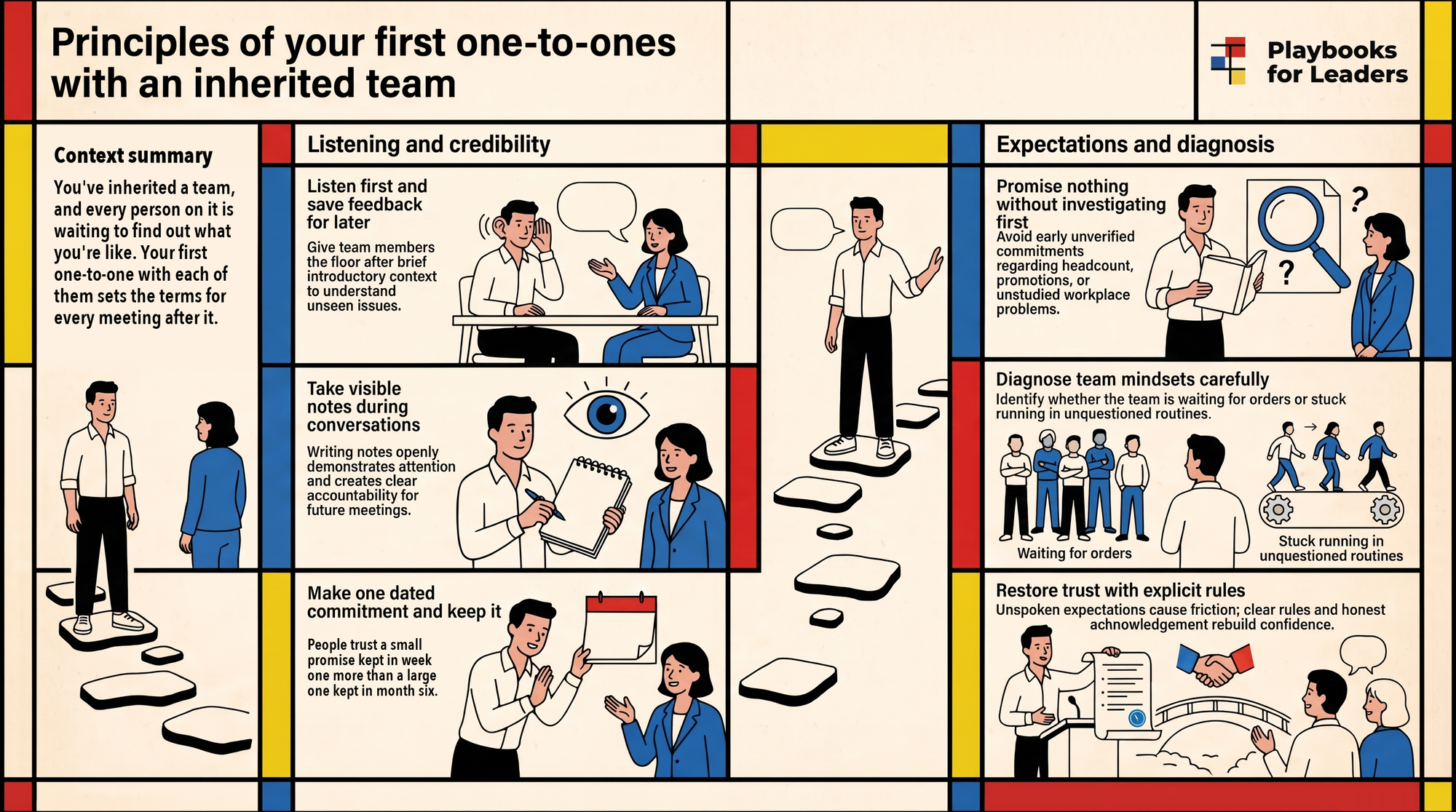
You've inherited a team, and every person on it is waiting to find out what you're like. Your first one-to-one with each of them sets the terms for every meeting after it. Keep the usual agenda from our guide to one-to-one meetings, but in the first one spend most of the time listening and save feedback for later, once they trust you. When it's time, start with the Difficult feedback Playbook.
What should your first one-to-one with an inherited team member cover?
Take two minutes to say how you work and what the meeting is for. Then hand them the floor, and ask four questions:
- What should I know about this team that I can't see yet?
- What did the last manager do that worked?
- What would you change first?
- What do you need from me this month?
Take notes where they can see you do it. The notes show you're listening, and next month you can hold yourself to what you heard.
End with one commitment from you, with a date: "I'll find out why the budget request stalled, and tell you by Friday." Then do it by Friday.
What should you not promise?
Headcount, promotions and fixes to problems you haven't looked into. Chances are your team has heard promises before, from the person who left.
Say "I'll look into it and come back to you by Friday," then come back by Friday, even if the answer is that you don't know yet. People trust a small promise kept in week one more than a large one kept in month six.
How do you tell what the team needs from you?
Listen in the first round of one-to-ones for which of two teams you've got. In the Inherited team Playbook we split them this way:
- A team waiting for orders. Capable people who learned to hold still until someone told them what to do. Hand them a blank page and thirty minutes to draft how they'd like the team to work.
- A team stuck in routines. Competent people running on rails laid before any of them joined. Swap one of them with someone from another department for a week, and listen to what the outsider notices.
You'll hear which in the one-to-ones. A team waiting for orders asks you what you want. A team stuck in routines tells you how things are done here.
What if the last manager was bad?
Then the first one-to-ones are harder, because people test whether you're the same. The After a bad manager Playbook asks first whether the team needs its autonomy back or a clean break from the old rituals.
If the last manager made people ask permission for everything, change the defaults: decisions go ahead unless someone flags them for review. If the team is bruised, change the surroundings, starting with when and where the one-to-ones happen. Either way, put one unspoken expectation on the table in your first week. Trust comes back when the rules are said out loud.
What if everyone says things are fine?
They will, at first. When Alan Mulally joined Ford in 2006, the company expected to lose seventeen billion dollars. He asked every senior leader to present their division's status each week in green, yellow or red. For the first few weeks, everything came back green.
When the first executive showed a red, Mulally applauded. The story is in the Inherited team Playbook, and it works the same way in a team of six. Thank the first person who tells you something is wrong, and let them see you act on it. The rest of the team will know by the end of the week.
If the one-to-ones still turn up nothing, try the first Play in the Falling morale Playbook: stop them for a month, and pair people up to meet each other weekly instead. People tell their peers what they won't tell their boss.
How often should you meet in the first few months?
Weekly, for 45 minutes, for the first six weeks. You're learning what everyone else already knows, and 30 minutes runs out before the context does. After six weeks, drop to 30.
You'll know the inheritance is over when people bring items to the one-to-one you didn't plant, and tell you about a problem before you hear about it elsewhere.
FAQ
Should you read the previous manager's notes before the first one-to-one?
Read them for facts: dates, decisions, what was promised. Form your own view of the people from meeting them. If the notes and the person disagree, ask the person.
Should you meet the team together first, or one at a time?
Both, in your first week. Meet the whole team briefly to say who you are and how you'll work, then hold the one-to-ones. People tell you things alone that they won't say in front of colleagues.
What if someone on the team applied for your job?
Raise it yourself in your first one-to-one with them: "I know you went for this role. I'd like to know what you'd have done first." You'll learn what they'd change, and you show them that you know about it and aren't avoiding it.
Is a new starter the same as an inherited team member?
No. A new starter needs to learn the work, and an inherited team member needs to learn you. For a new starter, meet twice a week for the first month. The New starter Playbook covers the first week.
Sources on inheriting a team
- The First 90 Days by Michael Watkins. It's our source for planning what you'll learn in a new job, and from whom. If you want the book itself, buy it from Bookshop.org or Amazon.
Some book links on this page are affiliate links. If you buy through one, we earn a small commission.