

Executive presence for women: moves for three hard meetings
Executive presence broken into parts you can practise, with the moves for a hostile meeting, a slipping project and scope that keeps moving.
The short version
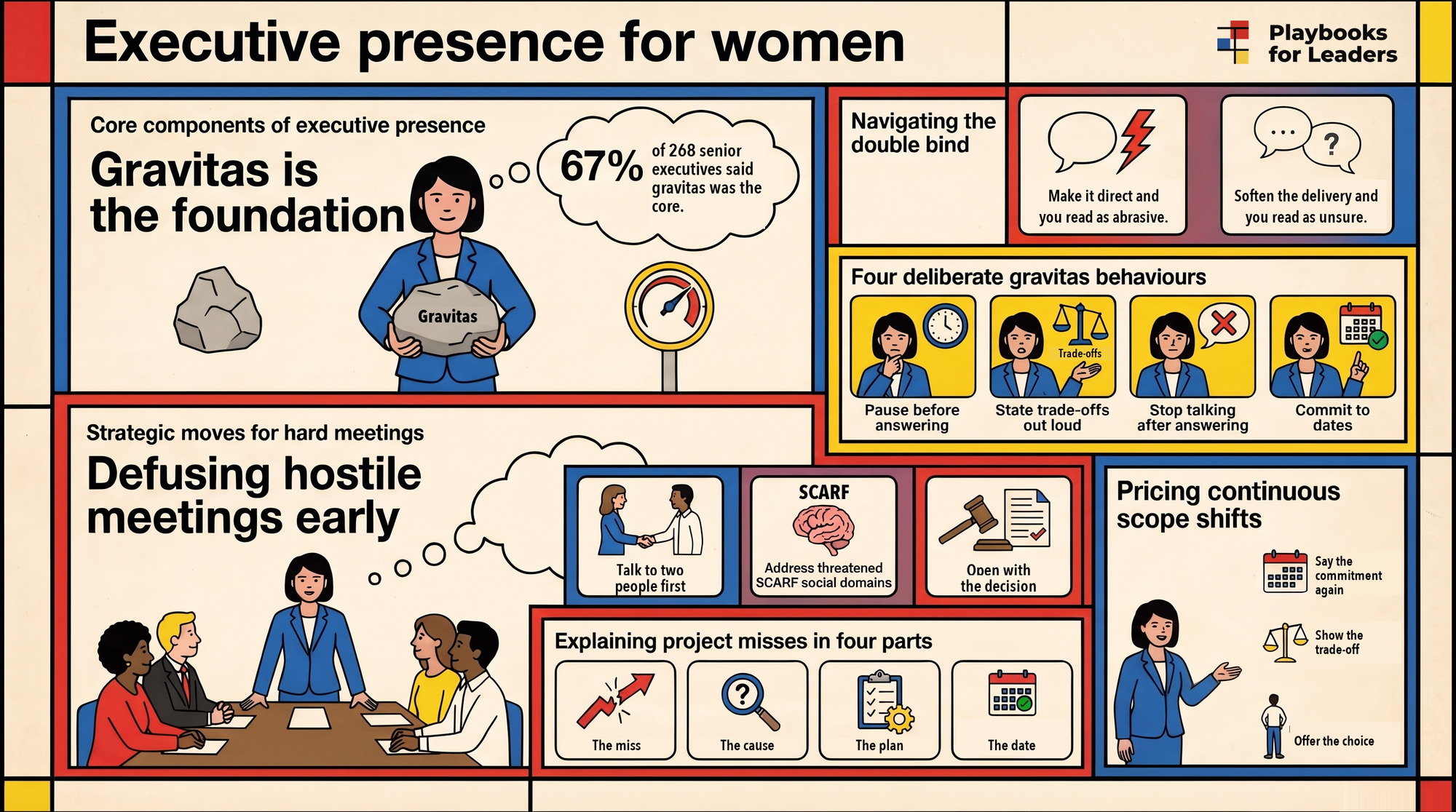
- Executive presence breaks into three parts you can see: gravitas, communication and appearance. Anything people can see, you can practise.
- Women face a double bind: soften the delivery and you read as unsure, make it direct and you read as abrasive. Prepare moves that work with that in the room.
- Before a meeting that's going to be a fight, talk to the two people whose objections will land hardest.
- Report a slipping project in four parts: the miss, the cause, the plan and the date.
- When scope keeps moving, put a price on each change and let the person asking choose.
Contents
- What does executive presence look like?
- Why do women need a different playbook?
- How do you build gravitas?
- The meeting that's going to be a fight
- The update on a slipping project
- Scope that keeps moving
- How much does appearance matter?
- Do executive presence workshops work?
Executive presence comes down to three things other people can see: gravitas, communication and appearance. For a woman, each comes with a catch, because the same behaviour can be read two ways depending on who does it. Below are the moves for three situations where presence gets tested: the meeting that's going to be a fight, the update on a project that's slipping and the stakeholder who keeps moving the scope.
What does executive presence look like?
In 2012 the Center for Talent Innovation, the research group Sylvia Ann Hewlett founded, now called Coqual, asked 268 senior executives what executive presence is. Two-thirds of them, 67%, said gravitas was its core. 28% named communication. Only 5% said appearance was a key factor (Center for Talent Innovation, key findings). Because all three are things people can see, you can practise them, review them and repeat them.
Gravitas is what people see when you keep your position under pressure. The senior executives put "grace under fire" first of its six parts. You say what went wrong before anyone else does. You ask for the hardest question first. You pause instead of filling a silence. Communication is whether someone half-listening can repeat your point after hearing it once. Appearance is whether you look like someone whose judgement belongs in the room.
"Be more confident" isn't advice anyone can act on. You can't rehearse a trait. You can rehearse a behaviour, which is why we write each situation as a Playbook and not as a personality test.
Why do women need a different playbook?
Joan C. Williams, who founded the Center for WorkLife Law, calls it the Tightrope. In a 2014 report on women in science, written with Katherine W. Phillips and Erika V. Hall, she wrote that women walk "a tightrope between being seen as too feminine to be competent" and "too masculine to be likable" (Double Jeopardy?, p3). Soften the delivery and you read as unsure. Make it direct and you read as abrasive. The room pushes back in plainer ways too. In McKinsey and LeanIn.Org's 2024 survey, about 40% of women said they'd been interrupted or spoken over more than others (McKinsey, October 2024).
So a playbook for women can't be about performing confidence. It has to be about choosing the moves that get you the outcome you need, in that room, knowing the double bind is there.
Prepared, not performing
What works is preparation that takes the judgement call out of the moment. Before a hostile meeting, decide your first two sentences and the point at which you'll walk away. During it, tie every claim to the project's own numbers rather than to your tone. Afterwards, close the loop in writing, so the record does the arguing.
How do you build gravitas?
Of the three parts, gravitas is the one you can drill. Four behaviours cover the situations below, and they work best together.
- Pause before you answer. When someone senior asks a hard question, wait two seconds. Count it silently if you have to.
- Say the trade-off out loud: "We can do this cheaply or quickly, not both." It shows you understand the whole system, not only your part of it.
- Stop talking after you answer. If the room goes quiet, people are deciding. You haven't failed. Let someone else speak first.
- Commit to a date: "I'll come back to you by Thursday."
No list of behaviours survives a hostile room without rehearsal, which is why the situations below matter more than the list.
The meeting that's going to be a fight
On 17 March 2015 Gwynne Shotwell, president and chief operating officer of SpaceX, gave evidence to a committee of the US House of Representatives. Beside her sat Tory Bruno, chief executive of United Launch Alliance, then the only company certified for American military launches. Shotwell put SpaceX's prices on the record: $80 million to $90 million for a Falcon 9. From ULA's contract she put its price at about $400 million a launch. "I don't know how to build a $400-million rocket," she said. Bruno answered with a figure of his own. On 26 May 2015 the US Air Force certified the Falcon 9.
Shotwell brought her numbers to the hearing. Do the same before any meeting that's going to be a fight.
Before: talk to two people
Pick the two people whose objections will land hardest. Send each a three-line note. Give the decision you need and the one fact behind it, then ask: "Where will you push back?" Their answers tell you what the fight is really about, and because they've seen it coming, they're less likely to ambush you in the room. If either doesn't reply, you've found your biggest risk.
The Hostile meeting Playbook asks one more question first: is the threat to their status, their certainty, their autonomy, their place in the group or their sense of fairness? The SCARF Model helps you tell which, and each needs a different response.
During: open with the decision
Open with the decision, not the background: "I need 15 minutes and a decision on X. Here's the case in one line, and then I want your hardest objection." Asking for the objection first brings the fight forward while there's still time to use it.
If someone interrupts, stop, let them finish, then say: "Hold that thought. I have two sentences left, and then it's yours." Then hand it over. If someone senior is going to try to take over the meeting, use the Hijacked meeting Playbook. Give them the job of challenger at the top of the agenda, or ask them to remind the room why they approved the project.
If the meeting stalls, fall back on the smallest move you can make: what can you do in the next week with the authority you already have? The 15% Solutions tool turns a stalemate into a next step without needing the room's permission.
After: two lines
Within two hours, send two lines to everyone who was there, including the people who pushed back: the decision, and who owns the first action by when.
The update on a slipping project
Bad news delivered well is a sequence. Tone doesn't carry it. Give it in four parts, in this order, in under two minutes.
- The miss: "Delivery is three weeks late." One sentence, nothing softened.
- The cause: "The vendor's sign-off slipped, and we took on two additions to the scope without replanning." Give the cause without naming a scapegoat.
- The plan: "We're taking the reporting module out of this release and putting it in the next." A plan shows you're still running the project.
- The date: "I'll confirm the new date by Friday." A date for the next update lets people stop chasing you.
Cut the history of the timeline, the praise for the team and every "we're working hard". Keep it to one page, so you can send the same four parts in writing afterwards. The Explain the miss Playbook helps you work out first whether the team missed the target or the target missed the world. If you can't yet say where the project slipped, use the Project slipping Playbook to find out before you give the update.
Scope that keeps moving
A stakeholder who doesn't feel what each change costs keeps moving the scope. Show them the cost and hand them the decision.
- Say the commitment again: "We're committed to shipping the reporting module by the 28th." Say the date out loud.
- Show the trade-off: "Adding the export feature moves the 28th to the 5th, or we drop the audit log." One sentence, two options.
- Offer the choice: "Which do you want: the new date, less scope or export in the next release?" You've put a price on the change, and the choice is theirs.
- Stop talking. Whoever fills the silence owns the trade-off, and it shouldn't be you.
The Scope keeps moving Playbook separates a stakeholder who is learning from one who can't commit. If they're learning, set aside a fifth of each sprint for changes and tell them you have. If they can't commit, make them take one feature off the board before they add another.
When to escalate
If the scope moves a third time after you've priced it, take it to the sponsor or your manager. Bring the list of trade-offs agreed so far and the dates each was accepted. You're raising a decision that's been made three times and not kept, with the paper trail to show it. Present it as a risk to delivery.
How much does appearance matter?
Appearance is a threshold. Nobody promotes you for your jacket. A crumpled one counts against you, though: in the Center for Talent Innovation's survey, 83% said unkempt clothes detract from a woman's executive presence.
So spend the least it takes to stop it being a distraction. Choose an outfit you know works for the room the night before. On the morning of the fight, you want to be rehearsing your opening line, not choosing what to wear.
Do executive presence workshops work?
Test any option against three questions. Does it fit the meeting in your diary this week? Can you run the same moves next quarter without a facilitator? Does someone watch you practise and tell you when it landed?
A live workshop passes the third test. Ask the provider about the first two before you book. Reading passes the second. The Playbooks at Playbooks for Leaders pass the first two and fail the third, and that's the honest headline. A Playbook can tell you what to do before, during and after the hostile meeting. It can't watch you deliver it and tell you your voice went flat in the second minute. For that, rehearse with a colleague you trust, and use the Playbook as the script.
FAQ
Can executive presence be learned?
Yes. Its three parts are things people can see, so you can practise them and review them. You can rehearse the pause, the trade-off and the date before the meeting.
How long does it take?
You can use the four gravitas behaviours in your next meeting. Making them automatic under pressure takes longer, and needs rehearsal and someone to tell you how it went.
How do you show presence when you're the most junior person in the room?
Use the same behaviours, scaled to your authority. Tie your points to the project's own numbers. Propose what you can do in the next week with the authority you have. Then send the two-line note afterwards.
What should a team look for in an executive presence workshop?
Apply the three questions above. Ask the provider to run the session on a real meeting your team has coming up, and to give you something you can use again without them.
Sources on executive presence
- Executive Presence 2.0 by Sylvia Ann Hewlett. It's our source for the research behind gravitas, communication and appearance, updated in 2023. The UK edition is hardback only. If you want the book itself, buy it from Bookshop.org or Amazon.
- What Works for Women at Work by Joan C. Williams and Rachel Dempsey. It's our source for the double bind. The authors interviewed 127 women and set out four patterns, the Tightrope among them, with moves for each. If you want the book itself, buy it from Bookshop.org or Amazon.
Some book links on this page are affiliate links. If you buy through one, we earn a small commission.