
Digging Deeper
“A discipline of asking probing questions to move beyond surface understanding.”
What is Digging Deeper?
Digging Deeper is an inquiry discipline that draws on several foundational ideas: Arie Kruglanski's work on premature closure (the human drive to accept the first reasonable answer and stop looking) and Chris Argyris's double-loop learning, which asks you to challenge the assumptions underneath the answer rather than just fixing what's on the surface. The practice maps closely to Rolfe et al.'s reflective framework: What? So What? Now What?
The explanation sounds plausible. Everyone nodded. But the same problem keeps surfacing in different forms, and you're starting to suspect you've never actually understood it.
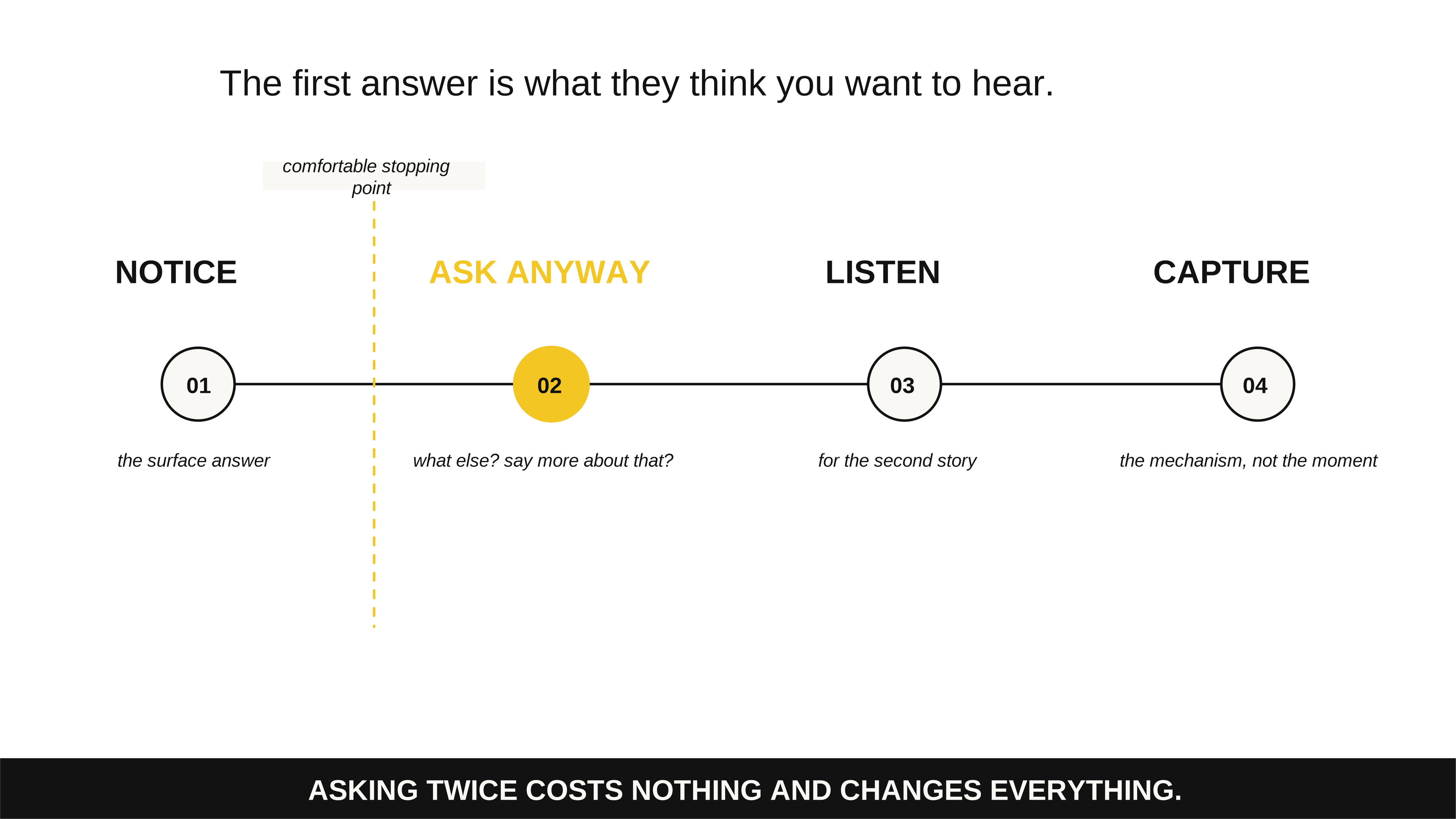
When should you dig deeper?
The technique fights the need for closure that Kruglanski identified: the pull to stop once a plausible explanation appears. Better questions typically matter more than better answers. Reach for it when solutions keep failing, which is often a sign you've been solving the wrong problem.
The practice requires intellectual humility: acknowledging that your initial understanding is usually incomplete. The failure mode is turning inquiry into analysis paralysis: asking one more question when the answer is already clear enough to act on.
Your next move: What's the question your team has stopped asking because everyone assumes someone else already knows the answer, and what happens when you ask it out loud in the next meeting?
Which Playbooks use Digging Deeper?
You use Digging Deeper in the Plans of two Playbooks:
- We've hit a problem I don't understand well enough to solve.
- The retrospective keeps producing the same three actions and nothing changes.
What works well with Digging Deeper?
Pair Digging Deeper with Five Whys and Problem Framing.
When shouldn't you use Digging Deeper?
For a simple problem, don't dig deeper: act. If the answer is already clear enough to act on, one more question is analysis paralysis.
How long does Digging Deeper take?
About 30 minutes. You come away seeing the problem more clearly.
Where it comes from: Chris Argyris, "Double Loop Learning in Organizations", Harvard Business Review, 1977
Learn more: dscout, "Dig Deeper on 1-1 Interviews with Insightful Follow-Up Questions"
“Morale has dropped and I can't tell why.”