
MINDSPACE
“The UK Behavioural Insights Team's framework summarising nine influences on behaviour.”
You redesigned the process. It's clearly better. People are still doing it the old way. You're blaming adoption when the real problem is that you designed for logic, not for humans.
MINDSPACE is the UK Behavioural Insights Team's framework summarising nine influences on behaviour: Messenger, Incentives, Norms, Defaults, Salience, Priming, Affect, Commitments, and Ego. You use it as a checklist for designing interventions that work with human psychology rather than against it.
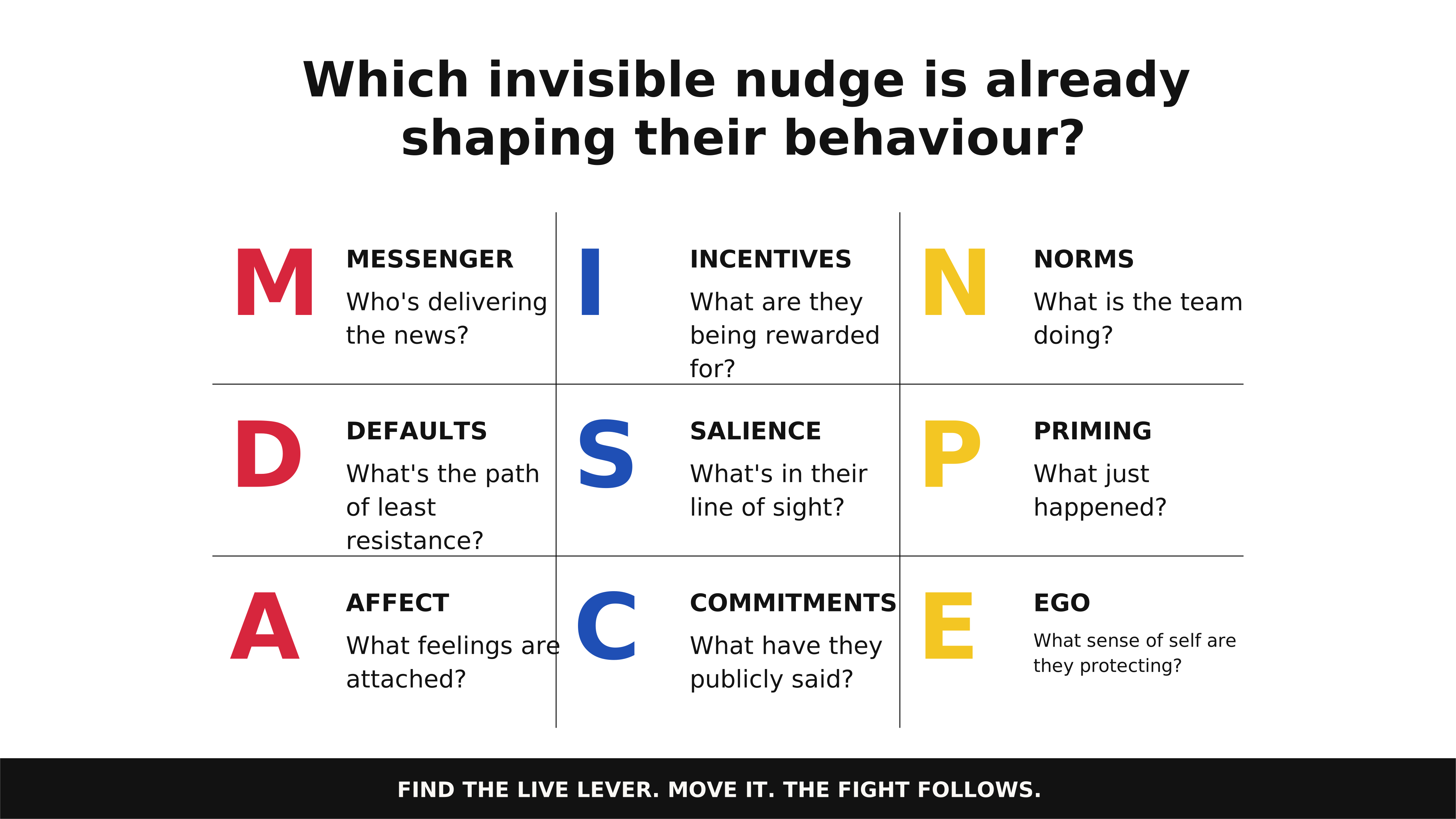
The unique strength is breadth — nine distinct levers where most teams only think about one or two (usually incentives and information). Defaults alone shape more behaviour than most deliberate interventions. Reach for it when designing product flows, planning change initiatives, or whenever you need people to act differently.
It pairs naturally with COM-B: diagnose the barrier with COM-B, then select nudges from MINDSPACE. It fails when applied without ethical consideration — these are influence techniques, and the line between nudging and manipulating depends on whose interests are being served. And it's less useful for decisions that genuinely are rational and well-informed; not every choice needs a behavioural lens.
Your next move: Which default in your product is currently shaping user behaviour without anyone having decided it should — and is it working for them, or for you?
What it looked like for them
Satya Nadella, Microsoft, 2014 onwards. Microsoft's stack-ranking system forced every team to identify its lowest performers for removal each cycle. The effect touched every domain of the MINDSPACE framework. Status: people optimised for looking good rather than being good.
Norms: colleagues became competitors. Fairness: evaluations felt arbitrary when every team had to produce a loser. The result was a decade of stagnation — engineers hid information, teams withheld help, market capitalisation stayed flat.
Nadella abolished the ranking system and reframed the culture from "know-it-all" to "learn-it-all." The fix was structural: he changed the incentive architecture that was producing the behaviour, rather than asking people to behave differently within the same system.
Market capitalisation went from roughly three hundred billion to over three trillion in the decade that followed. Same employees. Different incentive environment. MINDSPACE maps the levers that shape behaviour. Nadella pulled several of them at once.
“I'm taking over a team that's just had a bad manager.”