
TRIZ
“Built from the analysis of hundreds of thousands of patents to identify the patterns that actually produce inventive solutions.”
You're stuck on a contradiction — making it faster makes it less reliable, making it cheaper makes it less effective. The team has accepted the trade-off as physics. You suspect someone, somewhere, has already broken it.
TRIZ (Teoriya Resheniya Izobretatelskikh Zadatch — Theory of Inventive Problem Solving) is Genrich Altshuller's systematic innovation methodology. Starting in 1946, Altshuller studied hundreds of thousands of patents to identify the patterns that actually produce inventive solutions. You apply 40 inventive principles, contradiction matrices, and the concept of ideality to tackle problems systematically rather than relying on inspiration.
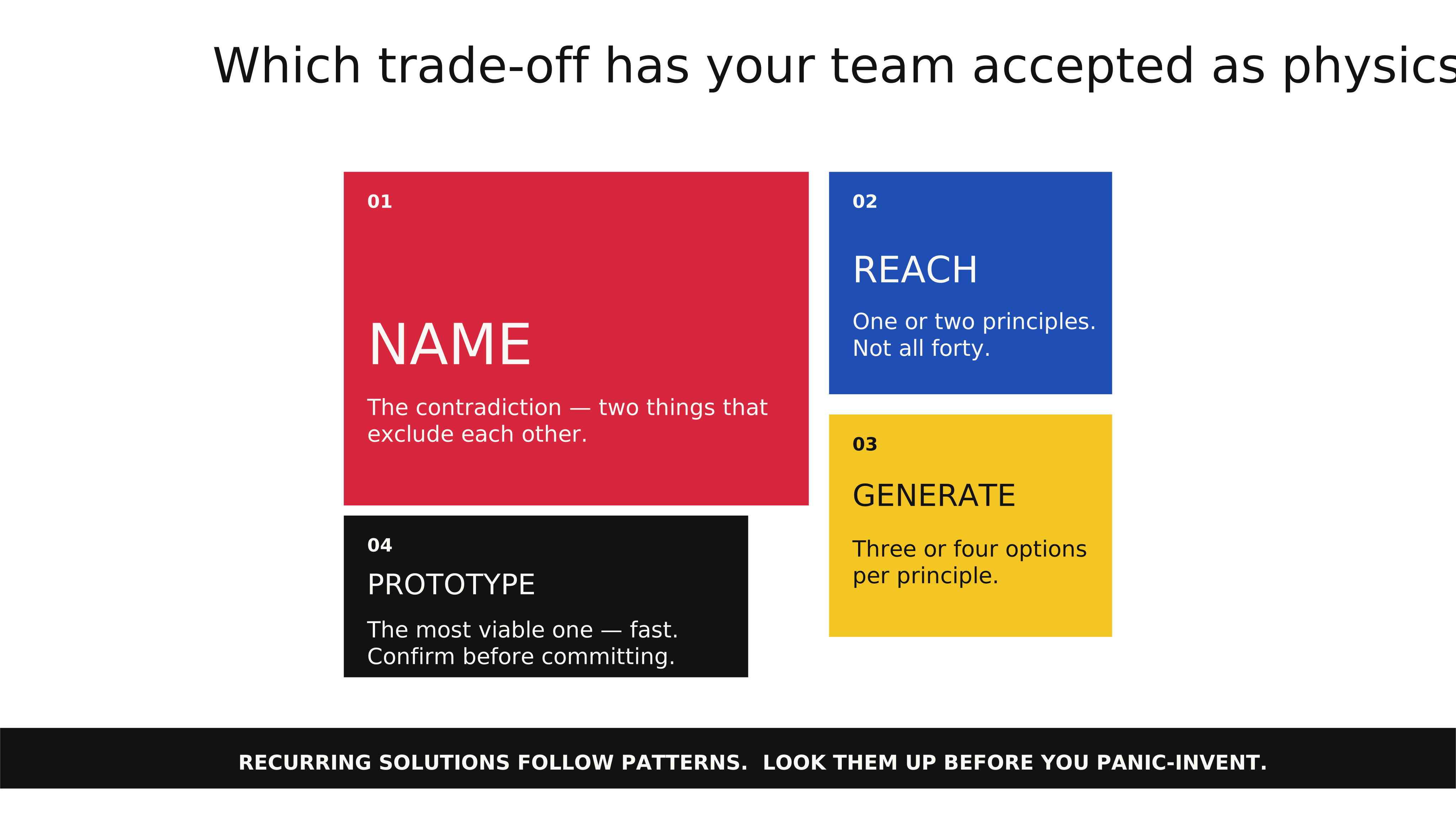
Most innovation methodologies treat creativity as mysterious. TRIZ is the exception — it transforms invention from a gift into a learnable discipline. Its unique strength is contradiction problems: situations where improving one parameter degrades another. It was built precisely for that class of problem, and nothing else handles it as well.
Reach for it when a genuine technical contradiction is blocking progress and conventional approaches keep trading one problem for another. It fails on non-technical or poorly-defined problems, and requires significant investment in learning — the methodology is deep, and a surface pass won't give you much.
Your next move: Which trade-off has your team accepted as unavoidable — faster vs cheaper, simpler vs more powerful — that someone, somewhere, has already broken with a patent you've never read?
What it looked like for them
Stepan Pachikov, Evernote, 2008. Pachikov had decided to shut Evernote down. Months of failed fundraising, runway measured in weeks, shutdown paperwork nearly signed. The product was good — the technology for automated organisation of personal photo libraries was years ahead of its time.
But good product and no money is a contradiction that normal business logic can't resolve: you can't grow without capital, and you can't raise capital without growth. The resolution came from outside the expected system.
An investor in Sweden — someone Pachikov had never met — had been reading about the product online and emailed offering five hundred thousand dollars. The money arrived the following week. TRIZ teaches that contradictions are resolved by changing the system boundaries, not by optimising within them.
Pachikov wasn't optimising. He was shutting down. The resolution came because the product had been visible enough, for long enough, that someone outside the founder's network could find it and act. Evernote went on to reach twenty million users. The contradiction was real. The solution was lateral.
“I've been told to 'be more innovative' and I don't know what that means.”