
Mind Mapping
“Tony Buzan's visual thinking technique represents ideas radiating from a central concept.”
The topic is too big to hold in your head. You've been chewing on it in the shower, in meetings, at midnight. It's only getting more tangled.
Mind mapping is Tony Buzan's visual thinking technique. You put the central topic in the middle, then branch outward — main themes, sub-themes, connections between them. Colour and images are optional but useful. The result mirrors how the brain naturally associates ideas, which is messily and non-linearly.
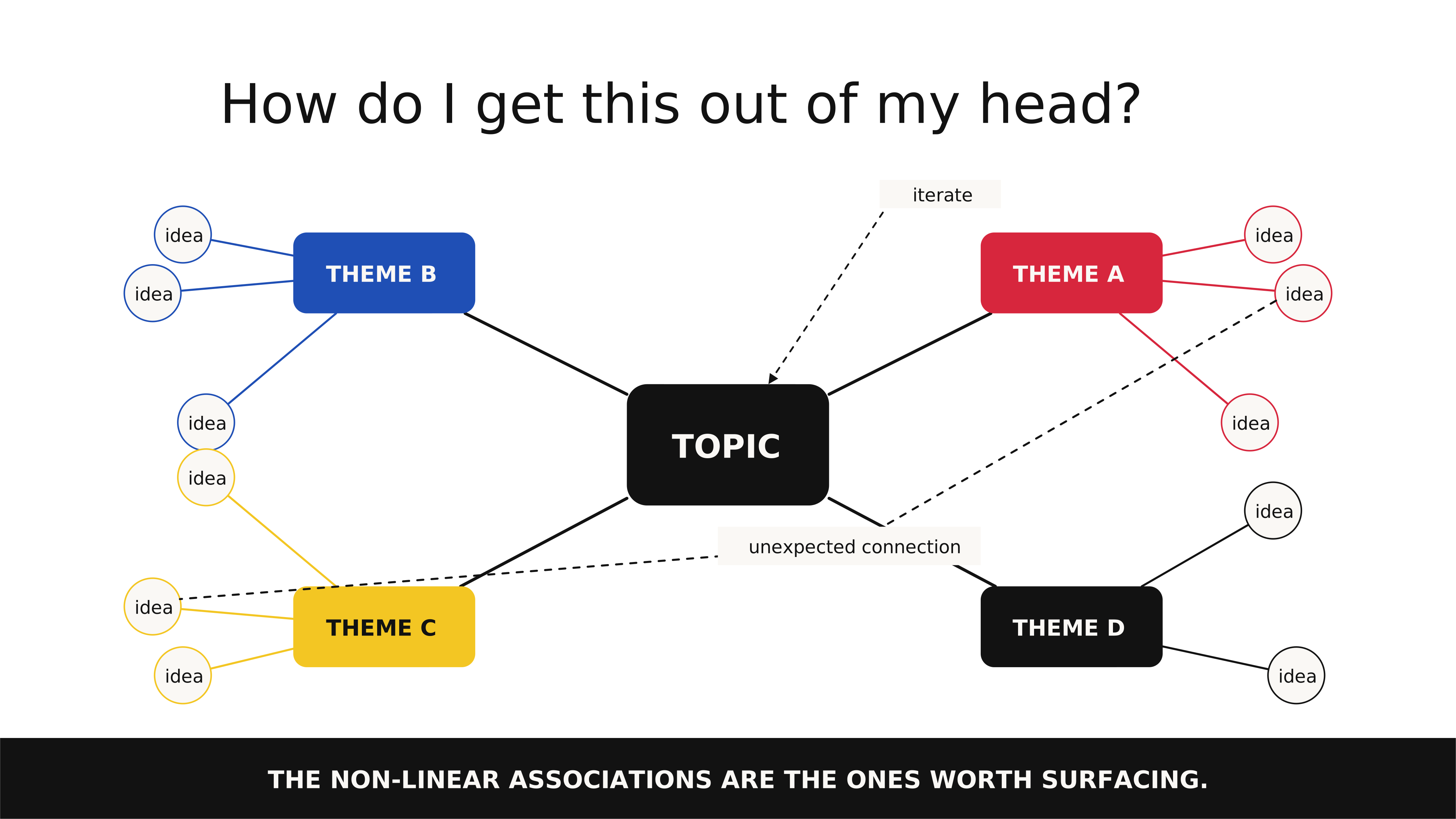
It's a thinking tool first, a presentation tool a distant second. The value is in the act of making the map — the topic gets unloaded from working memory, the structure becomes visible, and the gaps and overlaps you couldn't see in your head become obvious on the page.
It works best for individuals exploring a topic alone, or for very small groups co-mapping in real time. It fails for linear processes that have a defined order. As a group exercise without a firm facilitator, maps sprawl into everything-connects-to-everything diagrams that impress no one and help no one.
Your next move: When did you last get a complex topic out of your head and onto a page — or has it been rattling around in there making everything feel harder than it needs to?
What it looked like for them
Ray Anderson, Interface Inc., 1994 onwards. Interface was one of the world's largest commercial carpet manufacturers — and one of the most petroleum-dependent. Anderson read Paul Hawken's The Ecology of Commerce and had what he later called a "spear in the chest" moment: his company was part of the environmental problem, not the solution.
The challenge was enormous — reimagining a petrochemical-dependent manufacturing business as an environmentally restorative one. Anderson's response was to map the territory.
He charted every connection between Interface's operations and its environmental impact: raw materials, energy, waste, transport, installation, end-of-life. The map revealed which branches were addressable immediately (waste reduction, energy sourcing) and which required longer-term innovation (closed-loop recycling, bio-based materials).
By 2020 Interface had cut greenhouse gas emissions by ninety-six per cent and waste to landfill by ninety-one per cent. The map didn't generate the solutions. It made the problem navigable — and a problem you can navigate is a problem you can start solving.
“I've been told to 'be more innovative' and I don't know what that means.”