
Lateral Thinking
“Edward de Bono's term for solving problems through indirect and creative approaches.”
Your team has analysed the problem thoroughly. They keep arriving at the same inadequate answer. The logic is sound — the logic just isn't enough.
Lateral Thinking is Edward de Bono's term for solving problems through indirect and creative approaches rather than step-by-step logic. You deliberately disrupt established thinking patterns using techniques like random entry, reversal, provocation, and analogy to escape conventional paths.
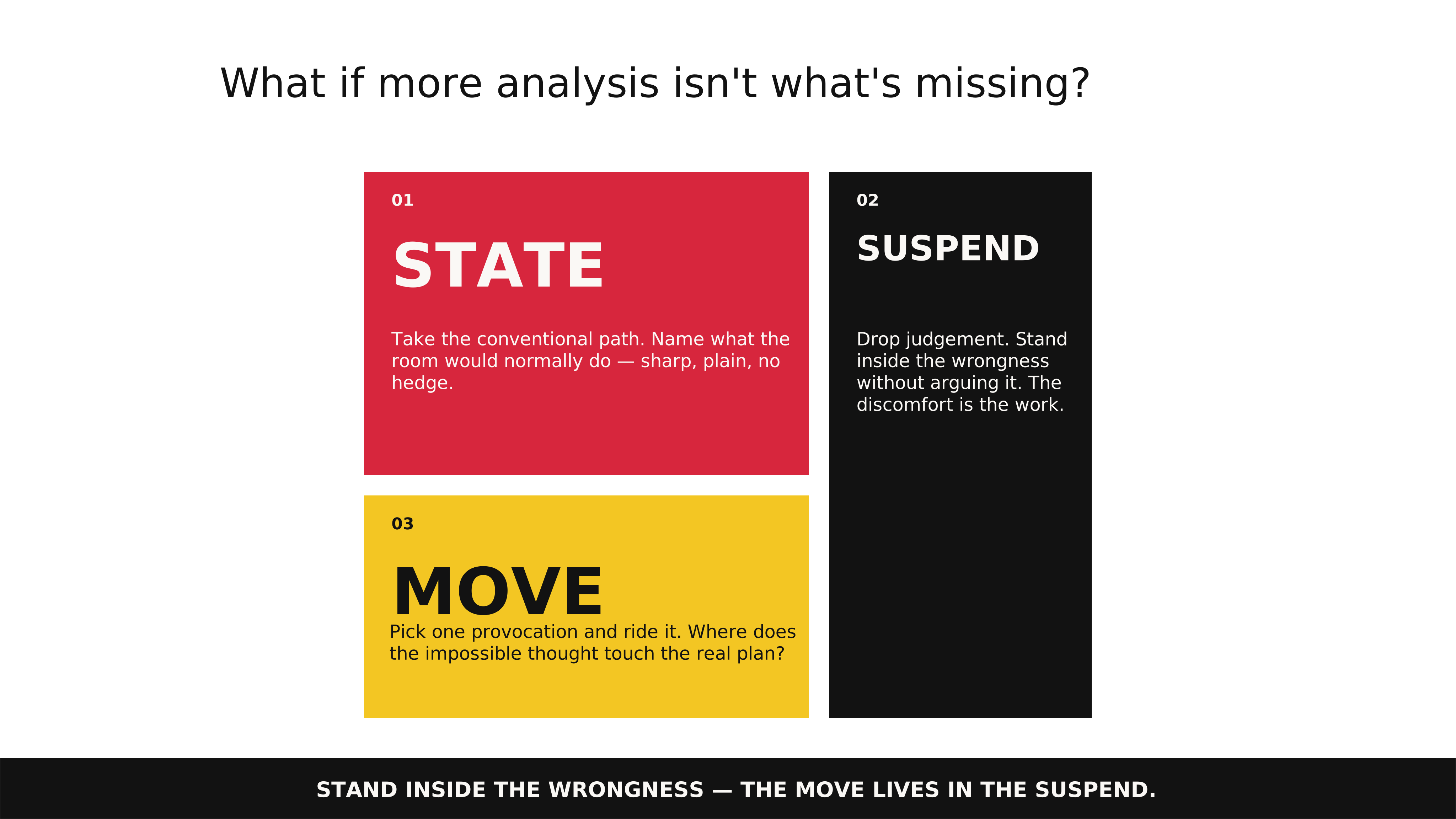
De Bono's specific methods — including the Six Thinking Hats and deliberate provocation — provide structure for what might otherwise seem like random creativity. The unique strength is that it treats creative thinking as a learnable skill with repeatable techniques, not a mysterious talent.
Reach for it after logical analysis has run out, which is usually when a team has been working a problem for a while and keeps producing the same inadequate answers through increasingly rigorous versions of the same approach. It fails when the problem actually does need analytical rigour — not every stuck point is a creativity deficit — or when used without follow-through to evaluate and develop what the lateral move produces.
Your next move: How many times has your team analysed its way to the same inadequate answer this quarter — and at what point will you accept that more analysis isn't what's missing?
What it looked like for them
Doug Dietz, GE Healthcare, c. 2008. Dietz had spent two and a half years designing a new MRI scanner. At a hospital visit, he watched a little girl approach the machine he'd built. She was crying. Her parents were trying to calm her.
Dietz suddenly saw his own creation through her eyes: a brick with a hole in it, in a dark room with flickering fluorescent lights and warning stickers. The lateral move: rather than redesign the scanner technology — his domain — Dietz attended Stanford's d.school, then assembled a team that included experts from a children's museum.
They applied colourful decals to every surface and wrote adventure scripts for operators to guide children through themed experiences — pirate ships, underwater submarines, camping under the stars. No changes to the scanner itself. Patient satisfaction scores rose ninety per cent.
Sedation rates dropped dramatically. Some children asked to come back. The solution came from outside the original domain entirely. That's the definition of lateral thinking: solving the problem by refusing to solve it on its own terms.
“I've been told to 'be more innovative' and I don't know what that means.”