
Workflow Optimisation
“The systematic improvement of work processes to reduce waste, increase efficiency, and improve outcomes.”
The team's working hard but producing surprisingly little. Deadlines keep slipping. The instinct is to push people harder, but they're already flat out.
Workflow optimisation is the systematic improvement of work processes to reduce waste and increase flow, rooted in Lean principles from the Toyota Production System. You map the current process, identify bottlenecks and waiting time, redesign for efficiency, and measure whether things actually improved.
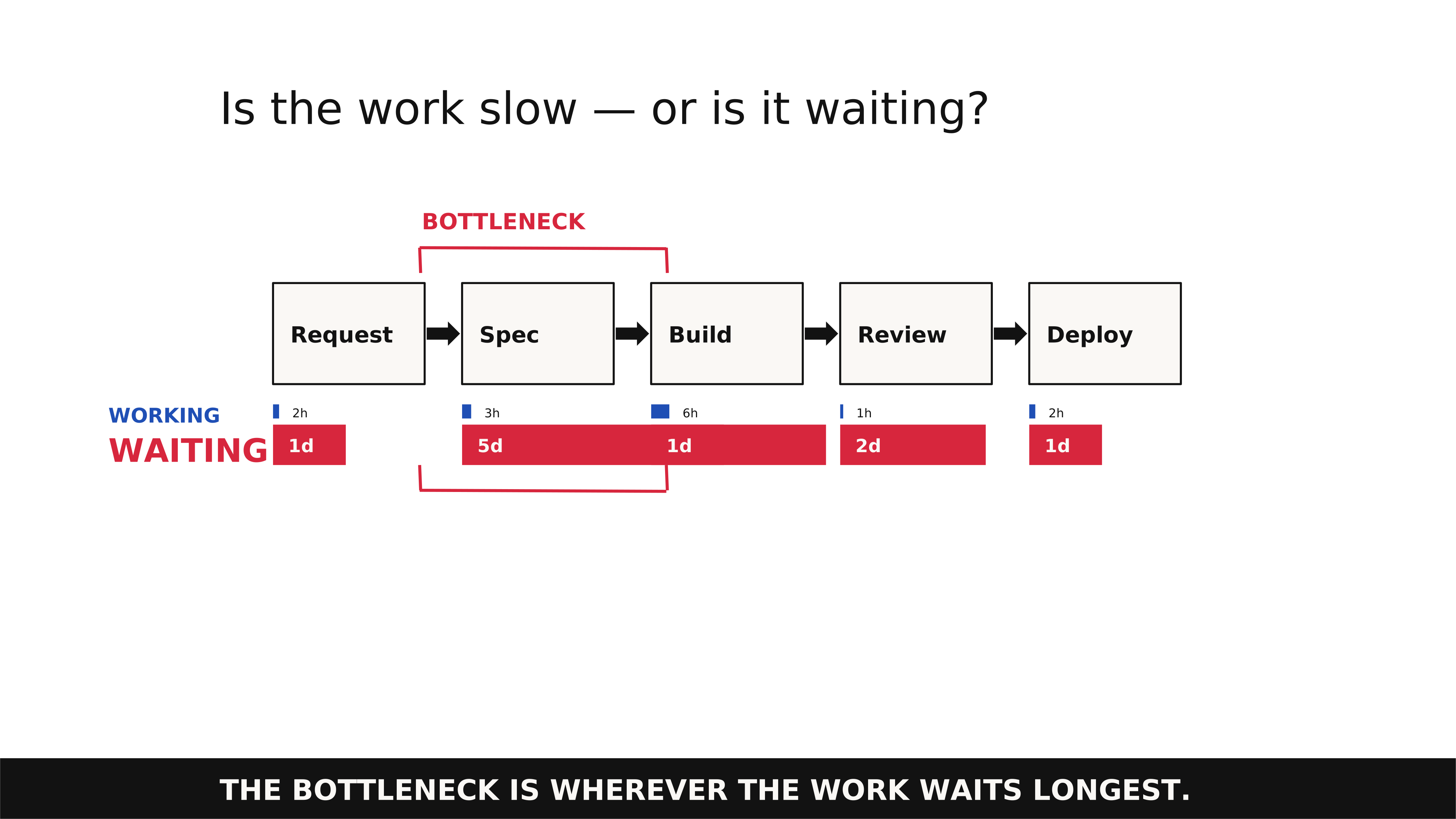
The unique strength is shifting attention from individual effort to system performance. A team producing less than expected usually has a process problem, not a people problem — work sitting in queues, handoffs creating delays, local optimisations making the whole slower. Reach for it when output doesn't match effort.
The critical discipline is measuring the current state before changing anything; without a baseline, you're guessing. It fails when applied as a one-off event rather than a continuous practice, and when it optimises the wrong part of the system — speeding up a step that isn't the bottleneck changes nothing.
Your next move: Where in your workflow does work currently sit waiting for something or someone — and how much of last sprint's missed velocity was your team's effort versus that queue?
What it looked like for them
A growing engineering team, mid-2010s. The workflow had a bottleneck with a name: the senior architect. Every code review, every architecture decision, every production deployment ran through one person. The team's throughput was capped at whatever that person could process in a day.
Adding more engineers didn't help — it made the queue longer. The fix was to optimise the workflow around the constraint rather than adding capacity upstream of it. The team codified the architect's decision criteria into review checklists and architecture decision records.
Deployments that met the checklist shipped without the architect's involvement. Only the exceptions — genuinely novel architecture questions — went to the bottleneck. The architect's queue shortened. The team's throughput doubled.
Quality didn't drop as much as anyone had feared, because the checklist captured ninety per cent of what the architect was actually checking for. Workflow optimisation at its simplest is the discipline of finding the constraint, understanding what it actually does, and building a path around it for everything that doesn't require it.
“The deadline moved and nobody told my team.”